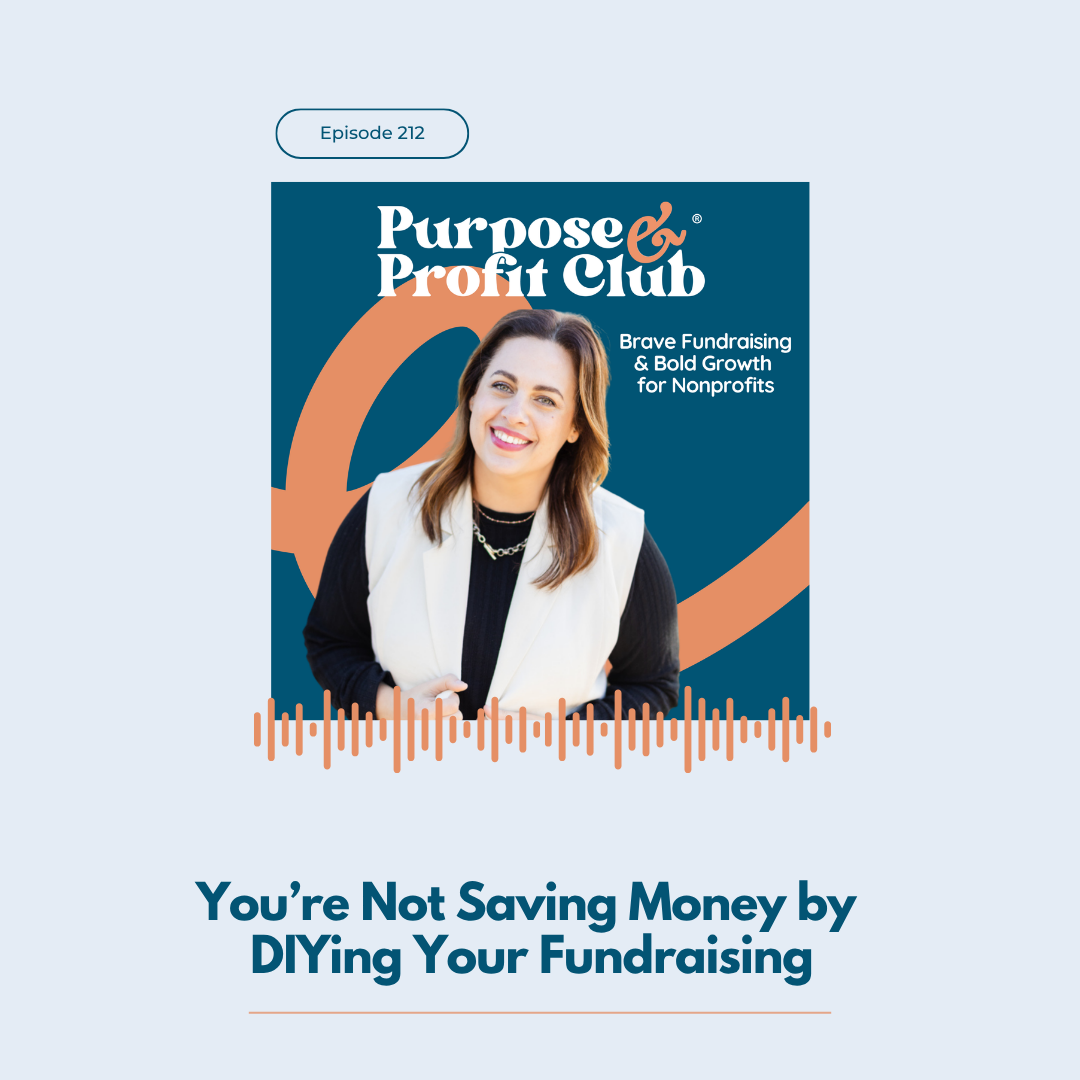
Ep. 212: You’re Not Saving Money by DIYing Your Fundraising
EPISODE 212
You’re Not Saving Money by DIYing Your Fundraising
About the Episode:
Most nonprofit founders and leaders think DIYing their fundraising is the responsible choice. It feels like smart budgeting and being resourceful, but it quietly costs the organization more than any support ever would.
In this episode, I share why free fundraising advice, AI-generated campaigns, and trial-and-error in front of donors aren't savings; they're expenses that never appear on a budget line. I walk through what DIY fundraising actually costs in time, momentum, donor relationships, and delayed campaigns, and share stories from clients like Mary who went from raising just $3,000 in her year-end to multi-five-figures with one change. You’ll hear about Sophia and Jamie who canceled a gala and raised $20,000 in one simple online campaign, and why investing in a proven system is the fastest path to your first $250K, $500K, and beyond in unrestricted individual donations.
Here’s what you’ll learn:
Why DIY fundraising costs more than it saves: in time, donor relationships, and revenue never raised
The "we can't afford support" loop and why it keeps organizations stuck at the same funding level year after year
Why AI is making it easier to produce more mediocre fundraising, not better fundraising
Mary's story: from a $3K year-end campaign to $12K after joining The SPRINT Method™
Why my clients canceled a gala, raised $20K in weeks, with less work, less overhead, and a lot more fun
What investing in a fundraising system actually gives you: accountability, community, expert feedback, and a repeatable process
It’s not your stories—it’s how you’re telling them. If your amazing work isn’t getting the attention (and donations) it deserves, it’s time for a messaging shift. The Brave Fundraiser’s Guide guide gives you 10 done-for-you donor prompts to make your message impossible to ignore. Get it for free here! https://christinaedwards.krtra.com/t/xKuLs6tOiPZa
Christina’s Favorite Takeaways:

“DIY fundraising, leadership, or marketing costs you, especially when you're growing an organization.”
“Everybody is using AI to help write their content pieces, and now it all sounds the same.”
“For one hour, you end up being executive director, and all the other hours, you're operations, and that is why your funding is staying small.”
“Most nonprofit founders and executive directors did not enter this work because they were trained in how to professionally fundraise.”
“Fundraising is an afterthought. Everybody acted as if you should just know how to do it, or you should be able to DIY it, figure it out, Google it. How hard could it be?”
“You can learn every term in the fundraising dictionary and still have no idea what to ask your donor today or what to send them tomorrow.”
“If you feel like you're bad at fundraising, it's not because you're bad at it. It's because you were never given a simple modern system designed for an organization like yours.”
“Are you creating more work because you don't know which work matters?”
“When you're DIYing it, you can't measure what is higher ROI, what is working, what is bringing in dollars, leads, donors, and what is not. Coach can help you do that.”
“AI has made it easier to create more mediocre fundraising, but just throwing everything over the wall to AI is not going to move the needle on your fundraising.”
“The goal is not to produce more copy faster. The goal is to say something to donors that they will actually remember and be inspired to give.”
Episode Resources:
From $3K to $12K: The SPRINT Campaign That Changed Everything
The $20K Pivot: Canceling a Gala and Raising More with Sharing Hope Africa
FREE Resources from Splendid Consulting:
How to Work with Christina and Splendid Consulting:
Easy Emails For Impact™ - Turn Your Inbox into an Income Stream
ENROLMENT IS OPEN NOW: The SPRINT Method™ - for 5 Figure Fundraisers
Connect with Christina and Splendid Consulting:
-
*Links may be affiliate links which means I may earn a commission at no cost to you.
Christina Edwards 0:13Today we're talking about why you're not saving money by DIYing your fundraising, and you're gonna hear some tough love today. Some tough love that you need to hear when you think about raising more money, so you can impact more people, more of your community. You can serve at a bigger level, you can grow your programs or services. Y'all need money for that, right? So we're going to talk about unrestricted donations and growing them today. Now, a lot of organizations come to me and think they can't afford support, whether it's fundraising or leadership or marketing or communications. We can't afford support, so they do what feels responsible, figure it out themselves, right? DIY it, the founder who you know writes emails through programmatic work and responding to putting out fires and doing the admin and DIYing the bookkeeping and the thank you notes and the social media and oh yeah, fundraising and board packets and donor calls and bookkeeping and whatever emergency appeared that this morning, right? And now, especially in the last like 18-ish months, I would say it felt like oh, now there's a solution: AI, ChatGPT, Gemini, Claude, right? You can just open that, and you can prompt your way to emails and a campaign, and you can Google subject lines, and you can register for a free webinar, and just kind of iterate on last year's fundraiser, right? And maybe a board member forwards you an email that like another nonprofit is doing so. You sort of ChatGPT your way and say, "How could we do something like that? And before you know it, you're down this rabbit hole, right? Somebody says, "Have the event, have the gala, or can't you use ChatGPT to apply for this grant or write your fundraising emails? And somebody says, "Social media, so you're using Chat for that too, and because nobody wrote another check for coaching or fundraising support or consulting or continuing ed, everyone calls this long list the more responsible, cheaper option. But is it because DIY fundraising, DIY leadership, DIY marketing costs you, especially when you're a growing organization. It costs you in time you already don't have delayed campaigns because what chat said yesterday versus what Gemini says tomorrow are conflicting and that sounds like a good idea but what about this missed donor conversations weaker messaging because I know y'all have seen it too it went from messaging that sounded very nonprofit speak and kind of just formulaic and sterile. Now everybody is using AI to help write their content pieces, whether it's social or email or anything else. And now y'all, now it all sounds the same, right? We've all been there. We're like, oh God, yeah, this sounds like AI wrote it, right? Now, one. you to know before I go any further, I am not anti AI at all. So I use most of them, and in fact, in both of my programs, we have AI coaches who are trained in our curriculum. So in the SPRINT Method™, we have a Sprint coach, and she knows like Sprint coach is up to speeds on our framework on our entire system, so that is a reliable source for you to work with. That is a very different thing than if I just start a new AI account somewhere and just say, "Help me with my fundraising. You're going to get very weak, low converting messaging. The result of that will. Be lost revenue and energy you can't afford to waste. Whether you're full time or part time, you're paying for this DIY strategy. It is not free. And number one place it costs you is your time and in your donor relations. That means retention. That means outreach. That means funding. So the expense doesn't just not appear as its own line and budget, right? The expense is what you didn't create from it. The expense is the money you didn't come in because you DIYed it.
Christina Edwards 5:31
And when I talk about fundraising support, I'm not saying you need to hire a major gifts officer. You need to hire a director of development. You have to hire a consultant, right? I'm not saying anything like that. I'm saying at the stage whether you're raising your first 50k, 100k, maybe 200,000 in unrestricted donations, not through grants or other sources. I'm saying at this stage, fundraising should be in-sourced. It should come from you. You are the best, closest person to the mission, and should be the person who's in charge of fundraising, right? You know the stories, the community, the donor relationship that should come from you. I don't want you to outsource that, but you need to know how to do it. You need the skill of fundraising. You need the skill of communicating with your donors, you need the skill of building awareness and marketing to donor prospects. You should not have to teach yourself an entire profession through Google searches, free trainings, outdated advice, random board member ideas, trial and error in front of actual donors, and that's what I see so many organizations falling into because they want to be quote unquote responsible, right? You're like, well, I can't. You know, we're we're we're still growing. We can't really afford in any of this. So you're DIYing it, and it is costing the people and communities you serve. Full stop. Because you're figuring it out on your own. I want to talk today about why investing in whether it's a system, a tool, a coach, feedback, some sort of support, can move your organization forward, grow it much faster than DIYing it.
Let's talk about the first piece. You are paying with the most expensive time in your organization. So if you're spending 15 hours a week doing a lot of this stuff, figuring out when to fundraise, who to fundraise to, writing the social posts and emails, and finding photos and fixing that broken donation page, and figuring out is that even the right page to use? What should your campaign say? That is time you're not spending talking to donors, running your programs, or helping manage your program person, building community relationships, supporting volunteers, growing your volunteers, following up with people who already care, making decisions only you can make. There are other decisions you don't need. I always talk about the printer toner, right? You do not need as the CEO, as the executive director. You just want your staff person, or your freelancer, or your admin person who works a few hours a week. They can order the printer toner. You do not want to be the person doing that. I want you out creating these relationships, out fundraising, and this practice is especially common in organizations. The person responsible for bringing in the money is often director of operations, director of programs, director of finance, board board corraller, right? Director of finding volunteers, communications, the never-ending administrative work. So for one hour, you end up being executive director, and all the other hours, your operations, you're something else, and that is why your funding is staying small. That's it, because when you're trying to remember your CRM password, or you're responding to what feels like a fire you need to put out right then, or you're figuring out how to be a bookkeeper, because by the way, you weren't trained in that either, right? Fundraising gets pushed to nights, weekends, whenever scraps of time remain, and your board thinks you're doing the fiscally responsible thing. You're saving the cost of bringing in support and training and capacity building, right? You're saving money, air quotes, right? But you are using your most valuable asset, your most limited capacity in the organization to buy printer toner to figure out your constant contact password, right? That is not the highest and best use of your time. Figuring out what kind of strategy works best in the fall to fundraise, figuring out how to apply for a federal grant versus a city one, right?
Christina Edwards 10:37
These are not the problems you should be solving because no one taught you how to fundraise, right? Most nonprofit founders, executive directors, even fundraisers I work with did not enter in this work because they were trained in how to professionally fundraise, right? Oh, especially my founders, especially my executive directors. You started this work because you saw the problem, you saw a need, you understood the community, the people. You're very excellent in program, right? You know the programs like that. Those are your people. You love it. You understood it. You understand. You care deeply, and fundraising became your job too, right? It was like, well, if you want to do that, you have to do this too, right? So this is a really common place that a lot of people find themselves, which is fundraising is an afterthought, right? Everybody acted like you should just know how to do it, or you should be able to DIY it, figure it out, Google it. How hard could it be? How to choose what to fundraise, what strategy to use, how to move donors beyond friends and family. If you are listening and the majority of your donors are friends and family, you need to get into the sprint method. Very, very common that I see with organizations. That is where we start, right? You work your network. Your network is friends and family. But at some point, you're like, it's getting weird with my best friend and my aunt, because I keep asking them, we need to get beyond that, right? So, how to bring in new donors? How to ask people to give again, not just once a year, once in a while? Nobody taught you, and then you maybe attended a workshop or something like that, or picked up a book at the library that had like a bajillion different ideas on donor stewardship that you and I both fell asleep reading, right? Annual funds, moves management, but it didn't tell you what to say on Tuesday, and it didn't tell you what to do over the summer when you don't really have a fundraiser planned. But oh my God, you need an influx of funding, right? You can learn every term in the fundraising dictionary and still have no idea what to ask your donor today or what to send them tomorrow. And a lot of traditional old fundraising advice was also built for a very different time, a different organization, and an organization that has a staff, a team, development, comms, major gifts, admin, operations, programs. If you don't have that, that's not your reality. Then what? Well, you get to learn that skill, right? That's why I created the Sprint Method™. Your reality doesn't have to be one that is, you know, squeezing in a free 30-minute something here or an hour there between your board meeting and your program. You don't have to only rely on AI and Google and YouTube, right? And if you feel like you're bad at fundraising, if you feel like why can't I get it? Why can't we grow like these other organizations are growing? It's not because you're bad at it. It's because you were never given a simple modern system designed for an organization like yours-the one you're actually running and growing. Now, let's talk a little bit about what this looks like week to week. You're paying for every week that your campaign does not launch, so DIY fundraising tends to drag on. You with me? Have you ever wanted to do a hobby, anything? So, like, I'm thinking about scrapbooking. Like, say you wanted to scrapbook. With my recent travel, I've been like working on like kind of like a they call it junk journaling, where you like journal, but also you like basically can glue in photos, mementos, anything, anything into the journal, and it's like this very tactile journal. So I've been working on that from our trip to Greece.
Christina Edwards 15:28
One of the things I noticed was I wanted to do it, and I hadn't done it. So I had like my stuff to do the journaling, and then hadn't done it, and it sort of in days turns into a week turned into a little bit longer. Now, had I signed up for an eight-week junk journaling class, you better believe that should have would have been done. Would have been done. I'd be on my like third one by now. Why? Why? Ask yourself why. It's the same thing when you join a program. If you are DIYing it, it's no wonder you haven't launched that campaign over the summer. It's no wonder it kind of petered out after the first few days, right? You didn't have support. You didn't have accountability. You didn't have a system. You didn't have a community, right? And it is harder now. Listen, I got mine done because I'm not in a program for for my junk journaling hobby, but it took a lot of internal motivation and internal accountability in order to do it. And in the beginning of fundraising, if you don't have a system, now I have a system for I've been doing the arts my whole life, so it was like okay, I just need to like get out of my own way and do this. But when it comes to fundraising, I just never meet anyone who's like I'm a founder and executive director, and I'm a professionally trained fundraiser. Haven't met that person yet. So for everyone else listening, it's okay that you're not an expert at this yet. You're not supposed to be, and you're not supposed to keep DIYing it. So, as you're DIYing it, if you find yourself going, "Wait, what should this campaign be about? How much should we ask for? Should we even publish our goal? Am I emailing too much? Am I asking too much? Is the donation page ready? Should we even use a page, or should we just have people go to our website? What about a video? The campaign, these questions, right? When you these questions go unanswered, and there's not a clear answer to all these questions. The campaign that could have launched in a week takes eight, right? There's delay, delay, delay, and donors can't give to a campaign that's still in your notes app, right? That delay has real cost, is actual dollars, money. It also has a cost when you launch the campaign and then it stalls out after a few days, real money. So you can't raise from a campaign that you're still planning, and you can't raise from a campaign that you let Peter out. Now the other thing that I see happen with DIY fundraising, right, and this idea of like, but it's saving us money, right, because we're not we're not we don't have continuing ed budget, we're or we're not you know budgeting for consultants or coaches or freelancers, right? Okay, sure, and you are learning through trial and error in front of real donors, your donors, trial and error, DIY, scrappy, quote unquote free sounds resourceful, but when the experiment is a major donor conversation or a campaign that you need to raise $12,000 for, and you don't have time for it to just maybe bring in 6000 or 10,000 or not hit its goal. The costs are huge. The stakes are huge, right? That vague ask or the outreach that you did or did not do, right? Those all have costs attached to them. You're not testing to imaginary donors and prospects. You're learning in front of actual people that you want to take action. You want to move. So the expensive part of DIY fundraising is not getting something wrong. It's getting it wrong in front of the donors you wanted to reach. Now, what I want to offer is don't make this mean it has to be perfect. This just means when you have foundationally a system to bring in five figures in every single online fundraiser, that you don't have to rely on grants, you don't have to rely on five Ks or auctions to bring in, then you have a. System. Then you are not guessing. Then you are not using Google or AI to say how do I raise money online, right?
Christina Edwards 20:07
There is foundationally a system. You're not looking for it to be perfect in order to launch. You are simply looking for step one, step two, step three, and we go. Let me tell you about my client, Mary. Mary is a client inside of The SPRINT Method™, and she didn't come into nonprofit work as a fundraiser. She was a middle school teacher who saw a need, right, and felt a pull, felt purpose, right, purpose. She couldn't ignore, and like a lot of founders, she began doing what made sense at the time, asking her network, friends, family, right, returning to the same small group of donors, taking a lot of my free trainings. I remember Mary, like I remember her, because she would show up and she's like, "Listen, I'm gonna, I'm gonna DIY this, right, to the wheels come off, like I'm going to squeeze it, and she really did show up. But eventually, she reached a point where she had taken the organization as far as she could take it. She was committed, right? She was working hard, and yet she didn't have that month, that momentum she really badly wanted. No one had ever given her the full system-a modern fundraising system designed for the founder who's doing this, wearing every hat. Her year-end campaign had only raised $3,000. Then she decided to take the leap, and she talked about it. She was on the podcast. She talked about like this was a leap, and I remember her saying this was a big investment, and I don't take that investment lightly, but she knew she believed in herself. She believed in the people she served, and she was ready for an up level. And she knew she was like over the DIY, right? And she could see the DIY was costing her money. The risk wasn't a one-time investment in joining The SPRINT Method™ for a full year of support. The risk was staying where she was at. So, after narrowing in, building her first sprint, she raised $12,000. $12,000 blew her goal out of the water. Blew her big dreams out of the water. This was back in 2025. She had the biggest year end to date for the organization. She didn't have to invent a strategy anymore. She didn't have to keep strategy hopping. Same founder, same mission, same staff size, aka just her. Different strategy, different layer of accountability, community support, the full suite. Right. Mary shared that she basically wore every hat in the organization, and she reached that point of like, "This is as far as I can take it with what I'm doing, right? She knew she needed something else. She joined Sprint, and it has been up and to the right ever since. It is so. It's an honor. It's an honor to coach her. It's an honor to watch her organization and the girls that her organization serves in Africa. It's it's an honor. She has now renewed, so she's in Sprint for another year. She sees the power of this work. She believes in the power of this work. It works. Having the support, having the training, having the coaching, it works. Now, are you creating more work because you don't know which work matters, I see this a lot, a lot. You're like, I don't have time to implement a new system. I don't have time to do more. I am not actually asking you to do more. I'm actually asking you to do less.
Christina Edwards 24:33
Because there is, if I look at like a pie chart of how you're spending your week, whether you're part time or full time, there is chunks of that pie you can stop doing, stop completely, low ROI activity, and a lot of times when you're DIYing it, you can't measure what is higher ROI, what is working, what is bringing in dollars, leads, donors, what is not. Coach can help you do that. Also, want to tell you about Sophia and Jamie. Sophia and Jamie were prepping to produce a large gala because that's what their board suggested. That's what the industry suggests. That's the way to raise big money, right? This was a co-founder-led organization, a significant investment, multi, multi, multi five figures. It's going to take a lot of time, a lot of risk attached to that. Figuring out silent auctions and centerpieces and table linens and food and how much and sponsors and selling tickets before you even get donations. Selling tickets, right? They ended up pulling that entire plan. I'm so glad they did. They ended up canceling the big gala. Didn't have to make the big investment. They joined Sprint™ instead for a teeny tiny fraction of that. They held a lower lift event. They went on to raise $20,000 in a few months. They raised nearly $9,000 in one weekend. They came in and they keep raising. They've raised over $20,000 in their spring fundraiser this year. They have not stopped the best 12 now longer, 14 months probably of their organization's history. They are doing this as co-founders. They are doing this with full-time jobs. They are doing this with caretaking and responsibilities outside of work, and I'm so honored to work with them. Right. So they said the campaign approach, the what we teach in Sprint™, was more effective and less work than the gala. Yes, you could do this from your laptop. They also describe using the same structure again and again and again when they were on the podcast, because you're not reinventing a system from brand new, right? So instead, you're iterating on it, and they have some of the most creative ideas because this ends up being a muscle they build. So if you feel if you think about joining a gym, it's like the first time you do your full arm routine, you're like, "All right, I'm going to stick to that. And then, as you get the hang of it, you're like, "Oh, what if we start adding this? Or what if we start instead of just using body weight, we add a machine? Right? You start iterating on it, and you get bigger. Your muscles get bigger. You get more confident at the entire process. You get more creative. And then the crazy part for anyone who does not like fundraising-you actually start to look forward to it. Can you imagine? Can you imagine being like, "I look forward to it" Sprints™ are so fun, you guys. They're so fun. You will start looking forward to your sprints. A couple more things before we wrap up today. AI has made it easier to create more mediocre fundraising. Now, I love having our AI coaches inside our programs, but just throwing everything over the wall to AI is not going to move the needle on your fundraising. Okay, we have entered kind of a sludge era in that it's helping you write maybe your emails or content, or you know some board packets, or things like that. But it starts to say things like, "Together we can create change. Help us empower the community. Join us on this journey, y'all. Anyone can say that in anywhere, right? It's not technically wrong. It's just forgettable. It's not moving the needle. It's not inviting your, inspiring your donors to give. So yes, it's helping you produce words faster, but it is getting you stuck in that treading water, that DIY cycle. Okay, so the goal is not to produce more copy faster or more content faster. The goal is to say something to donors. Actually, remember and are inspired to give from. And if you are part of an organization where we can't afford support, has become a loop. Whether it's something like my program, whether it's hiring an admin person, whether it's hiring a virtual assistant, just anything, right? This is the biggest one. This is like a cultural norm.
Christina Edwards 29:05
If it's inside your organization, that I want you to right side. It's very insidious because whether it's you or your board, you tell yourself that you know you're you'll invest in fundraising support or you'll invest in this other support once the organization is bringing in more money, right? But you are struggling to bring in more money because you do not yet have a strategy, system, and support to help you grow. You with me? So you continue to DIY. You continue to get another kind of average or disappointing result from those DIY campaigns. Then you tell yourself budget is too tight, and then you repeat the same cycle again and again and again. That's the loop, and you keep waiting to raise more money to invest in learning. How to raise more money? What are we doing now? Our profession does this, so I'm not just calling you out. This is like normalized in the nonprofit sector, but no other profession treats learning the core skill like an unnecessary expense. So think about it. Like a brain surgeon does not say, "Listen, medical school is expensive. I watched 12 YouTube videos. I read some articles. I got a book at the library. Hand me the scalpel. Let's go. No, a pilot is not crowdsourcing landing instructions from Facebook groups while the plane is descending. No, right? We learn the skill. They are trained to learn these skills, Even sales companies train salespeople on messaging, objections, conversations, follow up-the entire workflow. They're not hiring people saying, "You're our new salesperson. I want you to bring in half a million dollars of our product each month. Here's a list. Go do it. No, they're saying, "Here is our proven process. Here is our training. Here we're bringing you up to speed, right? They're not saying you care about the product. Go figure it out, right? But nonprofits are expected to learn how to fund the entire organization from free stuff, from DIY, from random advice, from old school. You do not need to outsource your fundraising. Now, I'm not saying you need to go hire a director of development or major gifts person until you're financially ready, right? Until you have room in your budget to hire that role. That is not what I'm saying. You need to insource the investment in learning how to do it well, okay. Free is not automatically frugal. It's not automatically a savings. Free advice can send you towards the wrong campaign in the wrong time, delay your launch, teach you tactics designed for a $10 million organization. I feel like raising my hand right now. Right? How many times have you sat on some training or read some strategy that is great for an organization that has a team of 50, right? Does it make sense, right? So, I want you to think about your first half a million dollars of unrestricted individual donations. So, if you're an organization that hasn't hit that number, I want you to think about. And if that number is too far away, go to 250. Your first $250,000 in donations. And for you, if you're already there, think about 500. And if you're already there, go to a million. Go to your next benchmark. Okay, but for half a million, you do not reach your first half a million by inventing five brand new fundraisers each year, right? You start, you create that path to your first half a million, your next million, and million after that by finding what works, improving on it, repeating it, doing it more often, growing your donor base, strengthening the donor relationships, making the decisions faster, giving people more opportunities to say yes. The slowest path to that half a million is figuring it out: one campaign, one mistake, one DIY, one Google, one search at a time. Nothing compounds unless it's being turned into that repeatable system. So the SPRINT Method™, my program where I teach founders and solo-led organizations, emerging organizations, how to raise five figures in every fundraiser, is officially open. Now is the time to join. You can grab our bonus stack, plus you can get in at the lowest price when you join during open enrollment.
Christina Edwards 35:18
You are investing in knowing what to do, why it works, what to ignore, stop doing, what happens first, how to repeat the process. You are paying to shorten the learning curve, collapsed timelines. Okay, you are creating a system, a SOP, a standard operating procedure for your organization, so that when you can afford to hire a director of development, there is a process in place for them to take ownership of. You also get the system. You get the proven system, so you know what happens first, what happens next, what can be ignored. You get expert feedback. So we coach every single month, so you can catch the weak message, the buried ask, the confusing campaign idea before it goes out to donors. You get accountability, right? So the launch date stops moving. The decisions get made. The hard conversations with board members or stakeholders get had. You get our community because fundraising can be isolating, especially if you're a team of one or two, right? So you get that community support.You get a trusted resource, so you have an expert fundraising strategist helping you decide what fits your organization. What coaching I'm going to give you is different if you are a community-based local organization or an international NGO, right? Or if you have a team of you or a team of three, right? Or if you have an urgent need, or if you have an important donor upgrade conversation, those aredifferent strategies. So, getting support, investing in support doesn't mean you couldn't do the work or figure it out on your own, right? It means you're tired of waiting. You're tired of guessing. It means you care so deeply about the people you serve that you're ready to get there and help them faster. You're ready to grow your programs. You're ready to grow your potential. You're ready for your vision statement to not just be a vision statement, but actually be something that you achieve. Right? You still bring the mission, the relationships, the stories, the knowledge of your community, but you stop wasting time and try and invent a fundraising process from scratch, because you have a system that we've proven again and again and again that works. You get the first campaign. The second campaign gets even easier, right? First day at the gym, you're a little sore afterwards. Next day at the gym, you're like, "All right, I know some people here. I know where the weights are. I have my routine. That's exactly why I created this system. Not because you can't do it yourself; you've been doing it yourself, right? You already are doing it yourself, but because you're ready to get there faster. So, if you have questions about Sprint™, if you're not sure if it's the right place for you, if you want to get more information about it, go to splendidcourses.com/sprint. if you are a more established organization and feel like you already have a sense of running fundraisers online, but you also have experienced a plateau, or you're ready to grow and impact more. Then the club is the right place for you. That is a like having a full service consultant and coach, where we hit marketing, we hit comms, we hit fundraising, major gifts, we do A lot of email inside of there. You can go to splendidcourses.com/waitlist for information about the club. All right, you guys, permission to stop DIYing and start getting support starting now. Cheering you on. See you in the next one.