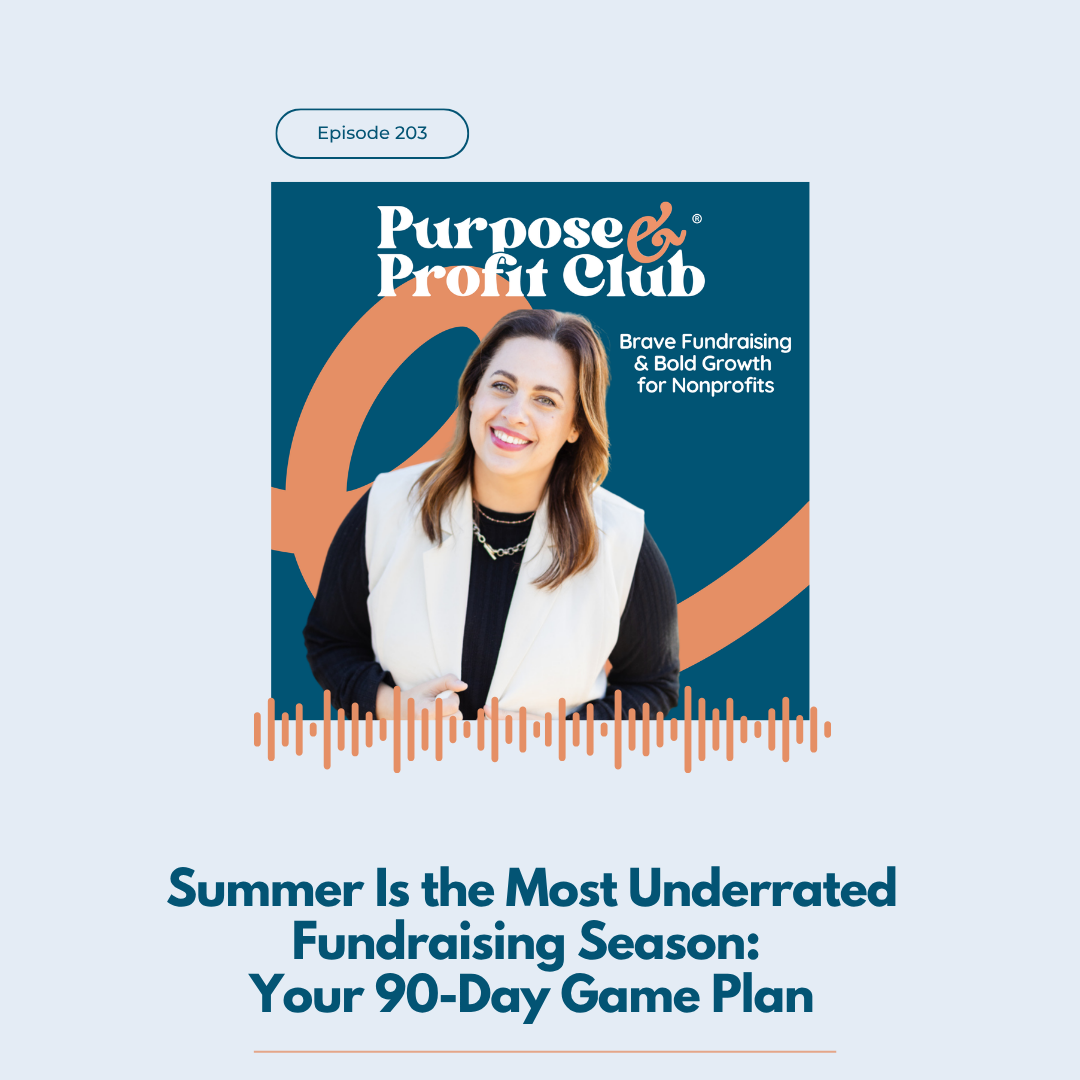
Ep. 203: Summer Is the Most Underrated Fundraising Season: Your 90-Day Game Plan
EPISODE 203
Summer Is the Most Underrated Fundraising Season: Your 90-Day Game Plan
About the Episode:
Americans gave $592 billion to charity last year. That was a record year, in the same economy, in the same tumultuous climate, with the same donors everyone says are pulling back. So why does it feel so hard?
In this special session recorded live, I break down the summer fundraising forecast and make the case for why right now (not September, not year-end) is the most wide-open fundraising opportunity of the year. I cover what's actually keeping organizations stuck (it's not donor fatigue, it's messaging), why 60% of nonprofits are fighting over 0.4% of grant money, and how to run a focused sprint campaign this summer that seeds your strongest year-end ever. Plus real client results, live Q&A, and details on how to work with me inside The SPRINT Method™ and The Purpose & Profit Club®.
Here’s what you’ll learn:
Why there is no generosity crisis, only a messaging and strategy crisis
The summer fundraising opportunity most organizations completely miss
Why 60% of nonprofits are fighting over 0.4% of grant money, and what to do instead
Email as the foundational backbone of online fundraising, and why "it doesn't work" usually means the recipe was wrong
Monthly giving as the most sustainable revenue stream, and why most organizations don't have enough monthly donors
Sprint campaigns vs. endless soft asks, and why short, focused bursts beat marathon fundraising every time
It’s not your stories—it’s how you’re telling them. If your amazing work isn’t getting the attention (and donations) it deserves, it’s time for a messaging shift. The Brave Fundraiser’s Guide guide gives you 10 done-for-you donor prompts to make your message impossible to ignore. Get it for free here!
Christina’s Favorite Takeaways:
“Americans gave 592 billion $ to charity last year.”
“I have clients who are seeing growth, not because the conditions are perfect or suddenly donors became more generous,but because they stopped waiting for the environment to improve and started building systems to create growth.”
“Email is foundational for digital fundraising. Email drove 16% of online nonprofit revenue last year.”
“Monthly giving now represents 31% of online revenue, and recurring donors are dream donors.”
“If you want more monthly donors, you have to not only ask for more monthly donors, but you have to create a campaign that brings them in.”
“You need to start activating the people in and around your organization to help spread the message.”
“Your donors don't want you to constantly be in a state of fundraising.”
“I don't want you to be in a marathon of constantly fundraising.”
“Fundraising shouldn't be something you fit into this work; fundraising is the thing that makes this work possible.”
“Eat the frog! Do the hard thing first thing in the morning.”
“Nothing moves without the fuel, and the fundraising is the gas.”
“Fundraising is the activity that creates every other possibility for your organization.”
“You're thinking summer is the wrong time to ask. There is no wrong time to ask.”
“60% of nonprofits get 0.4% of grant money.” source: candid.org
“Individual donors give 3X more to nonprofits than grants, and that money is unrestricted.”
“Fall fundraising is seeded now.”
“You need to get to know your audience better, and you need to get more reps under your belt.”
Episode Resources:
Stop Crying Wolf: How to Fundraise Without Burning Out Your Donors
From $2,500 to $10,825: How a Classical Music Nonprofit Won with a SPRINT Campaign
The $20K Pivot: Canceling a Gala and Raising More with Sharing Hope Africa
From $3K to $12K: The SPRINT Campaign That Changed Everything
Charity: Water Ambassador Kayla Houchin Raised $147K—And Proved a Movement Can Start with One Person
How Aftersight Raised $20K in 20 Days (and Fired Up Their Board + Donors)
FREE Resources from Splendid Consulting:
How to Work with Christina and Splendid Consulting:
JOIN THE WAITLIST: The Purpose & Profit Group Coaching Program
Easy Emails For Impact™ - Turn Your Inbox into an Income Stream
Double Your Donations - Raise More From Your Laptop Without Chasing Grants or Galas
Donations on Demand: Build a $5K Email Campaign System in 30 min/week
Connect with Christina and Splendid Consulting:
-
*Links may be affiliate links which means I may earn a commission at no cost to you.
Christina Edwards 0:00I'm gonna be sharing the fundraising forecast for you. I think everyone needs to hear this. Let's see, I'm gonna take a look, solo founder, director, co-founder, founder, executive director, part of a team, executive director. Okay, yep, major gifts officer. Okay, typical. So we have a good mix, we have like a good mix of solo founders, solo operators, scaling teams. Everything you're going to learn today is going to apply to you no matter what, because that's usually what I call in as a good mix. Okay, so let's begin.
So, you're here for the summer fundraising forecast. Happy June. It is summer, you know. One thing about summer that I think is interesting is, for me, I'm in Atlanta, it's summer. It's not actually the official day of, like, summer hasn't even begun, but, like, it's hot. It's summer. School's out for us, so it's summer to me. For other people school still in session, so your summers in a few weeks, totally fine either way. Before we talk about summer fundraising, I want to talk about the story that many nonprofits are actually telling themselves right now. So, if you hear yourself in this story, you're not wrong or bad, but I want to know if you hear yourself in the story, or maybe you hear your staffers in the story. You can say either in the chat for me. One donors are pulling back, people aren't giving, it's harder than ever. The fatigue is real.
Christina Edwards 3:55
The economy is anyone feeling that, feeling that pressure, feeling that grip, feeling that tension, or hearing that sort of receiving that, whether it's board members, executive directors, other nonprofits saying that 100% yep, yeah, that is the message that we in the nonprofit sector are fed, we are fed that message all day, every day, and it's just like compounding, meanwhile Americans gave 592 point 5 billion with a B to charity last year, 592 billion, that was a record year, that wasn't five years ago, that wasn't like COVID, no, that was last year in the economy we were in last year in the tumultuous times we were in last year, in the non perfect moments that still happens, so we know that the money is moving. The question isn't whether or not generosity exists. The question for you and your organization is whether or not you have a strategy to capture more of it, that is your opportunity, and that is the. Opportunity that so many organizations are missing out on right now, and that's what we're going to dig into today.
So, I want to hear from y'all in the chat. Tell me, the number one fundraising focus for the rest of the year. What is your number one fundraising focus? So, this can be a financial goal, this could be a strategy, this could be a hope or a dream or a wish, this could be something that is an initiative that has been dropped down to you, a voluntold. I know we, we, yeah, we get those sometimes. Okay, 30 more monthly donors love it, recapturing one-time donors, so meaning like maybe re-engaging those lapsed donors. Diana Capital Campaign, 1 million more. How much have you raised so far, Susan? I have quite a few clients in capital campaigns right now. Beautiful. Okay, she's 800k in, which is amazing, but I'm sure you're like, but I gotta do another million, right? So that heaviness is there funds to cover organizational structure. What does that mean? Like operating costs? Say more, Sammy Libby says, for me, major gifts in the first year, it's me, it's building my caseload and engaging major donors one on one. Awesome, very smart, very smart. I like to think about a goal, whether it's $100,000 or a million dollars or $50,000 and it's like I want you to do both. I want you to take chunks of that goal out from major donor gifts, and then I want you also to get small and midsize gifts as well. Okay. All right. Samie says yes. Most grants want to cover projects. We need to cover insurance, legal fees, salary, etc. Can we just give, like, an amen or a yes in the chat, like overhead is programs. The program doesn't exist without the people to buy the printer toner to welcome the clients to the program to answer the emails, and yet that's the catch 22 with grants. So anytime you come to my calls, I don't teach anything about grants, because grants are restricted dollars. Grants are time that is not guaranteed, and that application time that you never get back, for which you may not get awarded. And I remember this is like such a micro version of this, but my child's preschool is a little co-op, many, many years ago. And I remember volunteering there, and I was like, "Oh my gosh, you guys have a Vitamix blender, like that's a nice blender, that's like a $500 blender, at least, right? And the person, the director there, said to me, yeah, we got it through a grant, but no one, no one's here to make the smoothies, no one's here to clean up the cups. It was, it was just collecting dust, and it's like metaphorical, like we got this $500 thing, we have a dishwasher that doesn't work. We have a table and chairs that need new legs, or whatever it is. We have playground equipment we need, but we have $500 blender instead. Yeah, okay, yeah, you're feeling it. Okay, perfect. All right, so a lot of nonprofit leaders are bracing for a tough year, and everyone on this call doesn't have to. You do not have to brace for a tough year. Do you do not have to brace for a plateau year, a break even year? I was pulling some client data yesterday. This is not a lie, this is the truth.
Christina Edwards 8:09
I was pulling it yesterday, and one of my clients has grown 56% in online revenue year over year. Their monthly donors are up 33% year over year, their email open rates are 45% They are on track to cross $1 million in operating revenue for the first time ever, and they are mostly like, well, I feel very comfortable saying over 90% funded by individual donations. This is not from grants, this is not from foundations, this is not.. this is the other one I see. Well, we have one one wealthy donor that donates $500,000 a year. No, this is from a mix of mid, small, mid, and major level donors, and this client is not a unicorn. I love them, and they're not a unicorn. They are not special in an outlier. Our clients are seeing growth year over year over year, so that's what we're going to dig into that that pattern today. I, Patty's like, I hear Patty, Patty, and my mind is like, yeah, but what do they do? I bet they do something that people want to fund. What do you think they do, Patty? What do you think that they do? What do you think that here's the, here's the question. You can just type it in the chat, because I want everyone to hear it. What cause area, and everybody can participate is easy to fund. What do you think is an easy to fund cause area? Type in the chat,
Christina Edwards 9:35
Okay, cancer, food insecurity. What do you guess they do? Patty, animals. I was waiting for the animals. Yep, it's always animals. Yep, the latest issue. Yeah, something like, like, yeah, children's program. Kids, okay. All right, Patty, if you come up with one, just put it in the chat. I'm going to keep going. Um, isn't that funny?
Christina Edwards 9:57
kids and animals. You ready for this? No, kids, no animals. It's not that. And here's the other thing, and I think will break everyone's brain a little bit. They are not even there. They're spread all over. They are not community based. There is no annual event. All of their donors are across the country. Many of their donors have never been for a program tour. Many of their donors have never stepped foot on, you know, the property and the communities for which they're serving. I'm going to leave it there, and we're going to keep going. Art, yeah, so we all have, like, our own, yeah, but it's easier over here, and I can give you.. I could just spend a time spent.. I'm looking at my, like, I have a wall here of my clients, and I could just pick out other ones that, no matter what cause area you choose, I could find one where our clients' numbers are up in animal welfare, not in animal welfare, in youth empowerment, not in youth empowerment. So it's not your cause area, it is your strategy. Okay. All right. So that being said, we have clients who are seeing growth, not because the conditions are perfect, not because sudden, suddenly donors became more generous, not because they bought some sort of acquisition list, we're all sold, right, because they stopped waiting for the environment to improve and started building systems to create growth, anyway, this is what we've got, sometimes it's like, well, this is what we got, this is what we got, now what, so they're building better campaigns, better emails, more recurring revenue, more donor momentum, more visibility with what we've got. We don't know what we've got next year, we don't know what we got the rest of the year, like literally, who knows? But we have to have a fundraising strategy that is nimble enough to navigate, whether it's political, whether it's economics, whether it's some sort of natural disaster, like I think about how long ago was the Hawaii fires, right? And suddenly people were donating to that. How long ago were the fires on the West Coast in California? People are donating to that. So we have to have a bulletproof strategy for fundraising, even when emergent needs pop up, and you can. So let's start with what is underneath that strategy. These, these are the areas that I want you to focus on. I love that Jen said in the chat, so anyone that was like kids, Jen's like kids in general is not easy, like for every pro, somebody's like, actually it's not right strategy.
All right, so number one, email still wins when organizations tell me email doesn't work. I always say, "Forward me your last three emails. Foundationally, this is the backbone to raising money on your laptop. Period. Full stop. Not grants, not galas, not auctions, not Mackenzie Scott. Email is foundational for digital fundraising, for online fundraising, for any fundraising, the channel works. The execution is usually the root problem, because 33% of donors say email is what inspires them to give the most. Email, email drove 16% of online nonprofit revenue last year. We know that personalized emails outperform generic ones, and yet organizations are still struggling with email. If you are struggling with email, give me a one in the chat. I would also love to know, how often are you sending emails? And then you could even say, we send emails once a month, and we fundraise actively fundraise an email, what? And then you tell me that frequency. Oh my god, Tracy, Tracy says yes. I started an easy email campaign June 1. I received $12,000 as of today. Tracy's in my use emails course. Hell yeah, Tracy, that's amazing. Tracy, we're not unicorns, right? We're just doing the work. We're just doing the work. Yeah. Okay. I want to give you this analogy. When you're saying email doesn't work for us, we've tried funding raising for email, my favorite. Our donors don't like email, that's always when I hear anything in that it doesn't work right. It is like saying this recipe just doesn't work, but then you look closer, you skipped half the ingredients, you were subbing out like banana instead of egg, and what are you doing? Just like I do when I bake, I open the oven like four different times.
Christina Edwards 14:22
I'm like, is it doing anything that is not following the recipe right? So, if you have an unlocked email as foundationally the backbone to your fundraising engine, huge opportunity, huge opportunity. You can buy your time back, right? That channel isn't broken, it's something you need to iterate, and I just gave a talk about this. It's gonna be a little uncomfortable, whatever homeostasis is right now for you, whether you send emails monthly, quarterly, weekly, bi-weekly, I don't care. You're going to do to do two things: you'll need to change how often you send email, and you need to change the content. Within the email, because no one here, including myself, including you, is excited about getting an email that says make a difference, we need your help, right? We all send those emails, we all read those emails, that's not the emails that are converting.
Okay. Monthly giving, I want to talk about monthly giving. Monthly giving, who I want to know if monthly giving is something you're like, yes, sustainable income. I want that, and I would also love to know how many recurring donors, monthly donors you have right now. And you can give me an approximate, you can say less than x, more than y, I want that. I only have two, we have 150, 15,15, yeah, yes, I want it. We have, yeah, so our clients are doing a lot with monthly giving. Monthly giving now represents 31% of online revenue, and recurring donors are dream donors. And I'll tell you why. The average one-time donor, so I make a gift to your nonprofit right now, it depends on you and your organization, but it tends to be that eight out of 10 donors give one time, so we're one and done donors. That's a huge, that is not a leaky bucket, that's a bucket with a lot of holes in it. That bucket is like dripping, and so you feel like you're in a constant state of fundraising because of that one-time gift retention issue. Whereas monthly donors are amazing, they stay on, they have a lifetime value or lifetime span, rather of eight years. So, instead of one and done, it's eight years. So, it's really, really a strong strategy that a lot of people are talking about. The average recurring donor gives significantly more over time as well, but most organizations are missing a few things when it comes to monthly donors. Monthly giving isn't growing because donors suddenly woke up and said, "I'm going to start giving monthly. It started becoming part of our vernacular, and it started becoming part of their vernacular, and their habit, and their actions, because nonprofits started asking and started using tech tools that have good strong recurring giving options, so it's not me mailing a paper check, right? It's me and my Spotify subscription, where I forget I have it, my Netflix subscription, right? It just exists in the background. So, if you want more monthly donors, you have to not only ask for more monthly donors, but you have to create a campaign that brings them in, and that's the third piece. We're going to talk about campaigns a lot today. That's the big one. If you're like Christina, I have the donation tool, it accepts monthly gifts, it's cool, and we still have three monthly donors. It's because you're not running what I have created, I call them sprint campaigns. You're not doing sprint campaigns for monthly giving, and you need to, I always picture a four burner stove. Right now, monthly giving, really, y'all have like eight burners on your stove, but monthly giving is in the back burner, and that certain times throughout the year, I want you to bring it to the front burner, you know, the big pot, right? And then we're going to get it to a boil, and we push it back. That's how I treat all fundraising, is campaign style. They have a start and a stop date. All right. Third point I want to make today: community-powered fundraising is growing, so the organizations that are seeing the fastest growth aren't fundraising alone anymore.
Christina Edwards 18:15
Most people come to me, and they are very much in solo fundraising mode, and what that looks like is either you are literally a one person show, right, or you are solely responsible for fundraising in your staff and your org, and there are people who say they'll help board members who don't really help. It's really kind of all on you, and regardless of where you are, if you're a solo operator or team, it doesn't matter. You need to start activating the people in and around your organization, so supporters, those volunteers, those board members, partners, and advocates. They help spread the message. That's a huge part of what I teach inside one of my programs, where I teach on the social street team method, where we actually partner with influencers and ambassadors. You can do this even without going to like giant influencers. You can go to people to be audience amplifiers who are already inside your organization, because one person fundraising alone always hits a ceiling. It's a ceiling in time, it's a ceiling in bandwidth, right? It's a ceiling. Community-powered fundraising skills differently.
Now let's get into short campaigns versus endless campaigns, and I'm kind of curious when I say the word campaign, do you know what I mean? Do you have a sense of what I mean? What does that look like for you? And also, let's do a quick check in on how often are you fundraising right now? Like, how many fundraisers do you have throughout the year? And to give you, like, a little bit of a hint, typically what I hear is, like, well, we do year-end, or we have our spring blah blah blah event, or we have our signature fall. Gala, okay. Christine says 10. Christine, in the chat, tell me more about your 10. Like, what are they? Okay, Netta, I hope I said that right. Said three to four. Matt says once a quarter. Great, two to three, okay. Oh, Christine, I was saying, tell me about your 10 in the chat. Like, tell me more about how what does eight to 10 look like. All right, let's see. We have two major events in a year-end push. Dawn, I would say that's really close to what I typically see, two, and then Jennifer says two in-person events, and then your end, and then two to three this year, one event. Yeah, very, very common. Okay, so when I say a campaign, what I do mean, and I saw somebody say a specific message. Yes, one of the things that that I think has gets lost in translation sometimes is this idea of fundraising, your donors don't want you to constantly be in a, in a state of fundraising, we don't want you to always be asking us, right, and we also know that you don't want you to always be in a constant state of fundraising, but when the need is always there, that ends up kind of being the output. It's in your monthly newsletter, it's in your check-ins, it's in this and that. It's very like kind of a soft make a gift, and then at certain points it's a little more 911 but it's not a true campaign strategy, where there are key points throughout the year where you are fundraising, you know your fundraising, and your audience, your subscribers of donors and non-donors know your fundraising, like I always tell my clients, I want, I should know, I should be like, oh, they're fundraising right now, right? Anyone who is on an email list for any brand that runs a sale, you're like, oh, the sale ends on Monday, they have made that clear, they have made that clear, it should be similar to that, and I want to offer that takes a lot of guts, because to make it clear to your audience that, oh, they're fundraising that right now, that means you have to increase your volume, that takes courage, that takes being willing to hear, you know, Dan on the board, being like, that's kind of a lot, you're like, yeah, we would like a different result this year, Dan, so we're taking different action, so short campaigns beat these endless time, these endless sort of fundraisers that are soft but in perpetuity. Do you know what I mean?
Christina Edwards 22:29
So, instead, sprint campaigns are short, they can be for a few days, they can be for a few weeks, but they are not months and months and months long. They are not a capital campaign, they have a clear goal, a clear ask, a clear why. Why should the donor donate now? Can I just wait? Can I just give on Giving Tuesday? You should be able to answer that question. If you don't, this is what we teach inside my programs. It should have a high converting donation page. This is key. This is why I built the sprint method. The sprint method, we go into this in great detail of what your donation page should look like, because your donation page can can either have higher conversions for people who are thinking about donating or completely kill it. The words, everything on the page, all the way down to the tool you're using, but the words, the images, everything that can either get you across the finish line to making the gift or not, that's the formula you need. These short bursts, we sprint. It is not a marathon. I don't want you to be in a marathon of constantly fundraising. Christine says, okay. So, Christine was the one that said she does like 10 fundraisers a year. The reason why I asked her for more details, because my mind said that's more than I normally hear. Tell me more about that. I'm interested. And then she said, now, now she's saying she's exhausted. No wonder. She says they run from three to four weeks, raffles, auctions, etc. Are we exhausted for Christine? I'm exhausted for her. Okay, everything I'm teaching you about Sprint and about these short bursts of campaigns, no one gets a prize at the end. Donors don't want a prize. we don't need a thing. We do not need a goodie bag for donating. We don't need a T-shirt. We don't need an auction item. We don't need a raffle prize. And also, for you, Christine, and all the other organizations doing this, it is such an upfront lift that all that time you're taking. Hey, would you want to donate something to our upcoming auction? Hey, have you bought a raffle ticket? You could be going to book major donor meetings, you could be going to cultivate those mid-level donors to upgrade, but you don't have time to do that, because you can only do so much when you have to solicit for all these auction items, yeah. I, she's, yeah, Jen says completely agree. I want them slash us to put the money towards the cause. I have too many tote bags. Yeah, I don't need a pen. I don't need a pen. I don't need a thing. I don't want a thing. I want you to help the cause. I care. Out, that's what I want you to do, and that's that's a really big shift when you're in a state of this grassroots auction raffle, whatever your version is, prize kind of thing. Yeah, to shift into, but I want to say, regardless of cause area, we have organizations who are local. Hang on, let me even look at my wall, so I can look at some. We have domestic violence shelters, we have youth empowerment, we have arts theaters, international NGOs. Let's see, health, wellness, animal rescues, environment policy. This works for all of them. None of them are giving out swag, you know what I mean. None of them are like, 'Here's a prize for donating, and they're raising 1020, $30,000 in these types of fundraisers, again, not over the course of months, in the course of a week, two weeks, something like that, from their laptop. You could do this from a Starbucks, that's these are the essential pieces.
Okay, let's talk about frequency, so the belief is fundraising is something we fit around the real work. Somebody said this to me, I don't know now, I can't. It's blending together, because I've had some conferences lately, and some webinars lately, and I'm like, Who said, where was I? Basically, like, I don't have time to be fundraising, like you want me to do that, like that's kind of a lot.
Christina Edwards 26:22
She was kind of pushing back, like you want me to, like once a quarters, kind of a lot. I don't remember what I was telling her on frequency, whatever she was doing. I was like, I want you to do more. If you're doing twice a year, double it. If you're doing four year, add two more. She was like, that's kind of a lot. And I'm like, fundraising shouldn't be something you fit into this work, fundraising is the thing that makes this work possible. You with me? So, like, you, it doesn't exist without the funding, and I am one of the most impatient people you'll meet. And so, a wait list is not something I want your organization to have. I don't want you to turn down a new litter of kittens, because your shelters maxed out. I don't want you to turn away a mom that has nowhere else to go and is leaving an abusive relationship, because you just don't have the funding to add that next, you know, space, right? That's the piece. So, fundraising is number one. Everything else comes after fundraising. What else? Like, why are you prioritizing anything else in front of that? Fundraising is also the thing that you had to hire support. I love hiring admin support. I love it when my clients hire a VA. I love it when they hire a programs lead. Funding is the thing that does that. Yeah, Barb says, 'Who is all who's going to do all the work? You're probably speaking, Barb, like I'm in programs too, and that's okay. That's okay. What I'm saying is, instead of saying to me, Christina, I don't have time to do all fundraising, I'm running the thing. You have to look at, I'm hitting a ceiling on how much I can fulfill programmatically, because I have a funding problem, so I have to stop going over here and putting out fires until I put out the big fire and actually bring in funding first. That's what I'm saying. And it's like anyone who's heard the saying, 'Eat the frog, we've got to start eating the frog. And when somebody says to me, 'I'm full time at my organization where we raise less than $100,000 a year and I don't have time to fundraise, I'm like, 'Let me see your schedule. We got to start eating frogs. We got to start eating frogs a lot more often, because there's some passiveness happening here. And I want you to develop the skill of fundraising more often, asking more often, and you will see. Eat the frog. Yes. Okay. Eat the frog is a saying. Somebody will know it. It's like, do the hard thing in the morning. Do the hard thing first. Do, and if for you, asking, calling a donor, following up with a donor, making, sending another email, following up with the person on your donor match, those are all the things that we tell ourselves. I don't have time to do. I know this because you know I work with everyone out like, like you on this call. This is what I hear. Those actually don't take a lot of time. A phone call can take 90 seconds. A phone call is usually a voicemail. An email can take less than five minutes to write. Is it true that people donate to what you do in the program? Yeah, you sit down with a donor and you say, donor, I see that you care about.. let's see.. I see that you care about this after-school tutoring program, right? You care about that, and donors like, 100% You're like, well, we have to pay our tutors, otherwise the program doesn't exist, right? Well, we'll close down the program if your donation only goes towards books and snacks for the teenagers and the lights for the well, not even the lights, hang on, we're going to take that's overhead, you know? Right, very quickly donors are like, well, no, I want like really strong tutors here that we tell ourselves this is more of just the lie, we tell ourselves donors don't want to pay for this, we want to pay for this, I want to pay for, you know, the shelter to have volunteers to make sure the kittens are bottle fed and the crates are clean. Means I don't just want to pay for the, you know, toys, right?
Christina Edwards 30:05
We have to stop separating it. Yeah. All right, I'm gonna keep going. I want to give you this gas tank analogy, so it doesn't matter how strong your programs are, how beautiful your mission is, how talented your team is, how awesome your board is, nothing moves without the fuel, the fundraising is the gas, so you can't focus. You can't say, 'Well, we focus on the vehicle this year, we'll worry about the gas later, right? We're focusing on the program, the service this year. But this is what nonprofits do, and I would argue you're doing this for a few reasons. You're doing that because that's where your heart is, especially my founders, especially my executive directors, right, makes sense, right? But we've got to gas up the tank, right. And also, I would argue the other reason is like this thing over here is harder in its stretching way. Fundraising is a muscle. No one works out twice a year and expects to get strong. Nobody sends two emails and expects to get engagement, yet this is what organizations are doing. We're running two campaigns, maybe three campaigns, and expecting revenue to increase magically, but it's not right. So, muscles respond to frequency, repetition, consistency, not perfection. Let's talk about these campaigns and what they can do, they build pipelines, and this is huge. This is a huge result of running more shorter fundraising campaigns, more sprint campaigns. You might think campaigns only raise money, that is like the thing we want. Yes, I want you to hit your financial goal, but campaigns also create the following new donors, reactivated donors, meaning lapsed donors, monthly donors, major gift prospects. We've all had the campaign, or most of us have. We were like, dang, they were a $25 donor, and they just gave $1,000 They like poke their head up, they surprise you with an amount. I see some nods. Yes. Future volunteers, future advocates, a campaign isn't just a revenue event, it's a pipeline building event. So, when you stop fundraising for long stretches, 3,4,6 months, you're not protecting your pipeline, because you, yes, we can squeeze more juice from the people inside your donor base, yes, that's one initiative, but we also need to be bringing more people in your funnel. You with me? We need to bring people in. I would love to know in the chat what your donor acquisition strategy is. You just put in, like, I get new donors this year through what. While you're doing that, I'm going to riff on this in the chat. Libby says, I think nonprofits are embarrassed about asking for overhead. The issue is we don't connect the fact that overhead keeps us and keeps us open in a positive and excited message for donors. I'm going to even say we need to stop calling it overhead. I just think your gift towards my after-school tutoring program serves, keeps everything going. It's all in one. Why are we separating it? Why are we doing this? I think Charity Water has done a lot of things right. If I could do, take one thing and retool it, and I would even say I - I've heard them kind of talk about this a little. It's the separation of overhead. I wish that they didn't have. We do not have to have that. None of my clients have that, and none of my clients who are, who are winning at this, we're having success at this, are having overhead problems with donors. Okay. All right, so as the aqueous donor acquisition strategy, here's what I'm hearing. Don't have one. Asking more increased our mailing list, but this year we increased our mailing list, but didn't work. Did you mean direct mail or email, Barb? I don't have one. Don't have one. Yeah, okay. Got it. Totally fine. Here's what I hear sometimes, too: board member intros, right? We are all like boards, give us a warm intro. Acquisition lists, right, which Barb touched on with direct mail. Let me buy a list, right? Social media, I hear this a lot. Well, we're on social media, and then I say, how much funding is coming in through social media? Well, none. Okay, what are we doing? I don't know, or I'll hear, like, we're all get our gala, our signature event, whatever that is, that kind of brings in people.
Christina Edwards 34:27
So, if you're focusing on maybe a signature event, and then just your year-end fundraising, or a Giving Tuesday, those are like two months, just two moments trying to fill 12 months of growth. So, donors do enter through those moments. Yes, and campaigns create those moments. So, campaigns bring in more people, more leads for you. And if you're thinking, Christina, that's a lot of fundraising compared to what, compared to being stuck at the same revenue level year after year after year, compared to hoping the grant comes through that you're already like. I look at a grant application, I'll have to close out out of overwhelm. You guys are going deep on these grant applications, and they're totally overwhelming compared to cutting programs. Fundraising is the activity that creates every other possibility for your organization. How does a campaign bring in a lead? A campaign brings in a lead because new donors come in through our sprint campaigns, so for example, in the Purpose and Profit Club, which is more of my advanced coaching program, I'm thinking about one of my clients, and she did a campaign, so we, we use this model in both, and she brought in like 115 if my memory serves me, new donors in a, in a seven day campaign, okay, and of that, of that profile, it was really great. 22 were re-engaged lapsed donors. She brought back 22 lapsed donors. She brought then another chunk. I'm not going to get my numbers right here. Something like 50 or 60 were active donors, current donors. And then the last chunk to make the math, math, so 30, something like that. We're new donors, so that's how it brings in a lead. And of those new donors, you start to notice something. Oh, did they come in through a friend? Did they come in through a peer fundraiser? Did they come in through a board member? Did they come in because they're just, you know, saw, saw, you know, inspired by our cause, connected to our cause through a partner, or the other thing, you're like, well, this person just went from again $25 to $700 I'm going to invite them to coffee, so it's bringing in leads in a different way. You start to know more about them. All right, we're going to hit some, some myths, and I'm going to tell you, let's see, I've got a few more things for you. I'm going to make sure we hit some times for questions as well. So I want to hit some myths, which is, if I fundraise now, it will hurt year end. This is something I actually was asked recently, like, will this hurt my fall fundraiser or my year-end fundraiser if I do something now over the summer? No, giving is a habit, donors who give multiple times a year actually have a life higher lifetime value. And two things happen when you follow our email and our campaign strategy, regardless of the even if the donor email or a donor donates, they actually are getting value from your emails, they're you're building trust, you're building connection, you are staying top of mind for them, even if they don't donate, you're seeding them for a stronger year end. You with me, they're like more connected. You're thinking summer is the wrong time to ask. There is no wrong time to ask. In fact, summer, I find there's less, quote unquote, competition. I don't love the word competition, but there's just less action. We'll say there's less fundraising. We know November and December is Super Bowl season for us, and it's like everyone's fundraising. Summer is very blue ocean, it's wide open opportunity for fundraising. Another client said to me, yeah, but like, should we do this because it's like back to school time, and I was like, and then it was so funny, she like answered her own question, she was like, never mind, it's fine, we're doing it. So it's like, there is no, we just go, right? We just go. If you're thinking, I deserve a break, I want to travel, it's my summer too, I won't need time off, like 100% I, yes, take time off, travel, rest, you can do both. You take the time off, then you do a sprint campaign that is short, focused, email-first, laptop-based. You can take a vacation and still run a campaign.
Christina Edwards 38:27
We have clients who will run a campaign, especially I'm thinking of a few who do monthly giving campaigns while they're on vacation. They're just scheduled out ahead of time. Now that's something you would do, like after your first sprint, you're going to figure it out first, like you want to have one under your belt, but it is something you absolutely can go on vacation, take time off over the summer, and then do a sprint when you get back. We have quite a few people who will join my program, the Sprint Method, and within a week have their campaign live, so there isn't a lot of time, like it doesn't - it's you're not pouring over lots of of things to make a sprint happen. If you're thinking donors are fatigued, the generosity crisis, Christina, there is not a generosity crisis, there is a messaging crisis. I told you Americans gave $592 billion last year, that was a record. Our clients are growing year over year. I just did another client interview for the podcast. I think she said she was up total revenue, total donations over 35% last year, right? And before that, no, 35% and then had doubled. I'm inverting the numbers: growth year, growth year, growth year. I love her, not a unicorn, though, right? This is what's possible when you get off this sort of old school fundraising hamster wheel. Now, donors are not tired of giving. I wrote in my notes they're tired of bad asks, meaning sort of the sterile boring make a difference. I would also argue they're not even tired of bad asks, they're not seeing your bad asks. Not even seeing it there, you're not on their radar. Does that make sense? If you're not using repetition enough, if you're not in front of them enough, they completely missed you. Like, if you've ever missed a concert, a performance, an art show, like something you wanted to see, and somebody told you about it later, and you're like, 'Dang, how did I miss that? They came through town, and you're like, 'Mad about it, right? You're that, you're like, 'Why didn't anyone tell me anything? That's what you're doing right now when you're not running campaigns, where you're like really bringing yourself up to the center. If you're thinking grants, galas, signature event, auction is going to carry us, I want you to think about this. This is from candid.org They do beautiful research. They said that 60% of nonprofits get point 4% of grant money. 60% of nonprofits are fighting for a slice of the pie that is point 4% If I said to you, I want you to spend most of your week and you have a point 4% chance of this being a high ROI activity. You would be like, I am not doing that, and this is because it's the individual - they call it the invisible majority. They say that very small nonprofits below $50,000 make up 60% of US nonprofits, yet they received point 4% of foundation grant funding. Only 22% of very small nonprofits even received one foundation grant, compared to 72% of larger nonprofits. Said in very layman's terms, the big nonprofits are getting the big grant funding. So, if you are not a $5 million plus nonprofit, if you do not have established funder relationships, not a strong use of your time, not right now. I'm not anti-grant, I'm anti-spending a lot of time on these very small ROI activities. Here's the other thing: individual donors give three times more to nonprofits than grants, and that money is unrestricted. Remember, we talked about overhead. Yeah, we need that.
So, next 90 days, emerging organizations. I want you to focus on running one sprint campaign this summer. Get that under your belt. Get your reps in. Growing organizations, people who are like, I kind of know what you're talking about. This isn't brand new to me. I get this. I get the sense of it. I want you to run a sprint campaign. I also want you to start reactivating lapsed donors, once warm donors. Very strong opportunity. Do not wait until September for this. Scaling organizations start layering in your social street team. This is your group of audience amplifiers. This is where you're stealing other audiences.
Christina Edwards 42:38
This is a huge lead generation pool for you, so getting in front of thought leaders, ambassadors, digital partners, influencers online, so you're getting that audience activation here. You're building that audience now over summer, not when you need it, in the fall and winter. You do not need a bigger team, bigger budget for this. You do need a better system. So fall fundraising is seeded now. I want you to think about, like, I'm planting seeds that will bloom in the fall, right? I'm not going to see them, I'm playing them right now. Now, with sprints, you will see a pop, because you will see funding come in over the summer, but also you're seeding fall with this, and I see the questions coming in the chat. I'm definitely going to get to those, so keep them, keep them going. Okay, because we're good on time. If you are listening to this, and you're thinking we need about our fundraising system, I do want to take some time and talk about two different ways we can work together. Most of you belong in the sprint method. This is my fundraising program for organizations who want that repeatable campaign system. I teach you the entire process, as videos, it has templates, it has tools, it has the trusted system that I created that our clients are going through and raising 1000s and 1000s, five figures in every fundraiser, when they used to raise $500 when they used to raise nothing, when they used to raise $1,500 now they raise 15,000 so you'll learn what campaigns to run, how to run them, how long they should last, how to structure them, how to raise unrestricted revenue, how to go beyond that solo fundraising mode, how to get your board to help, how to activate community support around your mission. You'll receive monthly coaching. We coach as a group, and you have access to a community of amazing nonprofit leaders and fundraisers and founders. I'm opening it up for one day, 24 hours, that's it. It's normally $2,500 I'm giving you the launch price for 24 hours, it's $2,000 We also have a payment plan of 350 a month for six months, so we have a payment plan. You can join for 350 a day, you can get started today. You can go through. We have three separate modules in that. I can go into that for a second. We have CEO time, where I teach you to restructure your time. I teach you how to be boundaried. Some really great coaching sessions around that. The sprint method, a lot of people just jump to module two. Totally get it. Go through the sprint method, start your campaign. Launch, and then module three is where we talk about lead gen or retention, so starting those major donor conversations, what to say. Then we have a template vault of scripts done for you, templates done for you, pitch scripts, things like that, so it's there if you need it. And then we do coaching monthly, and you have that library, so you get to actually go back, and you can go see our last coaching session, or you can go all the way to the back. It is an amazing program. We've had so many clients come in. I had a client who came in and said we were about to spend $50,000 on a gala, because that's what we were out of ideas. We didn't know, right? She canceled the gala. She thankfully didn't have to pay right right before they were ready to sign. They canceled it, and they ended up having their strongest year ever last year. They raised more than they ever had in the shortest period of time, and I have to go back. They were on the podcast, they raised multiple five figures in all of their sprints, like they've killed it, killed it, killed it, killed it. So, $15,000 $25,000 They're moving on to recurring giving next now. Easy emails as an add on. I do want to highlight that Sprint teaches you how to run the campaigns, how to retain people, right? But if writing emails, formatting emails, designing emails, just sending emails, you're like, I don't know, sounds overwhelming. You have the option to add easy emails for $399 at checkout. I discount it for sprint members.
Christina Edwards 46:25
Many sprint members choose to do that because you get the templates, the subject lines, the entire strategy. We had a client go through there, he 9x his ROI, so he used to wait, raised 900 $1,900 in a campaign. He used easy emails, he raised 9000 Okay. All right. Then I want to share the Purpose and Profit Club, and then I'm going to hit some questions. The Purpose and Profit Club is for somebody, a team, perhaps, or a solo person who doesn't need a program, they need a strategist, they need somebody who's like in it with them. So you want to work with me on campaigns, major donors, monthly giving, donor retention. You're ready to really think about the entire 360 degrees. Your social street team growth, easy emails is included already in that program. The club isn't more content, it's proximity. I know your goals, I know your team, I know your campaigns. It is built to raise another $100,000 or more inside your organization, and it's very high touch. You get a lot of support. We meet about three to four times a month, and then we have high touch trainings as well. That is an application-based program. It's normally $5,000 for six months, and for the next 24 hours, we're going to open it up. We'll open up applications first, and it's going to be 3750 for six months. Now, we do have a payment plan for that as well. Okay, so I want to go through the questions. Oh, but I'm going to go ahead and put in the chat two links. I'm going to do two links. You're going to see a link for sprint. You can join right away if you're like, yes, I want that. After 24 hours, the price will go back up to 2500 It's totally worth it for 2500 We've had people join at that, but I was like, I'm hosting this, I should just open up Sprint for, for, for a day, or you'll, you'll see a link to apply if you're interested in the club. And then I'll go through that. And all right, let's see, I'm gonna take it, take some questions, take a sip of drink. How are we feeling? I need to wait until summer to join. Say more, Susan. It's summer to me. Can you give an example of a successful sprint campaign? What are the key components? Yeah, so a successful sprint campaign has the keys, we actually walk you through that inside the program, but you want to have a couple of different things in place. You want to have a strong goal, a strong reason, a strong messaging, and story to answer for the donors. Why should I give now and not later? You need to have a strong donation tool, not a check, not PayPal, not something clunky, easy to navigate, mobile friendly, and you need to have a strong launch strategy. So, if you have a week long campaign, we teach you the entire point touch points inside that week, what to send, when to send it. It doesn't just have to be email. I talked a little bit more about email today, because I'm like, email can change your life, so it's a lot of what I.. it's foundationally important for me to talk to you about, but we had a couple of people on the podcast, I'm going to mention, and I would go back and listen to them. Megan on the podcast, she's an executive director, she's in the sprint method, she did a lot of texting, and that worked great for her, she even works part-time hours, and she raised more on Sprint than she had in every other campaign ever, history ever. And she was feeling really burnt out, and she joined, and just like changed. We had Sophia and Jamie on the podcast, Listen to those two, those are two client case studies that they go into detail.
Christina Edwards 50:30
And then, and I'll put my podcast link in the here we go, and then episode 181 is Megan. All three of them great interviews, and they'll, they're all very different, like one's local, one's international, one's part-time hours, one's full-time. I mean, it's just such a great fix. We've had established organizations join Sprint, too. Those organizations that join Sprint are usually like, we've never done anything like this before, I had, I've had organizations who are raising maybe $300,000 in unrestricted funding a year, or something like that. They're like, but the way we're raising it is very old school. We have no sort of like online first, digital first, scalable way to fundraise. They do really well with it too. Okay, I'm going to keep going.
What do you tell donors when you don't reach the goal to do the project, so we don't make it like I wouldn't, I wouldn't structure it like we need like a Kickstarter. Does that make sense? Do you remember Kickstarter, where it's like we need to raise $10,000 so we can expand this program, and if we don't raise the $10,000 we're not expanding that program, so we would.. it's not the messaging is not that, and then we.. we teach you a process to pick a goal, so it's specific, so this isn't the outcome you're going to get.
We are under contract for a mortgage for a nonprofit location, and can't make any big purchases while in underwriting. Yeah, you, you're not allowed to. Your knowledge of, like, if I remember correctly, like, buy a car, finance a thing, right? You are probably allowed to do a monthly payment. Or, if it were me, we've, I mean, two things. If it were me, I would like, call a board member and be like, we need to join this. Oh, I've left out, like, so many people love this one price, three seats, you can join, you can bring in two other people at one price, so you could have that volunteer board member, extra staffer join too, you could ask them to pay for it and choose the payment plan. The other thing I was going to say is Megan, she talks about on the podcast, she's like, I didn't want to go to my board, I needed this now, she's like, I paid for it out of pocket, so that is an option for our executive directors, where they're like, I think this is continuing, or really anyone, Saffir, I think this is continuing ed and professional development for myself, and so we've had people do that as well. Do you filter the mailing list for sprint campaigns, or does everyone on the list get an email every day? So, it's not that everybody has to get an email every day. We teach a specific cadence, and you're allowed to segment. You are allowed to segment, so it depends on a couple things. It depends on you, your CRM, like what you're able to do, but I wouldn't get too in the weeds, because it's not bad for people to get your, your entire fundraising emails about that. Up to you. Random question about repetition: if you only send one email a month, can you just jump into a sprint campaign, or should time be spent increasing? You can totally jump in. Really good question. Actually, Jeanette, I like that question. You can jump in, because you're doing a couple things there. Remember, I said your audience, we want your audience to go, 'Oh, they're fundraising, oh, they have an announcement, they have a thing. So, you'll naturally create that through this, and you can also say, like, you can, you can have, you can give the view, the reader context, so it doesn't sound like salesy or awkward or weird or anything like that. Yes. Oh my gosh, amazing. Suzanne, Suzanne says this friend I watch is awesome.
Christina Edwards 54:32
I watch your webinar, Raised 13k with very little work on our end. Thanks for teaching us about it. I just want you to think, like, have you guys ever seen the pictures of, like, the Arctic Ocean, and you can see just the top of an iceberg, right. And then the picture is like what's underneath the iceberg in the ocean. It's like enormous. That is what's possible. Like, I'm teaching you the tip of the iceberg. You're not getting the coaching, you're not getting the templates, you're not getting the curriculum, you're not getting any of that today. So I'm like. If you had results with that, come, come, come, come, grab the payment plan, come. Let's see. Okay, if I didn't hit your question, just retype it again. Do you have me? Do you have a program to help me prioritize make 2525 figure asks for major donors? Yeah, you want to unmute and talk for a second, Tracy, and anyone else, if you have questions, just tell me in the chat.
Speaker 2 55:35
Yes, sorry about that, I have a little typo, I should say making. So, long story short, is I'm going to raise a few $100,000 over the summer. I have 20 major donors that have the capacity to give five figures. They already know about the Lantern Network. It's, it's me, I'm the problem. So, I need some help. Why aren't you
Christina Edwards 55:58
in the club?
Speaker 2 55:59
I need to be. So, we talked
Christina Edwards 56:01
before,
Speaker 2 56:02
I think. So we did. Yes, it was your street campaign.
Christina Edwards 56:07
Yeah, you need to get coaching, so you have the people you already have the names, and they have donated before.
Speaker 2 56:15
Some have, most of them have. Yes.
Christina Edwards 56:18
Okay, so they have alignment with your mission, and I'm going to guess you have some thoughts, concerns about what to say, how to structure it, etc. What else is on the way?
Speaker 2 56:33
Probably I haven't been able to communicate with them enough, almost like an easy email you have to give and talk about your program and the results and your impact. So, I just need a strategy, so I can go out and make the ask.
Christina Edwards 56:48
Okay, if that makes.. and then I mean, if you had the strategy, what would.. what would then.. what would be in the way?
Speaker 2 56:56
Like, this is something I've never done before, so I need some coaching, and this
Christina Edwards 57:01
is, I'm glad that you said that. Like, no, no one has ever trained in fundraising, and it's so frustrating because the nonprofit sector has a culture of, like, but just find something for free. Just my friend, my client, Kathy, she's.. I just interviewed her for the second time on the podcast, but the first time she was on, she's like, I hit my ceiling with free stuff, I knew I wanted to coach, and she has renewed every single year, she's the one that I said has grown, she doubled one year, she's gone up over 30% in this economy, in this, like, not a unicorn, but all that to say, we're not trained to fundraise, we're not coached to fundraise, but sometimes you look a little closer at the organizations that have grown in a short period of time, and you see they're getting support. Charity Water has a line item on their 990 for consultants and executive coaching, they're $100 million organization, right. So even with this, right, even with this, it's like, well, I want the support, it's like anyone who has a career, right, who's a, in a professional sector, they go, they get trained in it, right, they get support in it. And so, for some people, yes, I would love in-house if your organization paid for your support, if you're not the founder or something like that. However, I look at me, I've invested 10s of 1000s of dollars in support to run my business, and it had paid off and paid off and paid off. I could have DIY it. The problem is you lose time, and I want to collapse timelines for you. So, you say I need to raise $100,000 a summer, or a couple 100,
Speaker 2 58:35
300,000
Christina Edwards 58:36
perfect. So, you have time to waste on Google, like Chat GPT, will give you a strategy, but let's just get a strategy that's right for you. Where I'm in your business, and I know, and I'm like, you can have accountability if that's what you need, or you can say, you know, I'm, I've had this happen, I'm parked in front of this donor meeting. What? Huh, what do I do? And you can ask, you know, in real time, or I'm prepping. I have another client. She was on maternity leave, and she's back from maternity leave, which means, you know, she's a small organization. She's like, it's been kind of quiet, she doesn't learn communicating great. What's her major donor plan? That's what we've created for her. So, she's not sprinting right now, she's major donoring, right, and having a strategy. So, we, I think you need to join the club,
Speaker 2 59:20
the purpose and profit club.
Christina Edwards 59:21
Yeah, so we meet three to four times a month, and you get asynchronous feedback as well. So, the difference is you're going to say, I'm about to send this email for this meeting, I want feedback on it, or these are this is the body of work on my communications. We also have, like, it's just a little more high touch. I like to say it's like having a consultant on the on a retainer. Yeah,
Speaker 2 59:41
excellent. Thank you.
Christina Edwards 1:00:16
says our ED is nervous about trying the sprint campaign because our spring appeal brought in almost nothing, but I told her we won't know until I try. Okay, here's the thing, our spring appeal bought brought in almost nothing, so let's not try again is sort of the thought, right? It's sort of like the misbelief, right? I call this holding too tightly onto your current donors. So, what it looks like is this went badly and not as good as I thought it would. Crap, I don't want to. It's like I don't want to jinx it, so I don't want to ask again and piss them off. I don't want to ask again, and I don't want to do it wrong. Let's wait until fall. Yeah, exactly. Instead of what we planned in the spring was not effective, there was data in that. And here's the thing: if you run your first sprint with me and you don't hit your goal, you will raise more than you were planning to raise. Number one, a win is a win, and is a one, and number two, you, there's data in that, you learn so much in that, there's so much data, so I would absolutely not wait. I would be very curious, what your spring appeal strategy was, what it looked like, what the messaging was, the whole story, and I would get support, and it's not uncommon where the ED does this, where it's like, and this is the part that's hard for me, because I'm like, get out of the way, Ed. Let me do my job as a fundraiser, if that's your job, which I'm assuming it is. Where it's like, just let me do it. And so, what I would say is, you probably have shared alignment on one key thing, which is Ed wants you to raise x this year, right? Whatever that number is, that's how much ED wants you to raise, you're like, yep, that's how much I want to raise. So we have to reverse engineer. How are you going to do that? We know it wasn't through their spring appeal. We know how much the fall usually makes, right? So that could be like, at best, break even. What's the plan to make up the rest? It can't be weight, it cannot be weight. And so I would share with your ED these stats. I would share with your ED what's working right now. More is more. Repetition is key here, whether it's email, whether it's outreach, whether it's follow-up. You need to get to know your audience better, and you need to get more reps under your belt. It's again like if you signed up for 5k in the spring and you didn't finish, right? You were like, "I only was able to do the 3k. And then your ED says, "You know what? Don't sign up again until the fall. Run it again in the fall. No, you should be training now. You'll nail the 5k in the fall if you run one over the summer, right? It's like we should be training.
Okay, Sammy says we're brand new. What's your best step one? Sprint, sprint, sprint, sprint, sprint. So we have organizations in there who are like, I'm fiscally sponsored, I'm 501 c3 just got it, or pending. Join now. Don't do the stuff that a lot of people on this call are saying we're stuck, we're trying the raffles, we're trying the Grant Gallo. We're doing this. I'm burnt out. You get to just start. It's like you're starting at chapter three, and you don't have to do all this other stuff that doesn't work. Start exactly here. You do not have to have.. oh, I didn't even go over this. You don't have to have a CRM. You don't have to have the perfect tech stack. You need a Stripe account. We walk you through on how to create that. That's so I can donate to your organization online. That's it. And then we go perfect. You have Stripe, you're ready. Performing arts organizations traditionally have donor prizes for memberships. If you give it a certain level, you get perks. How should we rethink this? Yeah, it's kind of like the NPR model, a little bit to me, like you get the mug and things like that. That's not bad, that's wrong, that wrong or anything.
Christina Edwards 1:04:08
I have an NPR mug in my kitchen, it's very cute. So, like, I would say the nuance here is a few things that to me is a membership drive, and you can run a sprint campaign that is not for new members. Does that make sense? So you could run a campaign where you're raising $10,000 you know, by june 15 for blah blah blah. That's it. Now, if you still wanted to structure it as a membership drive, because that is just the way your organization is set up, that's fine, but I would look at too, and you'll know your people better. There are a few organizations that are the exceptions to the role, I think, like NPR is kind of a good example of that, where, like, people do like to rep with them, right? They like to kind of have the swag, have the thing, but I want you to think about what it would look like to run a fundraiser. Without that, because that might be the unlock for you, and the other thing that might be happening is people might only be giving at a certain level because they want that level of thing when they could be giving more, or a second time, or a third time a year, a just single one off gift. Does that mean you can unmute if you want to talk it out, but does that make sense? I
Speaker 3 1:05:23
Yes, yes, that does make sense. I'm, I'm new to this organization, and so this whole annual fund,
Christina Edwards 1:05:29
yeah, give
Speaker 3 1:05:30
this month. You're, you're a member, you're a friend, you're a sustainer, you're in the conductor's circle. It feels to me like a really old model of back when all of the doctors' wives were the people supporting the organization, and they wanted the prestige of being in this sort of inner circle, and getting to meet the conductor, or whatever the perks might be, and while I think some of those things are good to have for some special donors, and for our major, maybe for our major donors, I don't know if it's still relevant today to fundraise versus just saying this is what we do and that's why it's important, give us money.
Christina Edwards 1:06:11
So I would treat your membership campaign strategy separate from, like, as it's one arm of your fundraising strategy. It is not the whole thing, and I would look at, too, like, what is our membership churn rate? How long is our membership retention? What does that look like? Are people upgrading? And since you're newer, you may not have the answers to those questions right now, but I would say, like, I am the type of person who would give to the NPR an NPR campaign as a single gift, a one-time gift, right, and I might do that repeatedly, but I'm not like the membership right person, so I wonder, like, how many people you're missing who are just like that's not for me, but they're not even making enough, they're not making enough invitations over here and scooping up those people, the other thing that for the monthly giving model that works so beautifully is monthly givers do give to your sprint campaigns, and so monthly givers also give over here when you have a sprint campaign that has those those parts of the recipe in it, and so again, if we're running a few sprints through the year, we could probably bring in new donors, lapsed donors, and even some of those members as well. Does that make sense?
Speaker 3 1:07:28
Yeah, I think so. That's that's helpful in starting my brain rethinking some of that.
Christina Edwards 1:07:34
Yeah, yeah, good question. Yeah, okay, let's see what other questions? What other questions did I hit everything? Does anyone have any other final questions? Anyone who's like, "Yeah, I'm considering applying, I'm considering joining Sprint, I'm on the fence, will this work for me? Talk to me. You can unmute, or you could raise your hand, and I can unmute you, or you can type a question in the chat. Let's see here. How do you stop giving the plaque space? Can you unmute, say more, do Stop giving the plaque space, and then Patty, I'll get to you. Barb, do you want to unmute and tell me more about what you mean?
Speaker 4 1:08:41
Can you hear me?
Christina Edwards 1:08:42
I
Speaker 4 1:08:43
can. Historically, we give, we engrave,
Christina Edwards 1:08:51
okay,
Speaker 4 1:08:52
theme of a big donor, which for us is 250 bucks on perpetual plaque every year the plaques are taking over the walls, have a lot of wall space.
Christina Edwards 1:09:10
Do they want the plaque?
Speaker 4 1:09:12
Say names over and over and over again. I didn't start it, I inherited it, but I don't know how to stop it.
Christina Edwards 1:09:19
What if you did know how to stop it? How would you stop it? Like, what would you do?
Speaker 4 1:09:24
I don't know. Maybe recognition in an email, if that's what they want. Or how many
Christina Edwards 1:09:31
donors are we talking about
Speaker 4 1:09:34
this year? We had 22 names to put up.
Christina Edwards 1:09:36
Okay, that's a decent amount of names on a plaque. Okay. And do you know at least most of those personally,
Speaker 4 1:09:43
all of them, well, most of them, not all of them.
Christina Edwards 1:09:47
I would ask them, how important the plaque is to them. Are they seeing the plaque? Are they..
Speaker 4 1:09:52
I didn't. I forgot to hang it back up last year, and nobody said a word.
Christina Edwards 1:09:56
Okay, I think you know what to do here. I
Speaker 4 1:10:02
just talk to them,
Christina Edwards 1:10:04
or discontinue the plaque, sunset the plaque.
Speaker 4 1:10:09
Just stop, and don't make a big deal. I mean, you
Christina Edwards 1:10:12
can talk to them about that decision. You don't have to ask them, though. I think there's some what the wobbliness is about. There's a few things. What if somebody notices, then what, right? But you can have, you can have a communications plan for that, right? And then the other, I think, bigger question is, will people still give if there isn't, if they don't get their name on a plaque? Yeah,
Speaker 4 1:10:35
I think they will.
Christina Edwards 1:10:37
Then why haven't you gotten rid of it already?
Speaker 4 1:10:40
Because it wasn't my baby,
Christina Edwards 1:10:43
yeah, but you've been maintaining it, yes,
Speaker 4 1:10:46
yes, yeah,
Christina Edwards 1:10:48
and it hasn't been something that has produced a lot of joy, conversations, retention, anything like that, right,
Speaker 4 1:10:56
yeah, true,
Christina Edwards 1:10:58
so why didn't, and you knew to ask this question, so I'm wondering why you haven't gotten rid of it already.
Speaker 4 1:11:03
Well, I just got the plaque back and paid the bill to have, you know, it was,
Christina Edwards 1:11:08
but why continue to fill it out?
Speaker 4 1:11:11
Huh,
Christina Edwards 1:11:12
why continue to, like, have the plaque, you know, work, etc. Okay, I actually, maybe I'll say it this way, which is this is a really good example of very common, this is how we've always done it strategy, and so we just keep doing it. The audience isn't even responding to it, like the donors in house is like, I don't know, our walls are literally covered in plaques, like what, but we just keep doing it, because this is what this is what we've always done. So, I think you have an opportunity here to reimagine your fundraising strategy completely, and also look at what is working and what is not. What are people delighted, excited, joyous about, and what do people not even know that we're doing that is like time expensive, etc. that like we can sunset that no longer aligns for us.
Speaker 4 1:12:05
Okay, yeah. Does
Christina Edwards 1:12:06
that make sense?
Speaker 4 1:12:07
It does. It does.
Christina Edwards 1:12:09
Awesome. Thank you. All right, Patty, you can unmute.
Speaker 1 1:12:16
Yeah, I'm very.. I'm very interested in the. what do you call it, the
Christina Edwards 1:12:22
the sprint method?
Speaker 1 1:12:24
Oh, the purpose and profit club, that's
Christina Edwards 1:12:25
purpose and profit club. Okay,
Speaker 1 1:12:26
that's more intensive.
Speaker 2 1:12:28
Yep,
Speaker 1 1:12:28
and so I think I thought you said team, is that a team of two, three, you can up
Christina Edwards 1:12:33
to three, yep,
Speaker 1 1:12:34
three people for the same price,
Speaker 2 1:12:36
yep.
Speaker 1 1:12:37
Well, okay,
Christina Edwards 1:12:38
so for that, for both my programs, I have that, and for the email course too. I will tell you how it typically looks in the club, because then we have paid staffers, whereas sometimes in sprint we have kind of a mix in the club. It tends to look like executive director, fundraising lead, and communication slash marketing. Those tend to be the three people who join, and for all of us, all of for that, that policy for across all my programs, anything that we coach on, we coach one organization on the call. So, for example, if all three people came to the call, which we love, come, come, come to the call, interact, be there, be accountable, but we'll coach like one organization on the call. So that's the difference, but yeah, what does your organization do? Peace over
Speaker 1 1:13:25
violence, domestic violence, sexual assault, youth violence prevention.
Christina Edwards 1:13:32
Yeah, amazing. Yeah, I would love to support you. Fill out an application, and we'll reach out. Okay,
Speaker 1 1:13:38
okay, great,
Christina Edwards 1:13:39
awesome, all right. Okay, I'm very interested. Also, have to look at funding org and personal to see if this is the right time. Yeah, so as I said, after this, you know, the price will increase for Sprint, and really for both. And the other issue is that I really want you to think closely about is timing, like what is the value to understanding getting your first campaign under your belt over the summer to set you up for a strong year end. You get some data, you get some reps in, right? You're not feeling rushed. If you want to bring in some ambassadors if you want to start engaging your board, if you want to just listen to some coaching calls. I told you one of my clients was on maternity leave, and I was like, I don't know about you, but I was on leave. I had, I was like listening to audiobooks, I was like, if you want to like just come and listen or catch the replays, you can do that over the summer, even if you're not, if you're not yet implementing the content for either program. You could just come and start with the curriculum, so that you're ready to rock in the fall. You could even do it that way. And then that's why we have payment plans. So we have payment plans, 350 a month. I've designed both programs. If I don't think you can make $350 a month back in spring. It, I wouldn't have it. I would not have this program. Would shut it down like I have designed it, so you will 10x easily. Our first, our clients will easily raise 5,10,15, $25,000 even in their first sprint. Inside the club, same thing. Yes, it's a higher container, a higher price point, it's more high touch, and our clients renew because they're like, I need you, we're seeing an ROI. This is the this is what we need. We don't want to waste time guessing. So both programs are priced in a way where the value is very, very strong. I'm thinking of another organization, Aftersight, they're inside the club. We had an executive director and development director join, and it was really funny, because the development director, she was on the podcast, so I'm not outing her. She was like, I wasn't sure about this, I was not sure, I was skeptical, I didn't know it's a big investment. She said, this is very different than anything we've ever done, and she's amazing. They raised 20k in their first 20 days in the or in the club, the most they had done, and they have also renewed, like they're, they're awesome. So, yes, I'm, I'm not, I'm not being, what's the word, like obtuse on the investment, and the value is 100% there, 100% there.
Let me see, let me see. Interested in joining, can a team of two join? Yeah, so one price, you just fill out the application for the club, and then what will happen is I will review the application if it's a fit. A couple things I'm looking for, again, I'm kind of checking the health vitals because I don't want to take your money if you're not going to be successful, so I'm making sure it's a fit, and then I will send you a link to join, and when you join, you'll get, and this is true for Sprint, when you join, you get an email from me that has everything to log into our members area, has a welcome email, it sort of orients you, you reply to that email, and you say, our second person is Joe, here's Joe's email, our third person is Susie, and here's Susie, and my team will add them. They'll get their own credentials, so everybody gets their own emails. We're not having to share logins, and it's really, really easy to kind of navigate that. Okay, all right. Thank you, guys. I know we ran over, but I always love - I love these calls. They're the best.
Christina Edwards 1:18:08
Cool. Yes, okay. Let's see, I want to do it. Wait, I for sure want to do it. We only have $1,500 in the bank account. Did I read this one? And personally, not wanting to spend the money, I'm thinking that learning from you will bring more money than I could, 100% Sammy, yes. So, couple of things that I would do. If you.. I'm not sure what your role is, assuming you have like executive director, CEO, something like that, that you want to go to, and you can share this recording, or I have a different webinar you could share with them that really speaks more about Sprint, if that's the one you're interested in, you can share that with them, and what I would say is, again, they have a goal for you, they want you to raise x, and right now most organizations do not have a strategy. Their strategy is like, continue to do what we did last year, hope it has a different result, and also try and do a few other things. Right, it's like, very like, but we're not going to support you in capacity building. We're not going to support you in having somebody to actually look at your content. So, for Sprint, when we meet, as for coaching, you're seeing me. We had, we had a call recently where a client recently joined Sprint, and they were going live with their campaign, and before they went live, I looked at it, and I was like, okay, here are our edits, and when I checked it, they had already raised $3,000.20-four hours later, 24 hours later, $3,000 and they are pretty new, pretty new, and they were like, and they are not the, you know, animal welfare cute kittens, right? So they can do it, you can do it. And then I would say payment plan, and if they say something like, well, it's not in the budget, great, a budget is just a forecast. If the roof started leaking today, that wasn't in your budget for your building, right? If the, if your laptop is totaled, that's not in the budget. We find a way. A budget is a forecast, so we have this deliverable over here. We need, I need support to make that happen, right. And this is how much it costs, and this is her. I can send you this, the sales, actually, no, the sales page for Sprint has it on it. There's three or four video testimonials, she can listen to those, or he can listen to those as well, and get a sense of like our clients' outcomes and the ROI there. Hopefully, that's helpful. Sammy, I saw you. Okay? Do you want to unmute?
Speaker 5 1:20:36
Yeah, I just want to say, thank you. It feels so lonely and so new, and I don't want to use the word scary, right? Like, it's an exciting,
Christina Edwards 1:20:44
scary, yeah,
Speaker 5 1:20:45
like a positive, exciting, positive, scary, yeah, but yeah, feel really good to have a knowledge base that that's legit. So, thank you.
Christina Edwards 1:20:55
What do you do? You have to get approval to join for, like, with your organization, your executive director or your board, or like, what? What is
Speaker 5 1:21:04
the.. I'm the founder, the executive director. Yep, I am. And the boards super supportive, and they're like, I'm sure they would say, yes, we just have $0 right? Like, we have so little, and I still have to pay. How much did you raise
Christina Edwards 1:21:16
last year?
Speaker 5 1:21:17
We were brand new. We just started this January, so we're only five. What are we year to
Christina Edwards 1:21:23
date?
Speaker 5 1:21:24
Five months,
Christina Edwards 1:21:26
but revenue year to date
Speaker 5 1:21:28
1500
Christina Edwards 1:21:30
Got it, got it, got it, got it, got it. Okay, perfect. Um, you're like, no, that's everything we've raised, Christina. That is not just our current number in the bank. Okay. And what does your organization do?
Speaker 5 1:21:41
We are called one good friend. We support adults with disabilities in having friendships in the community, so not like a paid support worker, not a parent, just friends,
Christina Edwards 1:21:52
physical, intellectual disabilities, both. Okay, why did you start your organization?
Speaker 5 1:21:59
It was an organization in the 80s and 90s, and it was called Community Partners. Then had some time, I heard they were going to dissolve the organization, and so I worked to save it. We brought it under another company, and just the funding structure is silly. So we brought it separate again, because donor and grant is the way to fund it to make it more equitable for the people we support. I was a volunteer in this program when I was 20, and
Christina Edwards 1:22:26
so you currently have then some donors, and your donor base could, because you're you are in the organization has already been established. Does that make sense?
Speaker 5 1:22:36
We have two, so we have a 15 or a $500 donation, and 1000
Christina Edwards 1:22:41
but previous to that I'm saying,
Speaker 5 1:22:44
oh, previous to that.
Christina Edwards 1:22:46
Where are those hours? The
Speaker 5 1:22:47
very first one was funded by the United Way, and then they can't fund it anymore, because people need diapers and food, so that's kind of where it needs to go.
Christina Edwards 1:22:57
Okay, okay. And are you, where are you based?
Speaker 5 1:23:02
Central Wisconsin.
Christina Edwards 1:23:03
Okay. And would you imagine most of your donors will be local? Okay. And what have you tried so far this year to raise that 1500
Speaker 5 1:23:13
Just direct ask.
Christina Edwards 1:23:15
Okay. So you haven't done anything at scale yet?
Speaker 5 1:23:18
No, I don't know how.
Christina Edwards 1:23:20
Okay. And are you part time or full time on this?
Speaker 5 1:23:23
Part time, but sometimes it feels full time.
Christina Edwards 1:23:26
Totally get it. Yes. Okay. All right. So I think maybe that was you in the chat where I was like, oh well, you, if you starting at basically zero, somebody else said that. Maybe I'm not sure. You don't have to now figure out all the ways that don't work right, you don't have to do the pain of the auction and learn what a bandwidth eater that is, or the raffle, or something like that. So you get to just learn a plan that works. How? And you have a board members, five great. I think you're absolutely ready to start. Take the payment plan, that's what I would do, I would say, take the payment plan, get your first sprint on your belt. We didn't go into this in too much detail, but for somebody who, like you, Sammy, you've raised $1,500 Your first sprint to raise $10,000 may, for you, even in your nervous system, feel like I'm saying you're going to raise a million dollars, like it may just be too far away, and that's okay. We have clients who do come into sprint who are like more on the newer side, who are just like, I don't know what, I don't know yet, or we have two donors, right? You can make your first sprint a smaller goal, and we teach you a process inside sprint, so you know, you may say, but I want $10,000 but so we want some wins under our belt too, and so you start seeing some momentum there, so absolutely, I think you would do really, really well in there, and I just want to honor that. Like, let me look at my wall again. I can't think of one person in Sprint, at least right now, who previously was like, I joined coaching program. And I've done all these nonprofit things courses before. What I'm teaching you, what I'm doing, when I'm inviting you to join, is different, and it feels like a leap. It's not something that's like super normalized in the nonprofit world. It feels like a leap. You're like, am I really going to invest $350 a month or $2,000 for this? It works, it works, it works, it works. And also, like, I want to honor that it's not something that's like common yet, and yet is so needed, so needed, because the alternative is the old school fundraising playbook, which doesn't work anymore, which was built for an era of like dial-up internet at best, which is very, very old school, very, very slow, and very, very grant and gala heavy, and so this kind of orients you and can right side you to start out really, really strong. So, yeah, I think you did great.
Christina Edwards 1:26:28
What if the board isn't ready, but you are? Should I jump in and drag them along? Nope, I'm glad you asked that question. Nope, in the drag them along. Yes, and you should jump in. So, here's what I would do. I think one of the problems with nonprofit boards, especially for an organization that's less than five years old, which yours may or may not be, Julie, but particularly for, like, the founding nonprofit board or earlier nonprofit board, is we sort of get anyone who says yes, who's not quite right for the organization, who is maybe new to serving a board, and everybody is just kind of winging it, and so the culture of the board as a fundraising board has typically not yet been established. That's going to come from you. You're going to learn that in our CEO module. Okay, inside Sprint, and so you want to join this. We don't want to get everybody else to be excited to join this until further down the line. Okay, so they don't even have to go through it. It is their optional. We have lots of clients who are like it's just me, I have no one else that will take the extra two seats. That's totally fine. You're still going to get a strong result from this. Okay, so that's the piece. What we'll teach you instead, I call this coach energy. You'll learn, Julie, how to be a coach to your board, so that they're making those warm intros, so that they are actually helping you fundraise, so that they are not just saying, "Hey, I have a good idea, and then wanting you to run with it, while they don't do anything, so you learned that skill, and we don't expect them to treat this like a full-time job, because it's not their full-time job, right, they're the board, so that's how I would kind of navigate the board there.So, don't wait for your board to be ready. The other thing I was going to say on this is, sometimes, too, what kind of, like, it's a catch 22 is like, we're told, like, depending on your cause area, you know, get a lawyer on your board, get somebody in marketing, get somebody in corporate, get somebody in blah blah blah, you end up with a board of people who are making decisions sometimes for your nonprofit, who know nothing about day to day, who know nothing about fundraising, who know nothing about marketing, who know nothing about nonprofit comms, and it's like, I'm so glad that this orthopedic surgeon is on my board, but why am I asking her for approval on my fundraising plan. You shouldn't. You should be disseminating the fundraising plan, and something like this, the investment, depending on if it's in your board bylaws. A lot of times we think we need board approval. We don't need board approval, we just want board approval for joining something like this. So that's another kind of nuance to look into. You need to be on board with this, and that confidence. Your board will be like, "Yep, I trust you. They trust you to lead the organization. They trust you if you're a fundraiser in the organization. So, you want to have that confidence first. Christine, same thing for you. If you're taking this back from the board, you need to say, "I need this program. Here's what it's going to look like. Here's the results of what she's created. I have been in this world for over 15 years. I've had three successful businesses. I've worked long term with my clients. My clients renew, so I have a strong track record of this work. You'll see it on the sales pages, and you can also share the podcast with them, but you don't want your board, you don't want to abdic. Okay, let's see. Permission to your board, in the sense, right? You first, it's like you have to say, I need this, I want this, I'm joining, like. And then, if that, you really need approval, then go to bat, right? Okay, I'm actually a new board member that is taking this on. Okay, great.
Christina Edwards 1:30:19
I've also had that happen too. It's just a family board, so I'm glad I can just join and share with the executive director. Really, really smart. Exactly. Yeah, and the other way you can do it, if you do have another person, is you can kind of divide and conquer, where you're like, let's all take the sprint module, let's do that, but you know, I'm gonna handle the major donors, or I'm going to do this one other thing, so you can divide and conquer that way too. All right, anything else? Yes, and you have a full year. The reason why the year I structured sprint for a full year is because I want you to get reps. I didn't want either there are one week workshops, there are three month training programs. I don't want you in either of those. I want you to feel not rushed. I want you to feel supported for a full year. I want you to feel like I'm allowed to have time off, I'm allowed to, you know, have vacations and holidays, and I'm not going to miss it. I can come back to it. That's why we have a full year, and then we have a, we have a way to stay in it after a full year, which many of our clients choose to, or they choose to move up to the club, but that is why we structured it for a full year, because it's like I want you to say, like Sophia and Jamie, who are on the podcast, I've lost count of how many sprints they've ran, they're so fun, and you know, one's a mom, they're both, they're working in this some nights and weekends, and they have had the best fundraising year for their nonprofit in history, and they're able to do this, you know, with one with a baby at home, right, and so I want you to have lots and lots of time for sprints, and time for your personal life and time for, you know, professional life, if you're doing programs and things like that too. All right. you guys, that's our call. I'll reach out and respond to my emails if you have any questions, or just shoot me an email. You've got my emails, so hit reply if there's a specific question that you know comes up that I didn't answer today, and then go to.. I'll drop it in the chat one last time. Go to that sprint page, because on that page it will also have, it will have, you know, everything. You'll see case studies, you'll see everything like that. And then you'll also see videos, so you'll see video testimonials with my clients as well, so you can get a sense of like what actual client results are. All right. Thank you all so, so much. And I will see you next time.