Ep. 204: Scared Money Doesn't Make Money: The Donor Relationship Truth Nobody Says Out Loud
EPISODE 204
Scared Money Doesn't Make Money: The Donor Relationship Truth Nobody Says Out Loud
About the Episode:
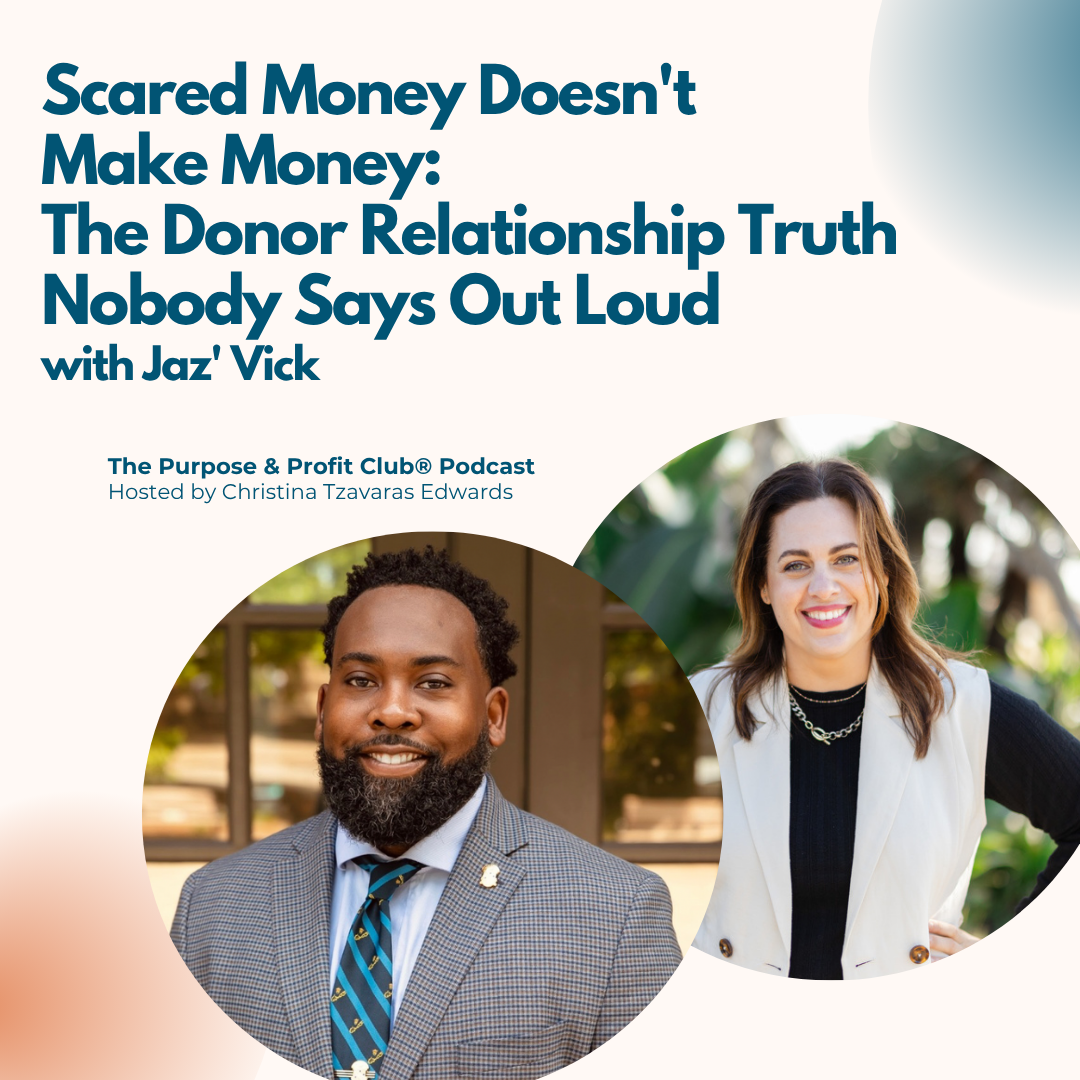
What's the real difference between a donor who gives once and disappears and one who goes to bat for your organization in rooms you've never been in?
In this conversation, I sit down with Jaz' Vick, Managing Director of Development at One Goal Georgia, a pastor, and one of the most genuinely gifted relationship builders I've ever met. We dig into what it actually means to fundraise from a place of connection instead of transaction, why assumptions about donor capacity destroy trust faster than almost anything else, and the simple habits that have made Jaz' one of the most effective development professionals in the sector. We also talk about what scared fundraising costs organizations, what great leadership actually looks like for a development team, and why the next generation of donors gives Jaz' so much hope for the future of philanthropy. This one is equal parts tactical and deeply human, and I think you'll feel it.
Topics:
Why transactional fundraising destroys donor trust, and what relationship-based fundraising actually looks like in practice
The simple 10-second habit that has changed Jaz' donor relationships
How to build deep donor relationships at scale without burning out
Why assumptions about donor capacity are one of the fastest ways to breach trust
What strong ED support looks like for a development team, and what it doesn't
Scared money doesn't make money: how fear-based fundraising keeps organizations stuck in the same cycle
It’s not your stories—it’s how you’re telling them. If your amazing work isn’t getting the attention (and donations) it deserves, it’s time for a messaging shift. The Brave Fundraiser’s Guide guide gives you 10 done-for-you donor prompts to make your message impossible to ignore. Get it for free here! https://christinaedwards.krtra.com/t/xKuLs6tOiPZa
Christina’s Favorite Takeaways:

“The world moves by relationships.” Jaz’
“If you're not building relationships, and you're only showing up when it's time to ask, you're missing an opportunity to have a greater impact.” Jaz’
“Whenever you think about somebody, reach out.” Jaz’
“If you learn the depth of relationships, then you don't get into the transactions, and you don't get into the frenetic energy. You allow what's supposed to be there as you do the work to come to life and to flourish.” Jaz’
“Assumptions can break trust or breach trust because you're not taking the time to really recognize the totality of the story.” Jaz’
“As a fundraiser, I try to move from an abundance mindset.” Jaz’
“There are going to be some people who are able to give more, there are some people who are able to give less, but across the board, people are still making money; so find those people.” Jaz’
“Nonprofit leaders would do well if they just embrace that there's a what that we're after, and then aim for the who to get you along the next leg of your journey, not the who to be there forever.” Jaz’
“Scared money doesn't make money. No money, no mission; no mission, no money.” Jaz’
"Just because it's simple doesn't mean it's easy." Christina
Don't hold so tightly to the donors you have to fulfill a growth goal; it's about bringing more people into your pipeline." Christina
“Live on purpose with purpose.”
ABOUT Jaz':
Jaz’ is a husband, father and mission driven changemaker who has spent over a decade building community, advocating for meaningful change. Jaz’ earned his Sociology degree from Georgia State and went on to earn his Master’s degree from the McAfee School of Theology at Mercer University. His love for people and community are evident through his work as both a Pastor and philanthropy professional as works to connect people’s passion with their pockets.
Connect with Jaz':
Episode Resources:
FREE Resources from Splendid Consulting:
How to Work with Christina and Splendid Consulting:
Connect with Christina and Splendid Consulting:
-
*Links may be affiliate links which means I may earn a commission at no cost to you.
Christina Edwards 0:01
All right, you guys, we have a very special guest today. Now, I've wanted Jaz on the podcast for some time, and he is finally here. So, welcome to The Purpose of Profit Club podcast, Jaz Vic. Tell us about your work. And hello. Welcome.
Jaz' Vick 0:16
Well, hello, Christina. Thank you for having me on the podcast.
Jaz' Vick 0:20
Share on Jaz Vic, I am the managing director of development for one goal in Georgia, and I am somebody who just loves to be able to mesh my passions with my purpose and really helping others connect their passions with their pockets. And so happy to be here and excited to get into this conversation.
Christina Edwards 0:38
We're going to dig into a lot of your work, a lot of what you've really excelled at, what you've seen happen, and changes that in donor habits today. But first, I have a very important question, which is, tell me about the apostrophe in your name. He spells it, y'all. He spells it J A Z apostrophe, and I just need to know everything.
Jaz' Vick 1:00
All right, so here's the story, right. For the first 18 years of my life, K-12, every school record has Jasmine, because my full first name is Jasmine, right? Only guy you'll ever meet named Jasmine, I promise. But K-12, it was Jay Z apostrophe M I N, that's how I was taught to spell my name. Shout out to my mom, who's probably going to see this, and that's what's on every school record. So, when I started applying to college, they called me to the administrative office at my high school and said, "Hey, Jaz, listen, you know we know that every school record has its spelled J Z apostrophe M I N, but your birth certificate says J S M I N E, and so I was like, Jasmine spelled the normal way isn't as cool, and it's not as easy to get away with, because
Speaker 2 1:54
yeah,
Jaz' Vick 1:54
so I never dropped the short hand spelling, the, but the government says I got a spelling J S M I N E, and so, yeah, jazz with the apostrophe is much nicer. Listen, and it's great for conversation.
Christina Edwards 2:10
This is as good. This is better than I'm so glad I asked, and I'll just share that I went by a nickname from, you know, zero to age 17, and right around, like, my tween years, I hated my nickname, like, I hated it, but I felt locked in. If that makes sense, like, I was like, I can't change it, I can't change it. And when I went and applied to college, it was like I felt like I had entered and witnessed protection. I was a new name, a new person. I became Christina. So, anyone who knows me from high school knows me as Chrissy, which is what I went by, and my brother still calls me that, because Big Brother, right, but everybody else since Christina, so I feel like there's like a period on for you two of like when you really stepped into that name fully, so that's so cool, yeah, amazing, so we know each other, we're both Atlanta-based. We know each other. I feel like through you, just you are a master networker, and actually want to start the conversation there. I think it's very easy when you work in house at a nonprofit to stay in, stay cozy in your in-house. If that makes sense, you're out there like you are out there having conversations with other nonprofit professionals with other people in and out of our sector. Like, tell me about why you prioritize that, and just all the things. Like, is that something that's always come natural to you?
Jaz' Vick 3:35
You know, I feel like it has. My dad is one of those people who never meets a stranger. I tell people all the time that my dad can sell ice to a polar bear, and it's true. Like, I have watched him throughout my entire life. We'll be in the grocery store, and he'll spark conversations, and all of a sudden I'm tired as him, like, 'Hey, is that your friend? And so it's crazy, because now that I'm an adult, my kids have also become the people, it's like, hey, is that your friend, and so for most of my life that I can remember, I just, I find ways to connect with people and really just figure out where we have alignment and build relationships from there, and it just, it's something that's important to me, because I think that the world moves by relationships, I mean, every job that I've had in my life, except for one in 20 years, has been because of a relationship, so I just see it as something that's really important, and even more now in the post-COVID era, connecting being something that's just really high priority for me.
Christina Edwards 4:39
Yeah, and I think it's just, it's easy, whether an introvert or extrovert, to be like, I'm gonna go to that thing, and then when it's time for that thing on a Thursday night, or whatever it is, be like, I don't want to, I just want,
Speaker 3 4:51
we,
Christina Edwards 4:51
you and I will see each other at that thing if we're lucky, yeah, yay, we're there, so even though I feel like you have developed a habit of. Whether it's a conference, whether it's like a We Are For Good meetup, something like that, like you're out there, so is it something that you've just created the habit to do? Is it something that do you have those moments where you're like, I'm gonna stay home tonight, but then you're like, nope, we're gonna go, we're gonna go. What does that like self-talk look like?
Jaz' Vick 5:20
I definitely have those moments, because with the toddler, and you know, my wife, I'm like, well, I could stay home and be cozy, but also I've never left any of those environments and felt like I shouldn't have gone, you know, so there's this this synergy that I feel with other people in the space where we just get to connect, we get to workshop ideas, we get to exchange thoughts, and we just to get to commiserate in some of the challenges of being in the space. And before I was a nonprofit, I was full time as a pastor, and I recognized that in these spaces where there's so much heart work and there's so much being done when you're just grinding. You need the opportunity to just connect, and it energizes me. I mean, some people will say I'm clearly an extrovert. I would say I'm an ambivert, because I also enjoy sitting beside the water and nobody talking to me. So, it is what it is, but the self-talk really is, you know, maybe I want to stay, but really there's something meaningful to take place when we all gather.
Christina Edwards 6:28
Yep, I feel the same way. It's, it's like I'm always glad on the drive home that I went, like, whatever the thing is, right? It's one conversation I had with somebody that I'm like, yep, totally needed that, that like fills your cup.
Jaz' Vick 6:41
Absolutely.
Christina Edwards 6:42
Let's talk about donor relationships. I want to move into, you know, you're a fundraiser. Talk to me about the difference between just fundamentally donor relationships and really a transaction. The this donor transaction, what do you see people getting wrong, getting right. How do you think about that?
Jaz' Vick 7:03
Yeah, so I think about the reality that we are people interacting with one another, crossing paths in our own stories, right? Like, no matter what you went through this morning, there's a point where we're going to have an opportunity to connect, and I hope that our interaction was meaningful, and even if it wasn't meaningful, I hope that it wasn't a drag on your day. And so, when we have conversations as a fundraiser with funders, I really want to know, how do I connect with this person to the ability and debt that they're willing to connect? I mean, some people want it to be all business, but what I have found, and so my greatest donor relationships has been I'm not just coming to you when I need something, I'm taking something that you may have mentioned in a meeting that you thought was insignificant, and I'm bringing it up. You know, one of my greatest friendships that I have, he actually just texted me a few minutes ago, is with someone who started out just as a donor, and we met at a networking event. We hit it off, and over time I took things that he shared about what he cared about, what he loved, what he hated, what what bothered him, and chose to intentionally lean into how do I build a relationship with this person and truth be told he is going to bat for me in so many spaces because we've built a relationship and he has shared man you're one of the few people I know in this space who is willing to really just build deep relationships and I think that the trends have gone towards, if you're not building relationships, and you're only showing up when it's time to ask, you're missing an opportunity to have a greater impact.
Christina Edwards 8:51
I can hear, like in my head, it's like two things: one is, like, I call, I say this, like boyfriend energy, like you only call when you need something, like you don't want to be that right, like the bad boyfriend, yeah, but at the same time I think of a lot of development professionals going Christina Jaz, there's only so many hours in the day. How do you develop the depth of those relationships at scale? How do you do? How do you do this practically? What does that look like for you? And maybe the answer is just consistency and time. I don't know. What would you say?
Jaz' Vick 9:30
I would simply say use everything that's at your disposal. Like, I have relationships with people who I will send a voice note and I'll see the voice note disappear, so I know they heard it, and they'll come back three weeks later. Like, man, listen, I heard your voice note. Thank you for thinking of me. I just want to circle back. There are others who I may send a text, an email, or I just pick up the phone and call, and I think that in this particular day and age, for me, it's not necessarily like I have this list. Like I'm working down a list, it's as people come up in your heart and mind, just check on, like, because we all are living this human experience where I fully embrace it. If somebody comes to mind, or I see something that reminds me of somebody, it takes nothing for me to just pick up my phone and say, hey, just thought about you, just wanted to check in. How are you? And I've just come to recognize that that is it goes so far with people when it really only took 10 seconds or less.
Christina Edwards 10:34
Okay, so good. You're reminding me that that saying, like, just because it's simple doesn't mean it's easy, like what you're saying is simple. Pick up the phone and call, and that actually is so much harder than it sounds. I know this because my clients give me fate this look on their face, where I'm like, why don't you just call them, why don't you just do give me a power hour, go ahead and call this many people,
Speaker 3 11:01
yeah. How,
Christina Edwards 11:02
how have you? How have you? You're doing two things. One is you're also bringing in what I would call like intuition, where you're like, you know, just thought of that person, and then you're like, and courage, and I'm gonna just call them. How does that process look for you? Is that practice that you've gotten better at it versus like I just thought of them. Nah, I'm not gonna call them, that'd be like I talk yourself out of
Jaz' Vick 11:30
it. I think a lot of it has come from practice feedback, you know? When I get the feedback from people that met I needed that, it just reminds me how life is short, and so if I can be, you know, if I can be a bright spot in somebody's day or week or month, then I take, I decenter myself, you know, so much of that self-talk of, oh, they're gonna, whatever, that's centering yourself, and if you're really striving to be selfless, you're striving to build genuine relationships. It becomes, let me decent to myself and think about what this could mean for this person that I'm reaching out to. So that's some, that's really what helps me, and you know, in a personal way. About a decade or so, though, I had a mentor who really helped me overcome a lot, and there was a day where I was driving, I thought about it. Unfortunately, later that day I didn't move on. Later that day, I got the news that he had passed away that morning, and for me that really, you know, created this this push in me to say, whenever I think about somebody, reach out, and so, for over a decade now, that's kind of been my mantra, is you know, you're feeling it for some reason, and more often than not, when I do move on that, the response is, man, you must have known I was having a bad day, so that's really what has helped me, and I think others just recognizing time is limited, and so just use
Christina Edwards 13:11
it, de-center yourself, so good, and what a great lesson there, as far as just like when I have that moment, when I have that nudge, I'm going to make the call, and then it's just like, and we go. I'm curious, how you've worked in house at several organizations, and I'm curious, whether in house or just watching other organizations, where do you see that orgs accidentally become transactional, where you're like, ooh, that didn't land, or where do you, where do you see that come up?
Jaz' Vick 13:48
I think more often than not, it comes up when there's this frenetic energy in an organization, when it's do or die, and the truth is, I have been in youth-serving organizations. My best friends are doctors. When they call me and tell me they lost a patient, that's an emergency. You know, when they call me and tell me that someone you know was having a terrible experience at the hospital, that's an emergency. More kick balls is not an emergency, and so for me, there's this perspective that I recognize organizations often miss, and I fully embrace that. You know, as a fundraiser, we're raising, especially if we're in the annual fund, you know, we're raising unrestricted dollars that we need to make sure the lights stay on and salary, but what I've embraced is that if you learn the depth of relationships, then you don't get into the transactions, and so then you don't get into the frenetic energy. You just, you allow what's supposed to be there as you do the work to come to life and to flourish, and you know if you're, if you're fundraising in a space where you are fully behind and passionate about what you're doing, then you will attract those people, but if you're just constantly like, hey, I need a withdrawal from the ATM, then you miss, you really miss having eyes to see those who are coming across you, who really will connect with what you're doing.
Christina Edwards 15:32
I was going to ask you about trust, and what you feel like destroys trust faster than maybe people realize. Is it this? Is it something else? What would you say on trust?
Jaz' Vick 15:45
You know, in this space, I think that this is definitely a killer of trust, because nobody wants to feel used, you know, like that's just in general, like nobody wants to feel used, and when it comes to these times, I don't want to say unprecedented, but it seems like we just, as millennials, just exist in unprecedented times. In these times, people don't want to feel as though this resource that they worked hard for and have acquired is taken for granted, and so you know, for me, I do think that that breaks trust. I think lack of follow up or follow through breaks trust, but also I think that, you know, things, another thing that breaks trust is simply just making assumptions, like
Christina Edwards 16:41
say more.
Jaz' Vick 16:42
I've had interactions with people who there have been so many folks who come to them who assume that they have the means, and so $1,000 means nothing to you. And as we build relationships, I come to find out that, yeah, you may have a high paying job, you may have some assets, because you know all your business is in the streets, right? But what we may not see is that you're taking care of a loved one, you're paying tuition of a sibling or a niece or nephew, we don't see that, and so in this space assumptions can break trust or breach trust because you're not taking the time to really recognize the totality of the story, and so that's what I mean about assumptions.
Christina Edwards 17:31
You're making me think about, like, resentment. Sometimes I think people can almost have this resentment, like they have the capacity to give. I just know they do, whether it's a wealth screening tool or something like that, and they're only giving x, they're only giving 1000 or they're only giving this, and those are really negative assumptions to make, and also those are just assumptions, right, to your point of like we don't know unless we get to know them, and they're probably not going to tell us the real, real until you get to know them on a deeper level. So, when you're starting that process of, you know, getting to know an existing donor, or maybe bringing in a new donor, what does that look like as far as like that relationship building piece for you. How do you think about that?
Jaz' Vick 18:24
I think about it from the perspective of how can I connect, right? Yeah, like there's a book by John Maxwell, I make Butch as a title, but you can Google it. Everyone communicates, few connect, and what I gather from that, and really all of the things that I've seen from my mentors in this space is really I'm going in to connect, I'm not going in with my agenda, I mean I may have in the back of my mind I would like to move us towards X Y, but really I'm looking for ways to make sure that if we're having lunch, your plate is full, my plate is empty, because you've been talking too much, and you know that's really one of my practical tools, is if we're at lunch and you finished your plate, that means I didn't shut up enough. Yep, so I think from there I just go in with, okay, based on what I've seen, how can I connect with them. Where's that point of intersection where we can really lean into that, and then grow from there. So that's that's really just my approach, is connecting first, as opposed to communicating my aims, my plan, my program, my focus about that this sometimes,
Christina Edwards 19:43
sometimes I think, like, you know, some fundraisers think they need the deck sometimes too, if they're going for the sponsorship or things like that, or a major donor, and I'm like, they just want to talk to you, you know that, right? Like, we just want to connect, like, no one wants to be taught to, and. Know, and on, you know, slide 17, you'll see, like, that's not connection. We think we need something more than what you said, which is just this kind of one to one connection, and understanding their, what they care about, their goals. You touched on the economy, I want to talk about this, or you touch on unprecedented times, I think was your word, and I wrote economy. We're gonna, we're, we're gonna umbrella just the current landscape we are in, whatever you want to bucket that as. I think it's really easy for some fundraisers to think that means we should pull back, that means we should ask less or ask less often, or or just take what we can get, whatever that looks like, because and then it's like, finish the sentence, it's so hard right now, it's, you know, I was talking to a friend, she is saying, you know, her health care is basically the cost of a mortgage now, like, right, and I'm going, yeah, it's, we are in whether it's this or that or the other, it's challenging times, and yet I'm finding people are more generous than ever, but there's a nuance here. So, how do you think about that nuance in fundraising?
Jaz' Vick 21:12
Yeah, so there I like to consider the fact that I've been fortunate enough to interact with people at every spot in the socioeconomic spectrum, like I have met people who don't have anything financially, and then I met people who this is the best time ever, because it's happening for a lot of people, this there are some people, business is booming, and the coffers are getting filled, and so I fully embrace all of the places on that spectrum, you know, and so for me as a fundraiser, I try to move from an abundance mindset, it's weird, especially being that last, like if you're listening to this and you are in a very small rural area, there may be a different context, and I still think that it's important to shift the mindset from a scarcity mindset to an abundance mindset, but in Atlanta, there is no shortage of people who care specifically about kids, and so my mindset is often, if there's a shortage, if there's a gap, then it means we got to go on a campaign to make sure more people know what we do, why we do it, and who we do it for. So I just, in these times economically, I just embrace that there are going to be some people who are able to give more, there are some people who are able to give less, but across the board people are still making money, so find those people.
Christina Edwards 22:57
Yes, and it's true, it's true, and even in economic crises, right, there are still people who are making a lot of money, and even right now, and so I think sometimes, too, it's like don't hold so tightly to the donors you have to fulfill a growth goal, it's about bringing more people to into your pipeline now, right? It's like a both end. Yeah,
Jaz' Vick 23:23
absolutely.
Christina Edwards 23:25
I'm curious, what you would say to this question, which is, what's one thing you wish nonprofit leaders would stop doing? Like, if you could tell them, 'Stop doing this tomorrow, what would that be?
Speaker 3 23:40
Oh
Jaz' Vick 23:46
I would say stop looking for the unicorn, you know, in this nonprofit space, being being in spaces where I'm the one being hired, and being spaces where I'm the one doing the hiring, too often there's this language of we need to find a unicorn, and a few years ago I remember hearing that, and one of my colleagues said tongue in cheek, but unicorns don't exist, so it's this idea of if we find this person who is great at a, b, c, d, e, f, and then go all the way to z, our problems will be solved, but if you find somebody who's good at A through Z, they're not coming to work for you. So I think that nonprofit leaders would do well to just embrace that there's there's a what that we're after, and then aim for the who to get you along the next leg of your journey, not the who to be there forever. So that's what I would say to nonprofit leaders in this time.
Christina Edwards 24:52
I'm also curious on support from executive director, CEO. What does that look like? For you inside a successful organization, because I feel like I've seen the good, the bad, the ugly, the I wish it was more of this, I feel like I've, I've, you know, through, through a looking glass, right, seen it all, and I'm curious, for you, what does a strong leadership from an executive director, CEO, look like that supports the fundraising goals.
Jaz' Vick 25:25
I think this strong support and leadership from an ED or CEO looks like someone who understands what it is you do. You know, I've seen scenarios where the CEO or Ed doesn't understand that fundraising is a process and not a trip to an ATM,
Christina Edwards 25:46
got it? And
Jaz' Vick 25:46
then I've seen what it looks like for CEO and Ed to support that there's a skill set that fundraisers have in fundraising being an art and a science to fully say, listen, here are the tools you've asked for. I want to hold you accountable. However, I embraced it. My mind is on program delivery, my mind is on fundraising, my mind is on dealing with the board. I want to give you the tools you need to succeed and run, and we're going to come back and have more conversations. So it's just, it's that duality of yes, I gotta steer the ship,
Christina Edwards 26:25
yep,
Jaz' Vick 26:25
but I'm also going to make sure that you have what you need and trust that you have the skills and expertise that I may be limited in.
Christina Edwards 26:34
when you say tools, skills, and expertise, do you mean you present a strategy to them and they support you at a run with it, or do you mean, hey, I would love to go to this conference or take this capacity building course and they give you the funds to do it, like what does it look like practically, or is it D all of the above? What do you think? I would say it's
Jaz' Vick 27:00
all of the above, you know, I would be remiss if I didn't forward the reality that I have been enriched by having the resources to go to conferences, to go and get a certification, to go and sit in the class, because all of that means that's time I'm not spending actively fundraising and and so you know, when I get to, though, then there's conversations that I had, there are relationships that are built, there are connections that are being made, there are people who are saying, "Hey, well, I didn't know you even needed this, I actually know this person, and so it's being able to recognize it, even though it may not necessarily be active fundraising, it's propelling the mission forward, and then to your point, that first option really is also I trust that you see this in a way because you're head down in this industry that I may not see. I mean, I had a great conversation with my boss yesterday, my ED, and one goal, Taylor, who she said, "Huh, you raise a good point. I haven't thought about that. Would you be willing to share some insights or share some articles? I love to read what you're reading. To me, that meant that I have a boss who is willing to learn and not be, you know, immovable in how she keeps fundraising, and I think that that allows me to have more flexibility in how I go about strategically growing the footprint.
Christina Edwards 28:37
What would you say to somebody in your shoes, who this is self-serving Jaz, who just sat through one of my sessions or read an article, and they're like, 'Oh my gosh, we want to do that. I want to try that. I want to, I'll own that. I'll take the ball and run with it. They tell their executive director, and their executive director is essentially too scared for them to do that, like, whatever it is they, because they're so used to staying in this one lane. This is how we communicate, this is how we fundraise, this is what it, what we do. What would you say to that fundraiser who's like, I feel like I can't, right? I can't, I'm like, can't get the approval to really try new strategies to be more courageous to implement these ideas. What would you say to somebody like that? Where it's really leadership, it's kind of on the
Jaz' Vick 29:34
well, what I would say, scared money don't make money, but
Christina Edwards 29:38
say it again, say it again,
Jaz' Vick 29:40
scared money don't make money, like at the end of the day we tend to, in this, in this sector, want to build a mansion with toothpicks, straws, and rubber bands, and what we know is that to move anything forward it takes money, no money, no miss. No, mission, no money, and at the same time, if you've been doing the same thing over and over again and not getting a different result, that's insanity. And so, why not embrace that? There may be an out of the box solution. There may be an opportunity to try something different, and if, if you know, and yeah, maybe you test it out and give it, you gotta give it time and space to breathe, like don't try it, and then a month later, nah, this didn't work. See, that's why we shouldn't have
Christina Edwards 30:34
great all
Jaz' Vick 30:34
of this takes time, you know, and so if you have a metric and an opportunity to build a runway for that metric to come to life, you may see something you've never seen before, and I think that's one of the things I love about what you offer, Christina, is you, you offer a way for people to think differently about something that this industry, unfortunately, has become concretized in how they do things, and I just told you I'm a pastor too, so I seen it in, you know, the nonprofit sector, even in churches. It's like, well, why wouldn't you try something different? And so I just think that in spaces specifically where hard work is involved, there are these parameters that tend to get put up, and fences that tend to get put up. When it's like, well, why don't we just change it? Let's do something
Christina Edwards 31:30
like, what if there weren't right? What if we just didn't do that anymore? And it's like, wait, what can we? And it's like, yeah, we can. You know, Joe on your board is probably going to have be a little uncomfortable, but like, is that worth it? Is that okay?
Speaker 3 31:46
Yeah,
Christina Edwards 31:47
so good. Thank you for saying that. Couple of final questions. I love in your bio you talk about connecting people's passion with their pockets. Tell me more about that. I love that.
Jaz' Vick 31:58
That is my tagline. Yeah, there have been several people like I'm going to take them, like just cite me,
Christina Edwards 32:06
that's right,
Jaz' Vick 32:06
but really it's when we think about philanthropy, we think about how people have things that they care deeply about, or they see the power in investing in, and so more often than not, we've been talking about relationship building and connectivity. More often than not, people really want to know, Can I really trust this person or this entity? And what am I passionate about? Like, I've met people who are gung ho about cats and dogs, that's phenomenal. They may not be as doggone about kids. Now you know, I will say that kids and pets, you very rarely get people to say no, but it's really about what are you passionate about. If, if you have your dog on your lock screen, you have dog phone protector phone case, you have dogs hanging up behind you in the Zoom call. Then I'm probably going to surmise that you love dogs.
Christina Edwards 33:18
Yeah,
Jaz' Vick 33:18
and so when I'm out fundraising, when I'm talking to people, I'm really listening to figure out what really makes them light up, you know. In Maxwell's book that I referenced earlier, he talks about what makes you cry, what makes you smile, because the things that make you cry and smile are likely the things that you're passionate about, and if I can get you crying or smiling, I probably figured out an entry point to really connect, and eventually see how that connectivity leads to your generosity.
Christina Edwards 33:54
So, good, you're, you're making me think about this challenge, maybe that organizations have been faced with, which is like kind of the rise of mutual aid, right, the rise of that, and you know, the rise of the GoFundMe, and things like that, or just people wanting to see my donation went right here, right, and I think we can still do that, we absolutely can still do that at scale, but there is like a nuance of giving people the feeling that they would get from like a singular fundraiser or donating to their free fridge, where it's like A to B
Speaker 3 34:34
outcome.
Christina Edwards 34:35
Have you, do you think, is that something that you've noticed in like people's passion and purpose, and their why is helping them helping connect those dots, or do you think of it that way, or how do you think about that as a challenge? If, if you do,
Jaz' Vick 34:52
in my experience, I don't necessarily think about it as a challenge, only because I've come to realize that some of the most. Most philanthropic people, in my experience, trust, you know, like there's a trust they have, and then there's a financial savvy, a business savvy that comes along with that, that says I fully understand that if I don't give, or if people don't give unrestricted funds, so to speak, then you can't sit here with me because you got a family to feed.
Christina Edwards 35:27
Thank you. Thank you. So, yes,
Jaz' Vick 35:30
more often than not, I just.. I try to point to the realities of.. and I faced this, you know, again. I think having the church background, I worked for a church where I was doing eight jobs, literally no hyperbole, and I was not making a lot of money, and so when people would give, they were not questioning why I was driving a Nissan Altima, like, you know, like, well, there was one, like, that's an awesome, but anyway, they weren't really questioning it, because they understood that if we were to come into this nice building, and this nice building looks this way, and the sound system works, and you know, all of these things happen, it takes money for work, and I think that you know, more often than not, there's this education piece for people across the board to understand that, you know, even if an ED or CEO makes a significant amount of money, they are doing a huge work, like, you know, like to lead an organization and have to make sure these multiple levers are moving, they could transition to the corporate sector and make double what they make moving these types of organizations, and so I just.. I don't necessarily see it as much because of the level of sophistication.
Christina Edwards 37:00
I'm glad that you said that. I think that's really important. Is sometimes, too, is we think, and I think again, sometimes we're in the pool, so we are not objective, right? And we think that, you know, donors don't want to pay for overhead, but one little nuance of, like, this program doesn't run without Shelley. This program doesn't exist without right, and they're like, oh right, good point, I'm in, like, there these are objections that most people aren't even saying, these are just headlines and clickbait and articles like that. Anything else that you want to share before we move to our final question? I am so grateful for this conversation, I think you've given people a lot of, like, a good mix of inspiration, like, okay, I can do that, he's can do this, and, like, tactical, so the kick, kick in the pants, good.
Jaz' Vick 37:53
I would really just say, don't overthink it, you know, and I'm not coming to this as someone who doesn't overthink, I actually don't know how to turn my brain off. However, in this space earlier, I referenced that, you know, we're not doctors in the hospital. However, I do think that a healthy urgency, a healthy stress is understanding that the organizations that we lead, the organizations that we're fundraising for, our organizations that are doing a communal good, that have the capacity to feed somebody, help somebody, house somebody, clothe somebody who can change the world, and so if we take one day at a time and hang our hats on that person we just talked to, even if they didn't say yes. Now they may come across a recipient of our services who can change the world, and so that's just that's really how I move, especially since, since that I'm passionate about youth serving organizations that exist in that lane, I'm fully confident that we are unearthing the next generational leader as we support them, serve them, and love them.
Christina Edwards 39:10
Do you love this next generation? Would this be Gen Z? And then is it Gen Alpha? Is that
Jaz' Vick 39:15
Gen Z? Yes, yes, they are. You know, having a Gen Z child and an Alpha Gen child, they are both very compassionate, empathetic children. Oldest is almost 20, so I guess I can't call him a child, but to me he's my child. He is a
Christina Edwards 39:36
child,
Jaz' Vick 39:37
but the level of compassion, empathy, understanding that they possess because they see so much, you know, so we often, we often say they see too much, they know too much, but parenting both generations at the same time. Right now, I realized that their access is wielded in the proper direction. Action leads to a more empathetic future where they're not as inclined to just shut somebody down or shut something down because outside of what they've been taught. So I'm hopeful, right?
Christina Edwards 40:14
Yeah, I totally agree. I feel like that's whether it's social media or just the fact that we just have more information at our fingertips than ever, and I think that's one of the more positive pieces, is they're way more informed, and I find the same thing. I'm also very excited, and they, yeah, they're already taking me to school on how to, how to use, they're like, give me your phone, I fixed that, give me this, I fixed that. My nephew's like, my nephew, and then we'll wrap up. I swear, was like, that's the mouse you use, that it was like, he's like, and I was like, is that bad? And he's probably 16 at the time. He's like, it's not good, and find me a better one. And so now I have my ergonomic mouse. Oh yeah, and I was like, come back in, is the office looking better? He's like, "Yeah, it's better. Your tech setup is better. So they're very smart. Well, we ask yes every guest on the podcast to share whether a thought they like to think on purpose, whether it's an affirmation, a mantra, a quote. Would you share one with our listeners today?
Jaz' Vick 41:18
Sure. For me, it's live on purpose with purpose, and that just that sums up my life, and what I choose to do, what I choose to invest in, and you know that's that's my mantra.
Christina Edwards 41:31
Oh my gosh, that's perfect. I mean, purpose and profit club. I'm with you. Where can everyone connect with you? I know we'll put your LinkedIn in the notes as well, but tell, tell everybody where to find you.
Jaz' Vick 41:44
Sure, I mean, LinkedIn is the best place. I'm pretty active on there. Once you connect, you probably won't open LinkedIn without seeing me at some point, so that's the best place. Jazz, Jay Z, Apostrophe, last name of it.
Christina Edwards 41:59
And if you're in Atlanta, you're going to see one of us or both of us at some meetup at some point. Absolutely, because we're around. Thank you so much for this conversation, Jazz. This has been so fun.
Jaz' Vick 42:10
Thanks for having me, Christina, and I've enjoyed it.