Ep. 180: The Anti-Gala: How Board-Led Micro Events Bring In New Major Donors
EPISODE 180
The Anti-Gala: How Board-Led Micro Events Bring In New Major Donors
About the Episode:
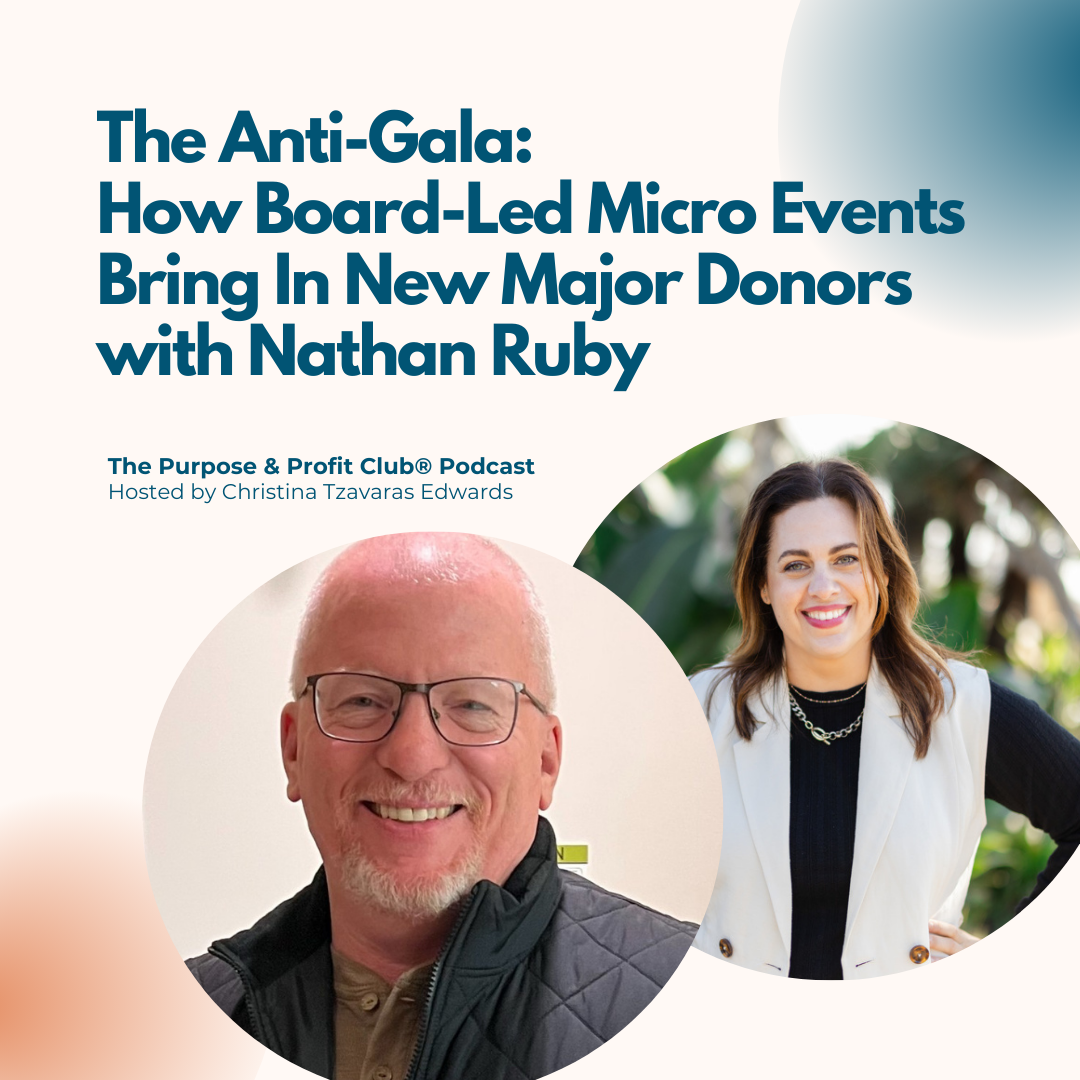
In this episode, I’m joined again by Nathan Ruby, Executive Director of Friends of the Children of Haiti (FOTCOH), who has spent more than twenty years raising major gifts, and doing it without relying on galas, grants, or flashy events. Instead, Nathan has built a deeply effective fundraising engine through micro events: small, relationship-centered gatherings hosted by board members and key volunteers.
Nathan walks us through the exact structure of these 45-minute “CPM events,” why they consistently attract the right donors, and how they eliminate the burnout, costs, and low ROI that plague traditional events. We talk about capacity-based invitations, board coaching, donor psychology, follow-up strategy, and why the biggest gifts usually happen after the event, not during. If you want a practical, high-impact, board-friendly strategy for securing major gifts in 2026 and beyond, this conversation will give you the blueprint.
Topics:
Why traditional galas are expensive, draining, and rarely profitable long-term
What micro events (CPMs) are, and why they outperform large events
How to structure a 45-minute micro event for maximum connection
Why small groups (even 2–3 couples) lead to stronger donor relationships
How to help board members invite the right people with capacity
The role of the ED in follow-up and major gift cultivation
How international or remote nonprofits can use micro events to expand nationally
Why fundraising is ultimately about relationships
It’s not your stories—it’s how you’re telling them. If your amazing work isn’t getting the attention (and donations) it deserves, it’s time for a messaging shift. The Brave Fundraiser’s Guide guide gives you 10 done-for-you donor prompts to make your message impossible to ignore. Get it for free here! https://christinaedwards.krtra.com/t/xKuLs6tOiPZa
Christina’s Favorite Takeaways:

“The more you get into major gifts, the more you'll understand and realize that it's all about the relationship.” Nathan
“The $10 gift that comes in the mail is just as important as a $50,000 gift; both those donors are valuable and are valued by us.” Nathan
“Start with one fundraising event.” Nathan
“Everything fundraising is about relationships.”
ABOUT Nathan:
As Executive Director of FOTCOH, Nathan is responsible for overseeing the organization’s work to bring hope and healthcare to more than 15,000 Haitians annually. He leads and supports the staff and volunteers to provide the best possible medical care and health education to the people FOTCOH serves. Nathan brings to his role more than twenty years of experience in leadership and fundraising with both domestic and international nonprofits. Throughout his career, Nathan has felt drawn toward health and nutrition-related organizations and has worked extensively in Sub-Saharan Africa and Latin America. He’s been actively involved with projects in Haiti since 2002. His favorite part of his job is getting to know FOTCOH’s donors and providing them with opportunities to live out their passion and purpose. Outside of work, Nathan enjoys spending time with his wife Missy, who works as a special education preschool teacher, and their three grown children.
Connect with Nathan:
Instagram: @fotcoh
Learn more from the previous episodes:
FREE Resources from Splendid Consulting:
How to Work with Christina and Splendid Consulting:
Easy Emails For Impact™ - Turn Your Inbox into an Income Stream
Donations on Demand: Build a $5K Email Campaign System in 30 min/week
Connect with Christina and Splendid Consulting:
-
*Links may be affiliate links which means I may earn a commission at no cost to you.
Christina Edwards 0:02
Welcome back to the purpose and profit club podcast. I am so excited. Nathan Ruby is back for part two of our conversation. We are digging into what I'm calling micro events. This has been a really successful strategy. He's the Executive Director of Friends of the children of Haiti FOTCOH. And we're going to dig into how you've used this strategy in your organization. So welcome back.
Nathan Ruby 0:24
Nathan, thank you. Thank you. It's awesome to be here. Glad, glad to share some time with you.
Christina Edwards 0:30
So you call them CPM events first. Let's like Level, Level kind of set, set, the foundations at the stage for what these events are. In my notes, I call them micro events, but I've spent a lot of time in the past several months really talking about how everyone needs to rethink the gala the like time, heavy expense, heavy labor, intensive signature event that ends up just dwindling down in profit and creates a lot of burnout For team. So this is like the antidote to that, because it does create connection and community with your organization, but also it creates new leads. So it's a lead generation event. So walk us through what it is.
Nathan Ruby 1:14
Okay, all right. Well, first of all, I'll give you my bias first, because you always, always have to listen to know somebody's bias when they're talking about anything. Really, my bias is I, I detest events, you know? I try to, I try. Would even go so far as to say I hate events with a passion. I don't like, the level of detail, and I think that's part of it, because I'm not a detailed person. I'm not even a 30,000 foot person. I'm a 50,000 foot person. And so events are especially big events, the galas, the golf outings, the whatever other big events,
Christina Edwards 1:58
five K's, the Yeah, yeah,
Nathan Ruby 2:01
to me. And again, this is my bias. To me, those are just opportunities to mess up and look bad in front of your constituency. Now, that's not fair. That's not That's not, you know, there's a place for, you know, events. It's just, it's just not me. It's just, it's not me. So, and my other bias is I'm a major gift guy. So my preferred fundraising, is either across the board table or across the kitchen table. That is the that is face to face, you know, digging in finding out what the donor wants to do with their charitable dollars, and figuring out how to MeSH. MeSH, not mash mesh. Our programs, the outputs, the outcomes that we're doing with donors, charitable intent, and putting them together. That's what I love to do. Okay, so our micro events, and there are micro events, and we call them micro events. These are designed CPM connection point meeting. That's what we call them. I kind of come up with a better name, connection point meeting sounds a little too we're gonna workshop it. I'm gonna workshop it after, yeah. I mean, who wants to go to a meeting? Nobody wants to go to a meeting. And so a connection, point blank, whatever it is, we come up with Christina. And they are designed for very small events, for four to five couples. So if you have the host, typically it's a host couple me, so that'd be three, or our board president, or you know somebody from the organization, so that'd be three. And then if you have you know, 10 people, five couples, that'd be 13 people. That's about Max. That's right, that is a that's a big group of people, and a lot these. So these, so they're designed for small, small, some of the best CPMs we've ever had had two couples come it is not, this is not about numbers. This is about connection. Hence, the first word in the name is connection. Yeah, that. It is about connecting with these new donors. And this is a, this is a tactic for getting into new major gift owners. That's how we use them. So, um, so then the kind of the flow of the evening is typically about 45 minutes. Sometimes they can be longer, but, but we we schedule out agenda out 45 minutes. So typically it's about 15 minutes, 10 to 15 minutes after the hour. Let's say it starts at seven. So typically by 7.10, 7.15, everybody is there. Sometimes not just did one in Texas. A couple of weeks ago, my wife got to go with me, which was awesome. And we didn't get started till 30 minutes after, because there was one one household that was going to be late. But we. Really, really wanted them there, so we just held everything up so but typically, by a quarter after things are ready to go, sometimes there is a meal, typically, not typically, it is a more of cheese and cracker and wine thing. It's more or Derby than sit down meal. So the so if we're starting at 7.15, about 15 minutes for people to kind of get their get their stuff, get their cheese, and find a place to sit, then the host does about 5 minutes of this is why this introduces me. This is why this organization is important to me. I love this organization. This is what it's meant to me. And then I do about 10 minutes. I try to keep it really short, vision, mission, a couple of the programs, what our outcomes are, a couple of stories, and get that in about 10 minutes. And then we do 10 to 15 minutes of Q and A. And because the organization I lead is in Haiti, we get a lot of questions about Haiti, and why is Haiti the way it is? And so, so I, I have gotten pretty good at weaving, okay? Haiti is the way it is because of this, this, this and this, and this is what it means for the people we serve. And so I can I weave that back in, but so 10 to 15 minutes of Q and A, and then that's it. That's the end of the formal, you know, schedule, okay? And then after that is basically how, you know, the one that we did in Texas a couple of weeks ago, they the couples all knew each other very well, and so they were, you know, some of them stayed another 45 minutes, maybe an hour, yeah, and just talking. And, you know, they were talking about, you know, whatever pickleball and vacations that they're going on and stuff like that. But every single person there came up to me afterwards, and then we talked about what was important to them, you know, their questions, yep, and so, so we had five households there. Then the other thing on these is, I do the follow up. The host will send a thank you. You know, thank you for coming. But then there, and we do not make an ask that night. It is that is we do not do that. Is all about being introduced ask that night, because the ask that I want to make is larger than what somebody would typically be inclined to do when they don't even know who I am. Got it these, get these, get major gifts. The more you get into major gifts, the more you'll understand and realize that it's all about the relationship. Yes. And if I have a donor who has the capacity to write a $10,000 check six months down the road versus writing a $300 check that night, I will forego the $300 to take the 10,006 months down the road 100% of the time. Yep. And so the follow up then is me, and I do that and that, and I make that up front with the host, so that they know they're not on the hook to most, most of your board members and and great volunteers would be willing to do this. Yeah, about 99.6% of them do not want to fundraise. They do not want to ask their friends for money. And so, stat, yeah. So when I'm so, when I asked them to do this, I know what their biggest fear is, and so I get through it, and then at the end I and they're like, and then I say, I'll do the follow up. I will do the ask if that, if I, if I think there is an ask to be made, I will do that. You do not have to do that. Or you just see the relief, yep, you know, their shoulders drop,
Christina Edwards 9:12
even the fact that you're saying, I was in Texas, you flew in town. You flew in town. You're like, I've got you, I've got you.
Nathan Ruby 9:18
Yes, yes, and I will go back the this particular one, the our host did a very good job of inviting, inviting people that were the right people, and I will fly halfway around the world for the right people. And this is, that's who that was, yeah. And so I flew down there, and I'd never even met these people, but my, my it was a board member, but my board member knew them very well. And so the board member invited them come to our house. You know, this is something that's passionate, that we're passionate about, that that we've have been, you know, invested in for several. Years, the executive director is coming to town, come to rouse. I want you to meet him. We're not making an ask. We just want you to find out something that we're excited about.
Christina Edwards 10:08
So I was in my notes, I have, what does the attendee think that they are attending? And you basically just said it, which is the board member the host is setting the stage. I care about this organization. I care about this cause. Come over there. She's even diffusing. It's not, I'm thinking of, like the old school Tupperware parties with it, which then got it, then got there was a, there was a jewelry company that then that was, like, the thing. It was like, come to our house and I'm gonna sell you a bunch of jewelry, and you have to buy jewelry. So they're different, longer burger baskets. Yes, you're not going to be asked. But come this is passionate to me, and I always say to my clients, listen, cat people. Hang out with cat people. So whatever you're interested in, you know somebody who is also interested in that. So like, if I was a board member of a cat rescue, you better believe I know five couples who are also like trap and release pros, and this is this would be true. I would note five cat people to invite would not be a problem for me.
Nathan Ruby 11:09
So, yeah, yeah. And I'm and to that point, I am deathly allergic to cats. I am around a cat, my throat literally goes and I can't breathe. That's how allergic I am to cats. So don't invite me to this.
Christina Edwards 11:25
You wouldn't come to my connection point meeting for the cat rescue, right? No. And so no, it really is a first. We talked about diffusing and set it diffusing and setting expectations for the attendees. What the heck am I attending? I love a few things that you said, it's not like, gosh, I'm going to be there for four hours, and people are going to be like, put out. It's a very low lift. It's snacks, charcuterie, it's at somebody's home. It's chill, it's fun. It's Thank you. It's fun. Then you also want to get who should attend, right? So that's so are you coaching your board members, or do they intuitively? I mean, I feel like your board members have been so well coached by you now that it probably is intuitive on who should be invited. And it's not just we need warm bodies in the house, correct?
Nathan Ruby 12:17
And we are, yes, they are. We have a sheet that we use where they understand, you know what we're looking for and and you're right. Our Our board is, it is the the best board I've ever worked with. They are exceptional.
Christina Edwards 12:33
that you have spent because I work with the organization closely. You have spent so much time coaching and building the capacity of your board. You have one of the most engaged boards I've seen, and the fact that you could have board members who are allergic to fundraising be like, Yes, I'm gonna invite people into my home who I know like and who are my friends and I trust you, but they see they care. So I know why they do it, like I know why. She was like, yes, come she cares so deeply about the people you serve in Haiti that she is just a vehicle.
Nathan Ruby 13:07
Yeah, she does. And when she did, there are 5 minutes where she was talking about the organization, she had to stop three times because she was starting to cry, I believe it. And, yeah, and you know you can't, you can't pay that, you know, you can't, you can't buy that that is so and that was genuine. And those donors saw that. And so they're like, Well, gosh, you know, I know, I know Julie. I respect Julie. And if this is, if she is that passionate about this, there must be something here that I need to listen to and so, but you know, for who we're inviting, you know, this is not about just getting, you know, breathing bodies into the room. Yeah, there's a time and a place for that. And every gift is, every gift is, is, is awesome. You know, you know, the $10 gift that comes in the mail that is just as important as a $50,000 gift that comes in the mail, both those, both those donors, are valuable and are are valued by us. But there's different strategies and different tactics for different outcomes and the strategy, the CPM strategy is about putting people with capacity, people who can write a, you know, $1,000 $5,000 50,000 $100,000 check, putting those people in the room and connecting with them on a one on one basis, and sharing what we do. And one of the one of the one of the pushbacks I get all the time from people that I asked to do this, because our board members are doing this, but I'm also asking some of our key volunteers and key donors to do this as well. And the very first thing you're going to get when you ask somebody to do that is, well, I don't know. Anybody with that at our capacity? Yep happens all the time, and my response to them is, I you probably do Yep, there's probably people with capacity to write a substantial check that live across the street from you. Thank you just you just don't know that's
Christina Edwards 15:20
who they are. Like not everyone has the flashy car. I've told the story to my clients before, my 20s, I used to bartend, and it was so much fun because I bartended at a concert venue that which means I got to see just so many live shows. And one of my favorite co workers was this other bartender. He was probably 15 years older than me. He had a family. He was like, part of me was like, oh, okay, you know, what's he doing here, right? And he loved, he loved the nightlife, he loved the concerts, he loved just working. And I figured he needed the money like I did. This was like, my job, right?
Nathan Ruby 15:54
Right? One day he would choose to bartend who would
Christina Edwards 15:56
one day, we decided we should carpool, because we lived in the same neighborhood, and so I picked him up at his multi million dollar house, and then I quickly learned he had a huge real estate portfolio. And yeah, he sometimes drives a rinky dink trunk and truck, and sometimes he walked to work, and I was like, Oh, this is fun for him. This is just an outlet for him. This is just Yeah, so you just cannot wait for the people with the fancy watch in the car and all that.
Nathan Ruby 16:25
One of my, one of my biggest donors I ever had, he, he walked in. We were meeting at Panera, and I had another donor was introducing us, and I had my back to the door, which I hardly ever do. I never sit with my back to the door, but this time, yeah, my donor had taken the other seat, so I had to sit with my back to the door, and he goes, Oh, here he comes. And so I turned around, and there was three sets of people coming in the door, husband, wife, two kids. I assumed it wasn't him. Guy in a suit, yep, and a guy in shorts, t shirt and a flip flop. Yep, flip flops. And I just assumed, you know, as a guy in the suit. So I turned around, I'm talking to my guy, you know, guy comes up stands by the table. I look up, it's the guy in T shirt, shorts and flip flops, one of the biggest donors I ever had, and that is all he wore. He just,
Christina Edwards 17:17
that's like, it's like, Adam Sandler chic. So, yes, yes, yeah,
Nathan Ruby 17:22
he had enough money that he didn't have to wear anything but shorts and flip flops. So anyway, so you never know, and, and so I, what I tell, what I tell donors is, or, you know, people that are going to do this is Pick, pick four or five. If you want four or five to show up, you're gonna have to invite, you know, 10 or 15 great because of people's schedules and stuff like that. But you know, if you want four or five couple, just go to the people that you respect, go to the people that you think would be the most likely to be excited about what we're doing and, you know, and if they turn if we invite them, and it turns out that their max gift is a $500 gift, it's okay, it's okay. We're not going to get caught up on that. Yes, it's kind of like in the last episode we did Christina. We're talking about major gifts. And I made the comment, the only bad gift is, or the only bad ask is the one that you don't make. This is the same thing. If you, if you, if you put five people in the room, and you know, if they only can write a $500 check, oh, that's 2500 bucks. And that's better than if we didn't do it at all.
Christina Edwards 18:38
Right, yep. And this answers a few things. So your organization is is international. Your board members are all over the country. For I for similar setup organizations, I would hear a lot of pushback, of like, it's so hard to get new donors because we're not local, we're not community based, we're all across the country. And so Okay, well, what do we want to do about that? Right? And this is one of the best ways to do it. We don't need the big gala for everybody to fly into one central. We don't need that at all. This is such a low lift, low expense way to bring in new donors into your organization. I just love it. I think there's so much,
Nathan Ruby 19:19
yeah, and you look at the you probably know this off the top of my head, and I forget what it is. But what are the what are the second gift rates? They're horrible. You know, you get a new donor.
Christina Edwards 19:30
It's, it's depending on where you look. On the high end, it says eight out of 10 donors only give once. So churn is big. Churn is big, yeah.
Nathan Ruby 19:39
So if you, if you have a gala, you put 400 people in the seats, you have 100 people that are not gonna you have 100 people. That's first time they've been there. They came with somebody. So there's 100 new people. Let's just, well, for easy math, let's say all 100 of them make a gift that year. Sure, or they're on the spot. Well. Okay, well, we know, out of those 100, you know, 80 to 90 of them are never going to make another gift again. So you've got, maybe you net 10 new donors
Christina Edwards 20:09
filling a leaky bucket, but in a way that takes you six months to fill, because the planning and the catering and the flowers and who's going to emcee and what linens are we going to have? I mean, you and I have this is another thing we have in common. So previous to this, I had an agency, and I remember we did one event, and after that one event, I said, take it off the website. I'm never doing that again. They are a beast. They are a beast. They are and here's what I tell my clients, I will happily attend your event like I'm not right. Anti get together. I love a get together. But I think that that for me, the low lift get togethers. There's so much there. There's so much there. The backyard barbecue, the in person, come have a cocktail and some some appetizers, and hear, hear about a meaningful cause that's meaningful to me, and how you could potentially
Nathan Ruby 21:03
get involved. And now me, me as the executive director, I am in personal connection with these people. Yep. Now it's obviously early in the process, but it but it's well, the I, we did CPMs three years ago that are now some of our best owners and and so I, instead of, instead of getting 10 donors who gave, you know, a $25 check at an event that I may or may not ever get to talk to, these are, these are people that I have their emails. I have their phone numbers. They've met me. In the case of the Texas thing, they met my wife, and people like her better, and they like me. And you know it. So there's that we are. We are in a relationship, you know. And the chance of them sticking, it's not 100% but I bet it's about 90% of these, yeah, yeah. And so you look at the five year organizations will say, Oh, I don't want to spend the money to buy a plane ticket to go to Texas. Well, if you take the five year value of those donors, you stretch that out of what it could be, plane tickets, nothing, it's nothing.
Christina Edwards 22:16
The plane ticket's a bargain for the value of that donor to your organization. And then we also think about the ripple effect. If you bring in five major donors from that, the value there, and then they go and host a few of these ultimately, like, that's how you grow. That's how you do it from your laptop, virtually. And I think the other key here is you made it low lift for your host. So yes, they didn't have to do the hard part you took care of, like that hard part, which is the asking and the follow up. But also, that's your zone, right?
Nathan Ruby 22:51
It's what I it's what I do. And if you're the executive director, that's what you do. That's what you get paid to do, because nobody else can do that. But you, even if you have a fundraising person, it's still your job to be doing that. And and we make it really easy the, you know, we have a draft invitation, and, you know, it's amazing. And you know, you come from the communications world, and so it's so hard to look at a blank piece of paper and say, Well, what am I? What am I? How am I going to do this versus you have a you have a template, you know, you have this invitation. I know it's amazing how it's like, well, I don't know what to send for an invitation, so I send them that, and they're like, marking it all up. And it's like, because it just, you know, it they had something to look at, and then their brain clicked and they, you know, they made it themselves.
Christina Edwards 23:38
Oh, that's so good. Any other final thoughts about these events? How many do you suggest doing a year? Or how are you thinking about them going
Nathan Ruby 23:49
I would, I would start with one to do one.
Nathan Ruby 23:57
I am for 2000 as we go into 2026 I will probably 15. Wow, is my goal. That's awesome. Now we've been, we've been doing for a while, right, right, right. And it was, it was not when I brought these up at the board meeting the first time, said, Hey, we're going to be doing these. And I actually had, actually have one of my board members is actually a high end fundraiser, major gift fundraiser, for a big hospital out in the East Coast and and so I had him do it, because he uses this strategy for him too. And so it was a little better received, because it was a peer, it was a board member saying, Listen, we need to do this. And so that is that that helped, but I still got blank looks from the board table. And like I said earlier, you know, we have a very good board, yeah. So, you know, this is a little bit of comfort zone for some people, so don't expect. To be like a you know, everybody raising their hands and say, who you know, like horsehack. You know, pick me first. Those of you that watched Welcome back Cotter in the day, Christina has given me a blank look there. YouTube, it ed. So what I would do, here's my suggestion, is pick out the most likely person to do this, whether it's a board member or volunteer, seek them out. Don't do it in the middle of a board meeting. Sit down with them to lay out the strategy. This is what we want to do. This is this is the impact I think it's going to make. And I need somebody to lead to do this first. Can you be that person? Will you do that for me? And that's how I would suggest you get it started. And if you need more help and you get stuck, call me. You know, call Christina. She'll connect us. I'm happy to help you. And you know, kind of just give you some, you know, to your particular situation. Happy to do that.
Christina Edwards 25:55
I think this is such a unused, like untapped strategy for so many organizations. So thank you. Thank you for taking the time to explain it to us and make it to me. I'm just like, this is a few hours of work for the board member. This is so much more of a low lift anything we ask them, and kind
Nathan Ruby 26:16
of, it's very and it's no work for you, the executive director, they're just giving you other than the follow up,
Christina Edwards 26:21
because you already have to, this is part of your job, so now they're giving you the great leads to and
Nathan Ruby 26:26
it's not, it's not even cold, you're not cold calling. These are people you've already met, you've already experienced, you know, you've already had a glass of wine with them, and you've told your stories, and you know them. That's right, these are people now, you know, I mean, how easy is that?
Christina Edwards 26:40
So much easier. Yeah. Thank you absolutely much. Any final words of wisdom as we wrap up today,
Nathan Ruby 26:48
everything fundraising is about relationship. Whether you're writing a letter or sending a newsletter or doing a social media post or sitting down face to face, it, is all about relationship. The deeper the relationship, the bigger the gift is going to be.
Christina Edwards 27:06
I love that. Yes. Thank you so much. We will link to your LinkedIn so everyone can connect with you. There anywhere else you want to shout out before we wrap
Nathan Ruby 27:15
up, not LinkedIn. LinkedIn is great. That's good place to get
Christina Edwards 27:19
me. Thank you so much. We'll see you next time. Nathan, right.