Ep. 175: Fear & Fundraising: How to Make Major Gift Asks That Don’t Scare You with Nathan Ruby
EPISODE 175
Fear & Fundraising: How to Make Major Gift Asks That Don’t Scare You with Nathan Ruby
About the Episode:
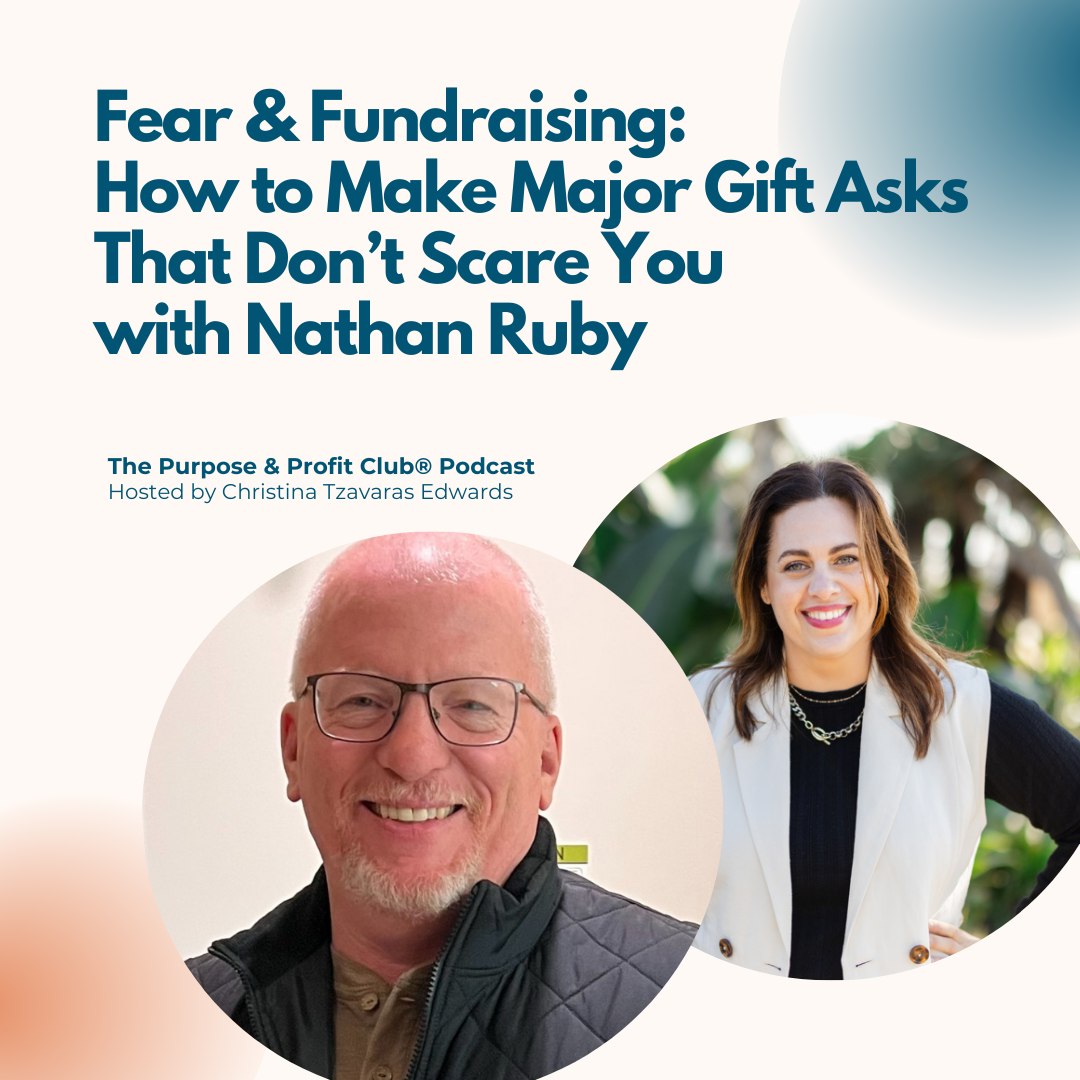
Major gift fundraising is where many nonprofit leaders freeze, but not because they lack passion or skill. The fear lives in the body, the brain, and the stories we tell ourselves long before we walk into the room.
In this episode, I’m joined by Nathan Ruby, Executive Director of FOTCOH (Friends of the Children of Haiti), one of the rare EDs who has raised millions of dollars from individual donors, not foundations. Nathan brings 20+ years of experience in major gifts, donor psychology, cross-cultural fundraising, and what it actually takes to have confident, courageous donor conversations. Together, we discuss the neuroscience behind fear and rejection, how imposter syndrome shows up during big asks, why culturally we struggle to talk about money, and why donors actually want us to be honest and direct. If you struggle with fear, freezing, or overthinking around major gift asks, this conversation will change how you fundraise forever.
Topics:
Why major gift fear is not a personality flaw, it’s neuroscience
How to reframe donor conversations by focusing on the people you serve
Why donors are used to talking about money (and why you don't need to be scared)
The science behind rejection and why “no” activates the same regions as physical pain
Nathan’s background in sales and how it shaped his fearless fundraising mindset
How to use donor questions to inform the right ask amount
Why genuine honesty is more magnetic than a perfect pitch
Why your donors want you to win and how to invite them into partnership
It’s not your stories—it’s how you’re telling them. If your amazing work isn’t getting the attention (and donations) it deserves, it’s time for a messaging shift. The Brave Fundraiser’s Guide guide gives you 10 done-for-you donor prompts to make your message impossible to ignore. Get it for free here! https://christinaedwards.krtra.com/t/xKuLs6tOiPZa
Christina’s Favorite Takeaways:

“Social rejection activates the same regions of the brain as physical pain.” Nathan
“If you close a cold call sale, you feel like you can do anything, and you also feel like you can get through the rejection loop a lot faster.” Christina
“70% of professionals experience imposter feelings.” The Journal of Behavioral Science
“When you're face-to-face with donors, the more passion you have, the more excitement you have that comes out to donors; it feels magnetic.” Nathan
“It's not about you, it's about the people you serve.” Nathan
“When it comes to the taboo of talking about money, you just have to get over it. So you've to put your glasses on the lens of your donor and how they view money, not how you view money.” Nathan
“Your donor wants you to win. If they weren't interested in your organization and what you do, you wouldn't be sitting down with them.” Nathan
“The traditional major gift process is identification, qualification, cultivation, ask, and stewardship.” Nathan
“If you call your donor, they see your name pop up on their phone and they answer it - that's a relationship.” Nathan
“If you have a strong relationship with your donor, it is that you can mess up the ask, you could fumble, you could say it all the words backwards, and it will not make any difference.” Nathan
“The only bad ask is the one that you don’t make.”
ABOUT Nathan:
As Executive Director of FOTCOH, Nathan is responsible for overseeing the organization’s work to bring hope and healthcare to more than 15,000 Haitians annually. He leads and supports the staff and volunteers to provide the best possible medical care and health education to the people FOTCOH serves. Nathan brings to his role more than twenty years of experience in leadership and fundraising with both domestic and international nonprofits. Throughout his career, Nathan has felt drawn toward health and nutrition-related organizations and has worked extensively in Sub-Saharan Africa and Latin America. He’s been actively involved with projects in Haiti since 2002. His favorite part of his job is getting to know FOTCOH’s donors and providing them with opportunities to live out their passion and purpose. Outside of work, Nathan enjoys spending time with his wife Missy, who works as a special education preschool teacher, and their three grown children.
Connect with Nathan:
Instagram: @fotcoh
FREE Resources from Splendid Consulting:
How to Work with Christina and Splendid Consulting:
Easy Emails For Impact™ - Turn Your Inbox into an Income Stream
Donations on Demand: Build a $5K Email Campaign System in 30 min/week
Connect with Christina and Splendid Consulting:
-
*Links may be affiliate links which means I may earn a commission at no cost to you.
Christina Edwards 0:02
Welcome back to the podcast. We have a very special guest today. I have worked with and been friends with, and just swapped stories with, Nathan Ruby. He is the executive director of FOTCOH Friends of the children of Haiti for many, many years. He's also an expert fundraising consultant. So we're going to dig into I feel like you have seen it all. Nathan, and so I wanted to have this conversation about what happens around fundraising, those big bold asks, what's happening in the body, the brain, those major donor conversations, and how we can make them feel easier and a little less intimidating. And when I knew I wanted to talk about this, I knew you were the one, because you have done this, you have you are in these shoes, day in, day out, and I'm so happy you're here. So I'll let you say hello. Welcome back to the podcast and tell us what you've been up to.
Nathan Ruby 0:50
Well, thanks, Christina, and I love being on your show. It's so much fun to get to hang out with you and you know you are still one of the best, not one of, probably the best communications, fundraising comms contractor, person that I've ever worked with, because you understand communications, and you understand fundraising, and you understand how nonprofits function, and it's very rare to get somebody that has all of that left brain, right brain. So I love you. I love working with you, and I'm glad to be here today. And you know what's going on? You know, with with with Friends of the children of Haiti, which will probably refer to as FOTCOH, the rest of the show. You know what we're we're just like, it's time of the year. It's is tis the season. And so we're out there talking to donors and getting our direct mail pieces out and on time, I might add, not late. Thank you, Christina for that, but yeah, so we're all fundraising. We're like most organizations, I think in the last eight weeks of the year, about 38% of our revenue comes rolling in. So it's a it's a critical time of year.
Christina Edwards 2:08
I remember a few months ago, I think I whatsapped you, and I was talking about this, this topic, the fear and asks. And you said, in your own way, I that you don't really have that. And I think that you've really walked your entire career in these shoes of, you know, having these conversations with donors who, you know, have the capacity, maybe donors who you're upgrading, who are already giving a very generous amount, and having those upgrade conversations, let's kind of anchor into where you were before you got to be confident and courageous in your fundraising. Some of the science of what you're finding that other fundraisers are dealing with, where they're really avoidant or feel that tension in the ask, yeah,
Nathan Ruby 2:55
you know, I am. I don't know if odds the right word. Maybe atypical. If you ask my my adult, grown children, they'll tell you, I'm odd. But I did not come up the the typical Executive Director chain of command. Typically executive directors come up through the program side of the equation, or often I did not. I came through the fundraising side, and so I started my career as a fundraiser. But before I was before I was a fundraiser, I was in sales. And my my family owned a trucking business, and so I've got plenty of miles behind the wheel of a semi, but I also ran the sales department, and so that was my primary role. And so that's, that was my background. And so talking to people a little bit of my personality, I am an extrovert, and so that helps. You don't have to be an extrovert to be successful at major gift fundraising. You just you don't, don't, don't, don't even get for a second that you have to be extroverted. I've seen some of the best, most successful, major gift fundraisers I've ever seen are introverts and so but I think it was always been easy for me to talk to people. Sometimes I have to be careful, because I could get to where I'm dominating the conversation. It's early in my career. That's probably some of the mistakes I made. I talked too much and didn't listen enough, but I figured out how to how to get around that with some coaching and some training. So yeah, I and early on, I never, I never. Was afraid of people telling me no. You know you hear no all the time. And there's actually a science behind that that the other fear of the fear of rejection. There's neuroscience that shows that social rejection and. Actually activates the same regions of the brain as physical pain, and it's particularly in the anterior. I'm not medical so cingulate cortex. I don't know if I'm pronouncing that right or not, but that means when we're thinking about, you know, like, Oh, we got to go see this donor, and what am I going to do if they say no, or they're probably gonna say no. When you're thinking that that's the same, the part of your brain is lighting up. That is the same part as when you're physically hurt, you know, when you're experiencing pain. So if you usually, when I make a reference of, you know, something I don't want to do, it's like, you know, I'd rather have a root canal, then, then do that. So when, when you're thinking about, you know, going to a donor, and if they say no, and the same part of your brain lights up as I have to go get a root canal, of course, you're going to feel anxious and upset and nervous about making that ask, because that's the part of your brain that's lit up.
Christina Edwards 6:00
So I love that you brought in your background in sales. I You know the saying, like everyone should work in the service industry once every once, or should at least wait tables once. I think everyone yes to that, and I think everyone should be in sales. Because that is also, I think what gave me the foundation of just being totally fine with rejection, is I there was even a part in my career where I was cold calling, and it just cold calling, cold calling, close a cold call sale, which I did, like, you feel like you can do anything, and you also just feel like you can, you can get through the rejection loop a lot faster, a lot faster. So let's dig into imposter syndrome. Let's dig into what that looks like. I think a lot of people you sort of you said you went from sales to fundraising, but a lot of people, and I've noticed this too, go from programs to fundraising, and I they're so deep and entrenched in the program. They they get it, their heart is there. And this is a completely other skill. And so the imposter syndrome really does take the lead sometimes.
Nathan Ruby 7:05
Yeah, yeah, yeah, absolutely. And, and there's science in that also. And I don't know, I know you've done some, some episodes on this, and you, you've got some good experience with this.
Nathan Ruby 7:32
you know, actually, Christina, there's some science behind that, and research from the Journal of Behavioral Science, something I read all the time, Christina found that up to 70% of professionals experience imposter feelings. And for those of you that don't know imposter feelings or imposter syndrome, it's a belief that you don't deserve the role that you're in or the success. And what they found in this research is that when you go into stressful situations like like a major gift to ask or talking to a major donor that actually spikes. And so it's even, it's even more acute. It's more you feel it more when you're coming under these stressful situations. And you know, the crazy thing about that is my and again, I just, I'm that's just, that's not something that I, I've, I've really ever experienced, but I do see it a lot through my wife. My wife is a 35 year teacher. She has her whole career has been with life skills. So teaching life skills to first and second graders, and you know, she, she will have classes that have that are lower than others. You know, some years the kids are lower, sometimes they're a little higher, but constantly she will come home and say, I, I, I'm a horrible teacher. I'm these kids aren't learning anything. And then you talk to the to the teaching assistants that's in their room, and they're like, Oh my gosh. You know, this kid did this, and this kid did this, this kid did Yes, and it's like, what, what are you talking about? And, and it's so that is real, and, and, you know, people, I think, high, high feeling, which a lot of people coming up through the programs, they're they are very sensitive. They're very aware of feelings. They're very aware of that. I think they're probably more susceptible to that.
Christina Edwards 9:44
That's a really good point. It's that sort of Empath, deeply emotional energy, yeah, that's a good
Nathan Ruby 9:50
yep, yep, yep. And so I think one of the things that you could do about that, to help with that, is to take the focus off of you, and. As you are going in and you're talking to these donors, it really, it. You don't have to pretend this. It's actually real. It's really not about you. It's not about what you're doing or your leadership or what you're bringing the table. The focus has got to be, and should be, on the people you serve, and you are going on their behalf, and so for a lot of people, if they are, they, I have seen some of the most introverted, quiet, fearful executive directors make massive asks on on donors, when they finally get it that they are asking for the people they serve. And and just like they get up, you know, and they they go to work, and they and they work and they fight hard every day to serve these people, making a major gift ask. It's the same thing. It's the same thing as going to work at doing the program, you know, doing the things that you love, for the people that that you are are deeply moved to help fundraising. It's just, it's just the same thing. It's just, it's just something a little different. So you go into that, into that meeting, into that ask meeting, with the understanding and the mindset of, I am doing this to help these people who desperately need to help. It's not, it's not about me and that that will help a lot of people kind of get over that in imposter syndrome.
Christina Edwards 11:30
Sometimes I will just to, like, diffuse the pressure. If I have a client who's really stuck in what I would describe as the before, where you just said they're like, It's really heavy. I'm like, You're not asking for 10 grand to go spend in Vegas. Like you're not taking the money to go to Vegas for the weekend. In a lot of ways, this doesn't have anything to do with you, right? It's over here, the people you serve as a pattern interrupt. I'll give them that. So sometimes that's helpful. So I think what you just said is exactly that is staying on the people you serve can help take you and the pressure of you being central and about it
Nathan Ruby 12:09
Yeah, and I and the more deeply you are, the more deeply your convictions are for the organization You serve and the people ultimately that you serve, the better that is for fundraising and that will, I mean, if you're, if you're looking for a $20 gift and you're sending a letter, okay, you can write that emotion. You can write that, that intense feeling for the people that you're serving. You can, you can communicate that through the written word, but when you get into a major gift situation where you're face to face with donors, the more, the more passion you have, the more excitement you have that comes out to donors. Magnetic. Yeah, it is. And so I think that's, you know, every executive director has their their strengths and weaknesses, and so that's just playing to your strength, if you're if your strength is is making an emotional connection of between the output that you do, the outcomes, not the output, the outcomes of your organization, and then telling that story to your donor, that could be a powerful ask. And then you just got to tack on a couple of sentences on the end, and you got it and and so I think by focusing on that, that that just wipes out that whole imposter thing, because you know what you're doing, and you're playing to your strengths, so that could make it a pleasant experience instead of an awful one.
Christina Edwards 13:37
So the next thing that this sort of parlays perfectly into is this idea of just culturally, we don't talk about money. We don't talk about, not really, how much people make we have. We just project everything is a projection. So imagine you see your maybe somebody you went to college with, you haven't seen them in a while, and they you're meeting them at for dinner, and they roll up with a really fancy car, right? All of the thoughts we have, great, they make more money than me. Oh, they must have it so good. We have no idea about their debt. We have no idea about anything. Everything is just a projection. And so we have all this like cultural discomfort about money, and then we plunk people into a role where their job is to ask people for the most money. How do you reconcile it? How have you dealt with it? And then the other piece is just like, and then we're supposed to ask them again and again and again, let's talk about it.
Nathan Ruby 14:31
Yeah, that. That's awesome. This is an awesome topic. And the answer to that one about your when you went back to your reunion and, you know, the one of somebody rolled up in a in a brand new, you know, expensive car, just to let you know that that was rental
Christina Edwards 14:45
that Exactly, exactly, it's all Exactly. Thank you. Thank you for that.
Nathan Ruby 14:50
Yeah, for sure, there's, there's no doubt about that, you know, and I think that it's how, how were you, how was money talked about in your house? Growing up and and whatever that is, whether that was a positive thing or a negative thing. And my dad was an entrepreneur my entire life. My dad's owned his own business, and so money, when I was growing up, money was, you know, at the at the dinner table, we talked about investment and cash flow and expenses and profit and profit per square foot. My dad was a car dealer
Christina Edwards 15:29
that was very unique. Yeah, yeah, yeah. Because I, I think you and I are the outlier. My dad did the same thing. I don't know if we know this about each other, but yeah, my dad is He is also an entrepreneur. I remember he told me he would tell me these numbers, how much he needed to make in an auction, how much it cost him a day to pay every like. And on one hand, that could be like a lot for a high school or a junior higher, you know, teenager, but on the other hand, it was a peek into talking about money and not a taboo way. So I appreciate it. So we're,
Nathan Ruby 16:00
yeah, as a fifth grader, I couldn't, I couldn't do I couldn't. I got a C - in math, but I could calculate burn rate. Yes, there we go. You know, I could do the math of the important things, right? Don't ask me to build a bridge, because my geometry is way off, but and so it's yeah. So as adults, we bring that into our preconceived ideas and our our preconceived answers for what we think our donors are going to do or say before we even walk into the room, and we, we have this baggage, and, you know, I think people of wealth, and you know, we're talking major gifts here. So typically, you're talking to people that have acquired some level of wealth. You know, it might be for your organization. It might be $1,000 as a major gift for your organization. It might be $50,000 whatever it is. It doesn't make any difference. Doesn't make any difference. It's still relevant. Yeah. And so people that have that level of wealth, they did not acquire that without talking about finances and talking about money and having conversations, you know, even, even if they inherited it, which most people who have wealth, some inherited it, but most people that you were talking to did not. They had a hand in creating that, and so they didn't get there by ignoring this. They are very they are very normalized in having financial conversations, and the only person who is nervous or feels odd or feels feels angst is you. You know the donors that you're talking to, or not. And so I think you have to walk into there and say, they, they know what you're coming for. You know, if you're the executive director of a nonprofit, and you have asked them for a visit, they and they've said yes, they know that sooner or later, you're going to ask for a gift. It maybe it's maybe it's this meeting, maybe it's not this meeting, but they know it's coming, and so you don't have to feel anxious or upset, if the person you're talking to is not anxious or upset. And I think another piece of that is also the when you're talking to your donors, you look at the ratio between what you want to ask them to do and their top range gift. So, if, if, if somebody's top range gift is $100,000 gift, and you're going to ask them for $1,000 well, okay, there's not a lot of, there's not a lot of stress there. Because, you know, they're gonna, they're gonna make that $1,000 gift, you know, kind of like, you know, Christina, you and I might make $100 gift or a $50 gift. It's like, if you ask me, I'll, if any, I hope my neighbors aren't listening. If any kid comes to the door, you know, and is selling candy, I will buy, yep, 25 to 50 bucks worth, just because they had, you know, just because they're out there, they're knocking on the door. My kids did it. You know, 20 years ago, 25 years ago. You know, my kids are in the neighborhood doing it. I'm happy to do that. So, so if you're, if you have $100,000 donor and you're asking for 1000 Good lord, there's no, there's no pressure there, yep. Now, if you have $100,000 donor and you're gonna ask for 95,000 or 105,000 Okay, okay, you know, maybe there's, maybe there's a little stress there, but then we go back to the, you know, it's not about you, it's about the it's about the people you serve. And so that bounces back and forth, but your your donors are very willing. It is amazing. Christina, and in my experience. It's in the times that I've done this, what people will tell you, if you just ask them, yeah, I will. I have donors. One of the things that I use for, for how much should I ask for, is, what are their other what are the other organizations that they're that they're giving to? Well, how do you find that out? Well, you ask and you just say, hey, you know, what are the what are the other, you know, top three organizations that you, that you fund, besides us, never, ever have I had a donor not give me that information. Now, would they have given it to me if I hadn't asked? No, no, they wouldn't have. But I asked, and they and they answered, and then I'll do the next thing. The next follow up is, well, we're, we're we, are we, like number one? Are we number five? And they'll and they'll tell you, and so it's so if you're, if you're number three on the list, and you went online and you found out that they made $100,000 gift there to their alma mater, and you're number three on the list. Okay, well, you know, maybe I, you know, maybe 50 is the right, the right ask, but, but I could, I could go in with a little bit more confidence, because I know I'm in the top five. I know they love us. I know what they've given in the past. I'm going to ask them to bounce it up. You know, 10% 5% 20% whatever it is. And so I just, when it comes to the taboo of talking about money, I think you just got to get over it and know that, hey, if, if you haven't had a good relationship with money in the past, you know, I get it that that's, that's part of it, but we're it's your donor that you're focused on, not you. And so you've got to put yourself, your your your glasses on the lens of your donor and how they view view money. Yep, not how you view money.
Christina Edwards 21:52
So you said a couple of smart, really smart things, which is somebody who has that higher capacity, that higher net worth, they're talking about money regularly. Oh, right. Number one, let's just level set that like they're having meetings with their financial advisor. They're they're making a statement, like money is something that is not taboo for them. So you bringing up money to them is totally fine. You're asking about the weather, right? Yes. And the other thing is that you said that was so smart. Was this idea of like you're not supposed to be a mind reader. The only reason you'll help, you'll be informed to know how much to ask is because you ask them questions, yeah, and ask great questions. People will give you answers, and those answers will help inform your ask
Nathan Ruby 22:39
your Absolutely. Okay, absolutely. I have asked donors before. I've literally asked, How much should I ask you for?
Christina Edwards 22:48
Oh, I love that. That's a very you and I style. So it's like, that's your style. I love that. That's your personality. How much should I ask you for?
Nathan Ruby 22:55
I love that. I I've also got myself caught a couple of times in that because I've said, I've said it many times to donors, especially, don't, I don't know as well. I think I'm ready for an ask, but I don't know them quite as well as you know the donors I've worked with for 10 years. And I'll, I said to one donor, you know, you know, we were getting done with the conversation. The visit was over. And I said, Hey, and this is I do this all time to donors. I said, Hey, next time we get together, I'd like to come back. I was in I was working out of Chicago. Donor was in Minneapolis, so wasn't like I could just drive down the street. I said, Hey, I'm gonna be back in Minneapolis in a couple months, in August. I think it was I want to get together again, and when I do, I'm going to have a I'm going to have a proposal with me to to ask is that, would that be okay? And he goes, Well, how much you're going to ask me for? And I said, I don't know. I and I'm like, my brain's like, I backed myself into a corner here. I said, I don't know. And I said, What do you think? And he goes, I asked, literally, he said, I asked you first. And I said, I probably in the 10,000 range. And he goes, okay. And so anyway, so, long story short, we, you know, August comes, I go back. I didn't, I did. I had other donors to see, but I built the trip around him. I got him nailed down, First Date Time wise, and then I feel backfilled around him. And the mistake that I made was we, we sat down at the restaurant. The first thing he did is handed me an envelope, and I put the envelope in my pocket. I didn't look at it. We finished the thing, I made the ask, and we got done. And anyway, the check, he'd given me the check at the beginning of the meeting, there was a $10,000 check I missed. I didn't ask for enough. He would have given more. And later on, he did. He did give more later on, but, but the point is, is I just I asked him, and you could get away with that if you're genuine about it, and you know you are. There are people out there. Bruce box and was one of my early mentors, taught me how to do from a fundraising standpoint, and he's major gift guy at Mayo's now. And the guy's a master. He is awesome. And I guarantee you that if, if, if Bruce comes to your donor, they're writing him a check. Yeah, it's Mayo Clinic. He knows exactly what to do. He is really good. Now, not everybody's that way, but what you have to be is you have to be genuine, yep. And if you genuine, will trump experience every day of the week and twice on Sunday, yep. So if you go in and you you genuinely are, interact with your donor and say, you know, Mr. And Mrs. Donor, I don't really know. I really, you know, I'm the executive director of this organization. You know, you love us. You've done such a great job of funding us. You made such a huge impact in the past. I really, you know, it's my job to ask people for money, and I really want to make a meaningful ask, but I have no idea what to ask you for. What what range Do you would be a good range for me to ask you can literally say that and and your donors will answer that. They will help you. You're all right. I'm getting one
Christina Edwards 26:39
honesty again, that honesty is so magnetic. Yeah, people and see how much you
Nathan Ruby 26:45
care and your donor wants you to win. It's not adversarial. It's not a zero sum game. It's not I win, you lose. You win, I lose. That's not it. They want you to win, because if they weren't interested in your organization, and what you do, you wouldn't be sitting down with them. That's right. Nobody, nobody is going to see you face to face to tell you no, that's now, anyway, so yeah, so you've got to you, you, you've got to get in there. You just ask questions, and they will the donor will help lead you home to the right ask at the right time for the right amount.
Christina Edwards 27:26
That's so good. So that was my next question, which is, really, I think we do put a lot of pressure on the ask. We do put a lot of pressure on the meeting. We put a lot of pressure on on nailing the right amount. A couple things you said, which is, with the example, with the $10,000 donor, you realized crap could have gotten more. Yeah, so I know you you got more at a later date. It wasn't over, right? So it wasn't over. So there's that piece. And what are you finding, too, that people think it's all about this ask meeting versus the relationship meeting, which we started to talk about earlier. Let's, let's dig into that a little more.
Nathan Ruby 28:06
Yeah. So you know the the traditional major gift process is identification, qualification, cultivation, ask, stewardship. I was taught that in 1997 when I started fundraising, still true today. They call it different names, you know, consultants come up with, you know, fancy new names for old stuff, and then they charge you more for it. Not not not us, not us, never other No, no, no. Other people do that. And so the so if you do that process right, and especially in the cultivation area where you are building a relationship, you are asking questions, you know, you kind of have a sense of what dollar amount to ask for, you know, what they're excited about. You know, I always use my The best example I ever have on this is a symphony. You know, it's lots of different things in the symphony, there's trumpets and there's violins and cellos and flutes and percussion. There's all these different things. And so if you're, if your donors, interested in the trumpets, I play trumpet in high school, so everybody's interested in trumpets. That's just a fact, sorry. Flute players. And so if your donor is interested in the trumpets, talk to them about the trumpets. Don't talk to them about the saxophones. They don't care about the saxophones. Talk about the trumpets. And so you know what that is? You know what their hot button is? You know, the nonprofit world that'd be just, you know, whatever program they're most excited about that's what you talk about. How do you find that out? You ask them, Mr. Mr. Donor, of all the things that we do, what is it that excites you the most? Duh. It's not that hard. And so when you when you have that down, you you know what to ask for, how much to ask for. You know, if there's any like, you know, they've got their granddaughter just got accepted to Harvard, and they're, they're paying for it, okay, probably not the best time to ask for a big, major gift. They just sold their their business for $100 million and had no debt. Okay, probably a good time to ask. So, you know, you know those things. And if you've built the relationship even to even, even at any level at all. And when I say, built the relationship, if you will call, if you call them, they see their your name pop up on their phone and they answer it. That's a relationship, because if you call me and your name doesn't pop up on the phone, no way in heck I'm answering that phone. And Part A lot of the times, if your name does pop up on my phone, I'm not answering that anyway. You know, there's a handful of people that I will no matter what you know, a lot of them are donors. You know, my wife, my kids, you know, et cetera. So if they answer that phone, that's a relationship. If you've got that, the actual ask is, is it? Is it goes back to the back to the money taboo thing. If you're making an ask, it is it is a at that point, they are making a financial decision in their head. They've already had to have made the decision in their heart that this is an organization I love. This is the program I love. This is where I want to make an impact. That's their heart, that's their emotions. But then when you make the ask, then it goes up to their head, and it becomes a business decision. It's a, it's a that's where the head gets involved, and so but, but that part of it is the smallest part of it. Everything else is the relationship and the emotional side of it. So if you, if you have a strong relationship with your donor, it is that you can mess up the ask, you could fumble, you could say it all the words backwards, and it will not make any difference. It won't. It's just, you just got to get it out. And, you know, even if you write it on a piece of paper and let them read it, that'd be, you know, that'd be better than nothing. But, yeah, don't over. Don't underestimate the level of the relationship. And that trumps how you do the ask.
Christina Edwards 32:19
Oh my gosh, that was so good ask imperfectly. The point is Ask, ask. Point is ask. This has been like a master class on fundraising, major donor conversations, those relationships. Thank you so much. Any final thoughts before we wrap up today?
Nathan Ruby 32:36
You know the only, the only bad ask is the one that you don't make.
Christina Edwards 32:41
Here we go. Mic drop. Love it. Thank you so much. We will have you back in just a few weeks. We're going to be talking about donor micro events that you have just been so successful in cultivating. So stay tuned for we're hitting it just a few weeks. We're hitting it out of the park. And where can we get in touch with you? Where can we find you?
Nathan Ruby 33:02
You can find me at,
Christina Edwards 33:06
should we link to it in the show notes? Yes, yes, your LinkedIn. Is that the best place to find you? Yeah, that'd be great. All right. Thank you so much. Nathan, bye.