Ep. 200: Live Panel from GiveCon: The Advice We Don't Put on Slides
EPISODE 200
Live Panel from GiveCon: The Advice We Don't Put on Slides
About the Episode:
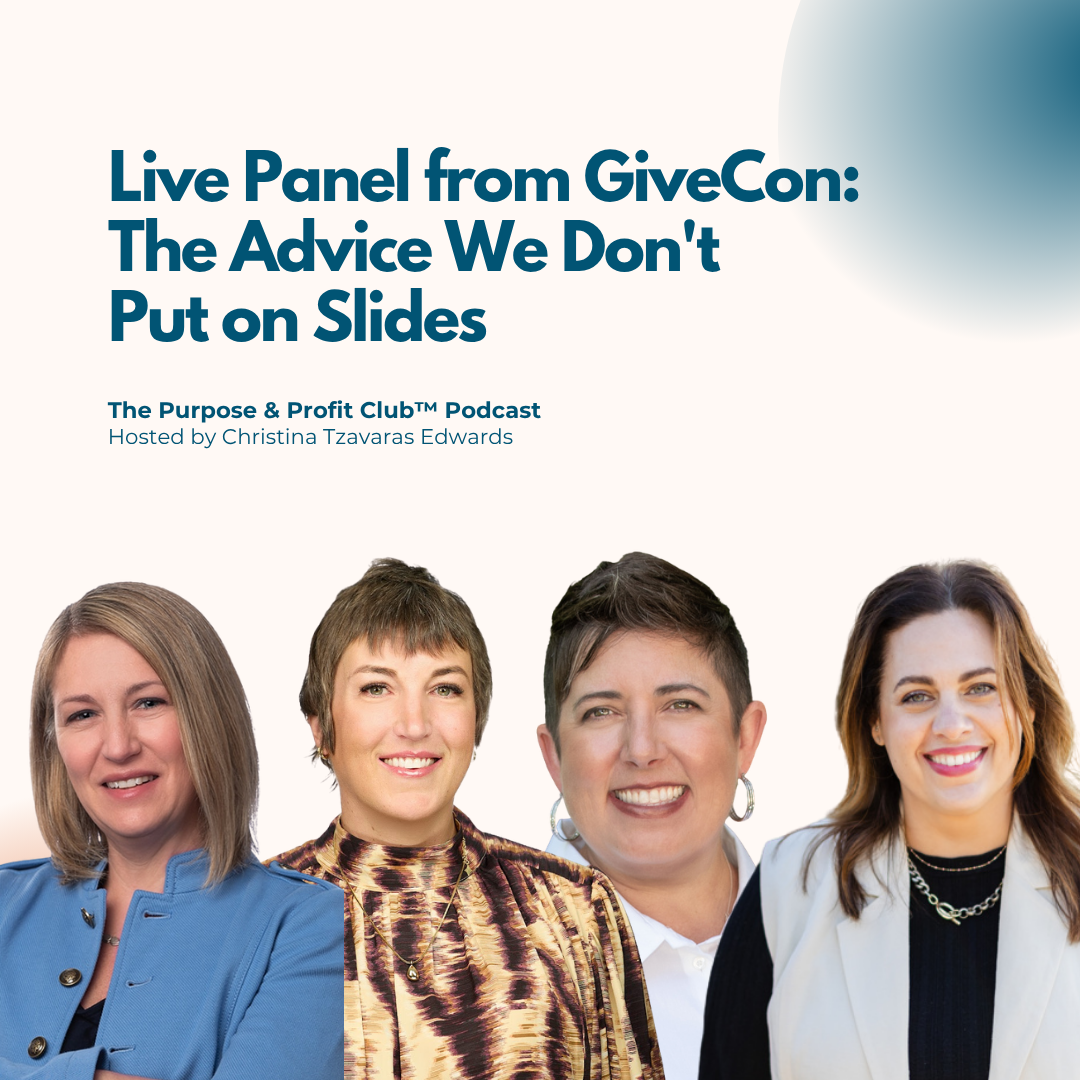
This is a special episode recorded live at GiveCon 2026, sponsored by Bloomerang.
I joined three powerhouse experts, fundraising event strategist Samantha Swaim, digital marketing consultant Julia Campbell, and Bloomerang CMO Ann Fellman, for a candid panel called "The Advice We Don't Put on Slides." No safe takes, no polished talking points, just the real stuff consultants say behind closed doors. We cover what nonprofits consistently get wrong, the trade-offs nobody wants to make, what actually moves the needle, and the advice we give all the time but wish we didn't have to. From a scarcity mindset to the 17 touchpoints it takes to convert a donor, from abandoning friend-raisers to stepping into CEO energy, this conversation is packed with the kind of honest, actionable insight you don't usually get in a conference session.
Topics:
The most expensive mistakes nonprofits repeat
Why the call is coming from inside the house when donor numbers decline, and what to do about it
Why "just do a raffle" and "friend-raiser" events are costing organizations more than they raise
The 15–17 touch points it takes before revenue comes in, and why that changes everything
It’s not your stories—it’s how you’re telling them. If your amazing work isn’t getting the attention (and donations) it deserves, it’s time for a messaging shift. The Brave Fundraiser’s Guide guide gives you 10 done-for-you donor prompts to make your message impossible to ignore. Get it for free here! https://christinaedwards.krtra.com/t/xKuLs6tOiPZa
Christina’s Favorite Takeaways:

“The number one thing you want people to feel is: this is for me.” Samantha Swaim
“Events don't need to celebrate money; they need to celebrate your mission.” Samantha Swaim
“We are responsible for the smaller dollar donors disappearing. We're not inviting people in, we're not making philanthropy participatory.” Julia Campbell
“You don't need more time, you just need to decide.” Julia Campbell
“Nuance is more important than consensus.” Ann Fellman
“People don't wake up thinking about us every day, so we do have to get in front of them and tell them about us.” Ann Fellman
“Asking more often and more than you're comfortable with - the big trade-off is comfort. If your revenue is plateauing, if your revenue has declined year over year, it's a comfort issue.” Christina Edwards
“I tell my clients it takes about 17 touch points before revenue comes in, and they make a face.” Christina Edwards
ABOUT Samantha Swaim:
Samantha Swaim has more than 20 years of event planning and fundraising expertise. She founded Swaim Strategies, a fundraising event consultancy, in 2004, working internationally with nonprofit organizations to produce impactful events that advance their missions. Samantha is the co-author of the book “Planning a Successful Major Donor Event”, is the founder of the annual Elevate fundraising event conference scheduled for March 2-3, 2027 and is the co-host of “The Fundraising Elevator” podcast.
ABOUT Julia Campbell:
Named as a top thought leader and one to follow by Forbes and LinkedIn for Nonprofits, and one of the 30 Nonprofit IT Influencers to Follow in 2026, Julia Campbell is a wealth of knowledge when it comes to designing social media and storytelling strategies that help nonprofits share their mission across the digital landscape. An international keynote speaker and host of the acclaimed Nonprofit Nation podcast, she’s written two books for nonprofits on social media and storytelling, and her online courses, webinars, and talks have helped hundreds of nonprofits make the shift to digital thinking.
ABOUT Ann Fellman:
High-impact, revenue-driven B2B marketing executive with 20+ years in the high-tech industry. Thrive in fast-paced, high-growth SaaS-based businesses where change is constant. Happiest fostering creative and innovative marketing teams that consistently deliver results for the business. Firmly believe in a strong partnership with sales organizations to win. Pragmatic Marketing believer. And just because it’s B2B, it doesn’t mean it has to be boring!
Connect with Samantha:
Connect with Julia:
Connect with Ann:
Episode Resources:
FREE Resources from Splendid Consulting:
How to Work with Christina and Splendid Consulting:
Double Your Donations - Raise More From Your Laptop Without Chasing Grants or Galas
Easy Emails For Impact™ - Turn Your Inbox into an Income Stream
Donations on Demand: Build a $5K Email Campaign System in 30 min/week
Connect with Christina and Splendid Consulting:
-
*Links may be affiliate links which means I may earn a commission at no cost to you.
Ann Fellman 7:18
Hi, good afternoon. Hello, hello. I'm Anne Feldman. I'm the Chief Marketing Officer here at Bloomerang. And welcome to our session. The advice we don't put on slides. This is going to be a fun hour, and I have some friends here with me to help me get through that. And before I introduce you all, I just want to talk about, like, okay, the things we don't put on slides, the things that you know, a lot of the advice in the sector is safe, and it's nice, and we feel good about it, but today this conversation, it's not, it's not that we welcome disagreement, okay, so, and nuance is more important than consensus, right? So, there's going to be different. We want, although we have a lot of like similar ideas and alignment, but there's nuance and there's difference, and we all have different types of organizations and what we're facing. And so we are going to get into that this afternoon and have a really candid conversation. And so before we do that, let's do some introductions. Julia Campbell, welcome. Thanks for joining us.
Julia Campbell 8:26
Thank you. I'm Julia Campbell, and I am a Bloomerang partner, a speaker, and marketing consultant. I host the podcast Nonprofit Nation, and I run the Nonprofit Social Media Summit every November, which Bloomerang is a sponsor of.
Ann Fellman 8:46
And next we have Sam Swaim.
Samantha Swaim 8:48
Hello, I'm Samantha Swain with Swaim Strategies. We are in the fundraising event space exclusively, so we advise, consult, teach, coach, but we have our Elevate conference, we have our podcast, The Fundraising Elevator, and we are Bloomerang Partners as well.
Ann Fellman 9:05
And finally joining us is Christina Edwards.
Christina Edwards 9:08
Hey everyone, I am a podcast host. I have The Purpose and Profit Club podcast, and I have two group coaching programs where I primarily teach organizations how to be email-first fundraisers and laptop first fundraisers, so how can you scale more from your laptop?
Ann Fellman 9:25
All right, well, you have three fantastic experts here, so I think we're going to just dive right in, and let's start. We're just going to get into it about things that not.. what do you see that nonprofits get wrong and get wrong consistently. Okay, so that's that is what we're going to talk about. So let's just jump in. Any of you can jump in here about, like, what mistake are you? What mistakes do you see that nonprofits are repeating consistently? Any takers?
Julia Campbell 9:56
Yes, I can.
Speaker 2 9:57
Okay,
Ann Fellman 9:57
Julia.
Julia Campbell 9:57
So for me, in my work, I. I do a lot of work with marketers or fundraisers or those, all you know, all in one shops, and something I see that nonprofits are consistently getting wrong is not having like a cohesive messaging strategy and a cohesive content strategy, and just posting and hoping it sticks, and throwing out emails once in a while, and maybe making a video here and there, and also not measuring what they're doing, so not creating content, putting content out in the world with intention and meaning, but rather just simply maybe putting up a flyer on Facebook because they think they have to, and I understand the reasons behind that, but I think we need to absolutely become better in investing time into creating the kind of content that our audiences want to hear and see from
Ann Fellman 10:51
us. That was fascinating. I had a lunch conversation today, and it was just about that kind of fighting the someone that's more responsible for the email and consistent message with the social media person, and like, you know, how do I get them to like
Julia Campbell 11:05
each other?
Ann Fellman 11:05
Yeah,
Julia Campbell 11:05
or fundraising and marketing. I think a lot of what I, the work that I do, I call it couples counseling between the fundraising and marketing departments, because they don't really know to speak to each other. They need to all be on the same page, they need to respect what each other's doing. Maybe there's some resentments there, so this is something consistently I see this division and the siloing around fundraising and marketing in nonprofits. Yeah, what about you, Sam?
Samantha Swaim 11:32
Well, I have a couple of things, but I wanted to tell off of that, because in the event space, so often I think people are doing the same thing, trying to simply just post on social and hope people come right, and they're missing that the way that you fill a ballroom of 300 people that give you half a million dollars is through relationship. So, for me, I think one of the big gaps that we see that we see as a like consistent issue coming up is that nonprofit does not value the relationship they're working on, the task list, the to-do list, but they're not valuing that key relationship. So, if one individual at the organization leaves and there's not a deep bench or a sort of deep relationship among multiple organizations or multiple people across the organization with a donor, then they risk losing
Samantha Swaim 12:23
the donor,
Samantha Swaim 12:24
but I would also say the scarcity mindset, I think, is the number one thing that people are sort of limited by. So,
Ann Fellman 12:33
we've had, we've talked a lot about scarcity, yeah, already.
Samantha Swaim 12:37
Well, I think abundance is, you know, mental shift that changes is my mic going out. Yeah. Thank you. Hello, I think that abundance is a mental shift that changes how you talk to donors. It changes how you approach the conversation. It also changes your own, like mental health around fundraising, right? It removes a lot of the barriers and the obstacles, when you start to think about, well, what are all the things we have, what are all the things that work well, what are all the impacts that we have. That abundance mindset can be transformative for an organization, and yet the name itself, nonprofit, is scarcity built into the sector, and when I work with organizations on their fundraising event. This shows up for me so much in things like we're going to have our entire staff spend the day building out the center pieces, where all of those staff hours spent in a relationship with someone could have yielded so much more impact instead of the $500 cost of the centerpiece, right? So that idea of leading with abundance and centering relationships, I think, is a missed opportunity, maybe not doing wrong, but a missed opportunity.
Ann Fellman 13:53
Yeah, rethinking your time and where's your time better spent? Yes, is like, let's think about this, can we do this a different way, and would that be better,
Christina Edwards 14:02
I think we're starting to touch on it, but this idea of you can spend 10 hours a day doing work that actually doesn't move the needle on donations, and it's actually very, very easy to be in like reactionary mode, it's very, very easy to tinker on things, work on a to-do list, reply to emails, research grants. Take a look at this task. Hop, you're doing a lot, but it's not moving the needle on the bottom line, which you're starting to touch on too. I think there's, there's inherent risk in that, there's inherent bravery that that takes, and so it makes sense that you would want to maybe I'll just reply to an email instead, maybe I'll just like check this out instead, or check this out instead. So I think it's easy to go, okay, what do I, what actually moves the needle here, and what do I need to do to put myself in that mode to take that action?
Ann Fellman 14:56
Yeah, I mean, probably all of us have been a victim of like. Perce being busy feels right, like check, check,
Christina Edwards 15:03
because I've done
Ann Fellman 15:04
it, yeah, right, but back to back to that abundance thinking, I would just, I'm gonna just throw this out here for a second, so at lunch, or having this, this conversation, and I was like, let's brainstorm for a minute, right, just talking to a couple of other nonprofit leaders, and let's brainstorm, what are you struggling with, and we came up with some really fun ideas, but it was giving them the chance to be like, there's no bad idea, think of something totally crazy that you'd want to do that would reach your donors and your supporters. We were talking about camp, like it was a camp, right? It was like, you know, when I was a kid, we had these really cool canvas backpacks, wouldn't it be fun if you could do that, or a day in the life of the water bottle at camp, like on social, like, how could we reach our donors that way? So we were just brainstorming, can't say they're good ideas, but they were ideas, and you could just see the juices flowing, and it's creating that abundance of there's no bad ideas, let's just, let's just get it out there, put it out there, and then, and then see where it takes us to to open up to abundant, more abundance thinking versus, oh, we do it like this, and kind of that scarcity kind of trap that we get, we get pulled into. It was really fun. Yeah,
Julia Campbell 16:06
and I would add to that, you know, we see these reports, like the Fundraising Effectiveness Project, we see that the number of donors are going down, we see the number of smaller dollar donors are going down, we see how challenging fundraising is, federal funding being totally decimated, and you know, I think other than the federal funding piece, all of that is a report card for us. Like, this is not something happening to us. We are responsible for the smaller dollar donors disappearing. We're responsible, we're not inviting people in, we're not making philanthropy participatory, so this scarcity mindset, it's so easy to blame somebody else, like, oh, that nonprofit is bigger, that nonprofit has a better board, that nonprofit is xyz, but we really need to start this introspection around, okay, this is not necessarily something that's happening to us. How can we fully get on board? Like, if my daughter came home and had 60% on, you know, AP bio, and was like, well, the teacher's mean. I'm not the kind of person that would accept that, right? I would say, okay, well, let's work on this. Like, what are the strategies that you can do to get your grade up, and like, maybe we can talk to the teacher, and we can see, but having this mindset of, like, well, there's nothing we can do, and there's just too many competitors out there. I mean, there are billions of dollars out there, billions and billions of
Ann Fellman 17:36
92 last year, yeah, or $92 billion
Julia Campbell 17:39
Yes, and I know the small dollar donors want to get involved, but they don't feel appreciated, they don't feel asked, and they don't feel connected. So that is something that I feel pretty strongly about, that makes nonprofits, I think, uncomfortable, because it is easier to say this is happening to us rather than accept that we can do better.
Ann Fellman 18:01
Why does this keep happening? If some of these things are like, well, maybe to us so obvious, but why does it keep happening? Like, how do we get out of the way here? Like,
Christina Edwards 18:12
sometimes I say it's like turning around a cruise ship, like it's not fast, right? I think that even just a smaller shop organization, when there's more than one decision maker, opinion board, right? It just can. You're asking a lot of people for opinions, sometimes you're asking for more opinions, you're asking for actual approval, and so it can feel really arduous. But, like, to your point, like the call is coming from inside the house. So, what do we want to do about it? And I think there's also this thing that happens, which is, if donors are disappearing, I'm saying it in quotes because they are not right. Then I think you start acting weird to the donors you have, you start to tighten, you start to disconnect. It's like, in an effort to not lose more donors, you actually disconnect from the donors, because you don't want to, like, be too much, ask too. And so it's like the scarcity piece you're perpetuating, and all we want is like we want to hear from you more, we want to know you more.
Samantha Swaim 19:09
I also think that scarcity mindset limits innovation, to your point about brainstorming, is that in the scarcity mindset, so often people get stuck in, and I'm sure everyone here has heard this, we've never done it that way, or we always do it that way, and that always statement, I think, gets us stuck and limits our ability to be able to think out of the box, brainstorm, get creative. But in my space, in fundraising events, I've been doing fundraising events for 30 years, I've never seen more transformation than in just the past five years, and I think it's because we are living through a connection recession right now. The term that's been coined by the Wall Street Journal, this idea that we have a divide where between COVID and technology we are not in community in person as often, and we are communal by nature. Are human beings, and so that I think is part of why we are seeing repeat donors drop, why we are seeing retention rates decline. It's not that they're not there. People generally consider themselves generous. People generally want to be a part of giving to things they care about, but we're not inviting people in, in a way that they feel connected to, so I feel like right now one of the easiest things we can do is things like, I know this is going to be controversial, but don't have your board meeting on Zoom, like a simple solution is bring people back in a room together to be in conversation, have a staff retreat, like, get out and laugh together, like some basic tactile things we can do to kind of inspire that connection again, and invite people back into our organizations.
Ann Fellman 20:52
The tactile thing is a really good point, even it can be as simple as, like, or go get your team outside, or I used to do, I'd have like Lego kits and coloring books and other things, like, whoo, I heard that,
Speaker 2 21:07
but
Ann Fellman 21:08
those things get our brain on a different plane, if you will, so that we can break out of the mindset thinking of, well, we do it like this, and it was like, well, but do we have to, like, let's, let's just, for a minute, I'll allow ourselves to think crazily. If we had everything under the sun, what would we do? And
Julia Campbell 21:26
that's really good to bring to bring together people that have really opposing viewpoints. So, I'm on the school board where I live, and we really have some very divisive people and opinions on the school board,
Christina Edwards 21:40
and we're
Ann Fellman 21:41
doing that, by the way.
Julia Campbell 21:43
Okay, and it was coming to a point where we couldn't function like we couldn't have consensus of disrupting the board meetings. So we did a, we did like a half day Lego tactile thing. We were paired with the person we least wanted to be paired with. We had to like complete these challenges, and while you know it's not going to help me change my views and my values, and what I stand for is helping me understand the thinking of another person. So, if you have that kind of division in your organization or on your board, I think it's a great idea.
Samantha Swaim 22:12
I just feel like the like being in community is one of the number one things we can do right now, and Clay Buck, who's a fundraising consultant, once said, stop asking, start inviting. We've like terminated things like volunteer programs, because it was just easier, right? During Covid, we weren't utilizing volunteers, so we let go of our volunteer manager, and then now we don't have robust volunteer programs. Like, find ways to invite people back to your organization.
Ann Fellman 22:39
I love that. The inviting back, you hit on something, and I don't think we're gonna get to it later. So I'm gonna ask you now, your idea was when we were doing Fundraiser Focus Week, Sam, and you talked about the paddle raise, and you talked about inviting people at the $20 planting, you know, can you just talk about like they're right? That's a beautiful invitation, and I was like, oh my gosh, that is, that is such an awesome idea. Yeah,
Samantha Swaim 23:04
if I want to go back to your first question of what do people do wrong in Myspace, they don't ask that idea of inviting people to an event that is a fundraising event, and then they say this is going to be a friend raiser, don't do that, because when you
Julia Campbell 23:20
have friends,
Samantha Swaim 23:21
when you have invited folks to be a part of something, and then you share with them, this is the work, this is the impact, this is what we could be doing together, and you never give them an opportunity to be a part of that, it's, it's literally like you're saying ready, set, ready set, and you're never giving your mind, their mind, the ability to go, and they leave honestly disappointed, because they didn't feel like they could be a part of it, and sort of like, why did I spend my time here? So it can be a great party, but if you don't invite people in or make an ask, you don't give the brain that relief when you do paddle raise, having one critical element is the lead gifts that kick it off, so you know you have momentum. If you don't have those lead gifts already committed and pledged, you risk creating distrust, and it happens so fast. You ask for $10,000 and there's nothing you immediately tell your audience. Ooh, why isn't anyone giving? I don't trust this,
Christina Edwards 24:28
and this happens online too. Yeah, in online campaigns, the bummer, you like launch your campaign, you post it out, I click on it, zero,
Samantha Swaim 24:39
yeah, do
Christina Edwards 24:39
that,
Samantha Swaim 24:40
yeah,
Christina Edwards 24:40
because our brain is literally going, is this something I could contribute to? Is this safe? Are other people doing this? And when the answer is no, more people exit than that. And I think just seeding it and having a few people ahead of time.
Samantha Swaim 24:56
Well, and then also having an accessible level, to your point, get accessible. Level earlier in the, in the opening, the chat about the latter, I think, is so important, is that if you don't have that accessible level, whether it's in a campaign or an event, or you know, in your media, if you don't have a way that people can reach you, it says this isn't for you, and I feel like
Speaker 2 25:21
the
Samantha Swaim 25:22
number one thing you want people to feel is this is for me,
Ann Fellman 25:28
okay? So, inviting people in, we've talked scarcity, sometimes there's going to be trade-offs, right? Like, we have to make choices, right? We have limited staff and time, right? There's only so much we can do in a day, but let's talk about the trade-offs that nobody talks about. So, what are the trade-offs that nonprofit leaders avoid making?
Julia Campbell 25:52
To me, I don't know if it's a trade-off, but it's definitely a decision that a lot of nonprofits make, and I was talking with Rachel Baer Bauer, if any of you are familiar with her, at lunch, and she has a session tomorrow, and she said something that really stuck with me. She said nonprofits need to be stopped, need to stop being so precious with their brand voice, and I thought absolutely, we need to stop averting our eyes to what's going on all around us every single day. We need to stop pretending like we don't exist in the world and in our community and in our society. We need to talk about these issues, and this could be a trade off, because yeah, if you are doing something important and saying something important, you're going to get pushback if you are just simply toeing the line and putting out content that makes everyone feel comfortable, then either people aren't listening or they're really not going to trust that you can get the hard work done, and it does come back to trust. So, to me, I really want to see more nonprofits just talking about how current events are affecting their work, how the demand has risen, how resources are stretched thin. You know, and if you say you like apples, someone's going to say, "Why do you hate oranges? And obviously that's going to be a thing, but we have to get over that. I mean, the work that we do is so important, and the people that support it want to know that we have sort of a line in the sand, and we stand up for the people that we serve. Yeah, I would say
Christina Edwards 27:30
asking more often and more than you're comfortable with, like the big trade off is comfort. If your revenue is plateauing, if your revenue has declined year over year, it's a comfort issue. It is easier to do exactly what you're doing, and you will either see a plateau or diminishing returns, and it takes more guts to have more campaigns, more fundraisers, and more asks, because when you do that, you will hear more nos, and then you will also hear more yeses, but the no's that muscle to that you will have to build to metabolize the nose and keep going to hear the yeses. That's it. That's the trade off. Is am I willing to do that, or do I just want to keep doing what I'm doing because that's comfortable?
Samantha Swaim 28:17
I think that we tell ourselves often that we can't ask because we just asked, and yet there's so much data that proves if you ask more it actually helps the donor to feel more connected. It's another outreach point, it's another engagement point. I also think that if you're not asking, you're not receiving, but I also think that the world is political and people fear talking about the politics, but to your point, being able to step up to this is how it's impacting us helps your donor to see where they can step in. There's actually a great story. I was talking to Alice Ferris, who is a consultant. She was advising that a client that is in the public broadcasting space. She works a lot in the public broadcasting space. They had a huge deficit, multi million dollar deficit, and she advised that client, "You need to be talking about this to your donors, because it creates distrust if you're not talking about the fact that you're losing funding, even though this is very public and in the news. And one, the very first donor conversation they had with one high-stakes donor that was a big major donor. She asked, "How is this impacting you? They had their stats ready, they had their information ready, and she filled the gap for them singly. They had no idea she had that capacity, but to her this was the like benchmark lifetime gift she wanted to make. So, I think it's not just important that you're speaking to your values and holding your values and not being like scared to hold your values, but also speaking to your donors about that implication and impact.
Christina Edwards 29:50
It's almost like the pursuit of professionalism.
Samantha Swaim 29:53
Yeah,
Christina Edwards 29:53
it's hurting.
Samantha Swaim 29:54
Yeah,
Christina Edwards 29:54
because
Samantha Swaim 29:56
perfectionism,
Speaker 2 29:57
we
Samantha Swaim 29:57
holding those back,
Christina Edwards 29:58
professionalism, like, we, it's like. The pursuit of, like, I have to, I have to present, like, our organization's doing great, so that you know everyone will trust me. But, in fact, the invitation to say, like, it's really hard right now, or our grant funding got cut, and that means this donors are like, "Oh, we would love to help.
Samantha Swaim 30:16
Well, I also think you can do both, right? Like, to be able to be like, "We're really good at this. This is our mission. This is our program. This is what we excel at. Unfortunately, this
Christina Edwards 30:26
is what we're facing. Yeah, yeah. Yes, exactly. When
Julia Campbell 30:30
I was a development director, I worked in domestic violence program, and it was in Virginia, and we received a pretty significant state budget grant cut, and I do remember being in the room with the board and the executive director, and all of them saying, well, we can't say anything because it was very politically motivated, and specifically against programs that served women and girls, and all this fun stuff. So to me, I thought, okay, we, it's a fact. Okay, we're not expressing an opinion. It is an actual fact that our budget was cut 25%
Samantha Swaim 31:09
right?
Julia Campbell 31:09
That's a fact. And if we can't talk in facts, then we've totally lost the plot.
Ann Fellman 31:16
Yeah, I mean, that's that's what builds a trust. You have the knowledge of the organization, what you need, what you're really good at doing, and this is the gap. We had this conversation in a session I was in earlier today, where someone is tasked with raising, I believe it's $76.5 million and they've, they're at 71.5 and you know, the state came in and they had a huge grant, which is like a huge. it's like, how do I get past this, this, this last mile, right? How do I get there? And it was like, let your donor, let the community know about your gap.
Samantha Swaim 31:49
Yeah,
Ann Fellman 31:50
talk openly about your gap and how good you've been getting to this point, because we've had customers talk about, they went to the next major donor, they were just having a conversation, and all sudden they're like, I will do a match if you raise another $100,000 by the end of the year, and it was like, and they did it, and they surpassed their goals, and so it is about acknowledging that gap, making that ask, the, I mean,
Samantha Swaim 32:14
you just tapped into something, though, with a match that I think is important, is that people want to be a part of something successful, and they also want to be a part of something that's collective, right? Like, I want to join that. If everyone else is joining, I want to be a part of that.
Ann Fellman 32:27
Yeah,
Samantha Swaim 32:27
so I think that that's a powerful tool that doesn't get utilized.
Ann Fellman 32:30
Yeah, you realize your dollar can be double, you know, like, oh yeah, that's that sounds like a great way to contribute.
Samantha Swaim 32:36
And oftentimes I'm a sucker for that. I'm the first donor to be like, ouch, I'm gonna end it
Ann Fellman 32:40
as a match. We
Christina Edwards 32:42
should briefly address matches, because I hear all the time from my nonprofits, like, do matches even work anymore? And I feel like you're nodding, so you're with me. Yes, we're in the pool, like we see it too much. We are like, yeah, yeah, match it totally still works.
Samantha Swaim 32:59
It absolutely,
Julia Campbell 33:00
yeah. Well, it's that sense of why this, why now. So, when I teach social media, you always have to have a why this, why now. It could be a great story, but when you're fundraising, especially, why am I paying attention to this right at this moment,
Samantha Swaim 33:13
right?
Julia Campbell 33:14
And a match is a great way to do that, and the data does show that it does work.
Samantha Swaim 33:18
Yeah,
Ann Fellman 33:19
can we talk about discomfort for a minute, and just thinking about clients that you've advised over the years. What's something that you often advise that's really uncomfortable to hear? Is there anything we have a hit on there?
Samantha Swaim 33:30
Well, for me, it's always the client story. So often we work with organizations that say, especially organizations are dealing with any direct social service support, where someone has been in a state of crisis. The immediate response is, we don't tell our client's story. Confidentiality, we do not tell our client's story. And yet, there is a ton of data behind the fact that one, a client's story moves giving significantly more, and two, the client's story is something that, if done well, if done ethically, if done with trauma-informed care, can actually be a healing part of someone's journey. So we frequently are coaching an organization toward the paddle raise moment at their event, which is your biggest revenue opportunity at an event, hands down, in which we ask everyone to turn their focus, focus on one story, not every story, one story that represents the impact of your work, and then move into the fundraising paddle raise, and so often the barrier to get to telling that story is this fear of poverty porn, right, that idea of like we're gonna, you know, the sad kitten in the cage, sort of fundraising, and it is an old, old, old model of fundraising, and you know what, we've learned better, we've learned that you can actually tell a story in a very. Ethical trauma-informed way with kindness and care that is part of a powerful journey that connects people deeper to the giving, so I frequently run into that kind of like gap. The safe model is frequently we'll just go to the list of programs we offer.
Ann Fellman 35:18
Yeah, that's sanitizing it, right? Yeah, versus an emotional, not
Samantha Swaim 35:21
emotional, yeah. Also, you don't have to cry. That story does not have to lead people to cry. We have over 300 plus emotions. We feel you do not have. You could feel nostalgic, you could feel excited. You don't have to cry.
Christina Edwards 35:35
I would say send more emails than you're comfortable with. Like sending more emails can change your fundraising life, and it's going to be uncomfortable. You're maybe here some pushback about it, but email and social media are not the same. Social is great for awareness and visibility, but the conversions - everything we heard in that first session this morning - donations are happening, that email is your foundational backbone, and I'm kind of thinking about as we're speaking, like, how come for-profit brands and businesses get like a totally different set of rules, like I can order, I can discover a new brand and be like, I like that brand, I can order something from them, and three days later they're inviting me to buy something else. Yes, and I am not offended. Do
Ann Fellman 36:23
you get from whatever you just bought, or you looked at pair of shoes, you know, bed sheets, whatever. And you're getting five emails a day. It must work. It must.
Christina Edwards 36:33
It's as if it does.
Samantha Swaim 36:34
I think we think the for profit. We are not for profit. We are not capitalistic. We are not going to be like that, and yet that is what your audience is knows is seeing, and how they are buying and shopping for their product. Why don't you want your brand to be in front of them in the same way? Retargeting campaigns, marketing campaigns that do geo-fencing, people go, I would never, and I'm like, but the shoes you just bought came to you that same way. Why wouldn't the mission that you care about come to you that way?
Julia Campbell 37:10
I agree.
Ann Fellman 37:10
Get your story out there. For
Julia Campbell 37:12
me, teaching marketing and digital marketing, what really makes people uncomfortable is that social media, the algorithm, like, doesn't care about you, right? Doesn't care about you and your mission, and how great the work is that you do. You have to create content that matches the platform, that matches your audience. We have to kind of get out of our own way and our own agenda, and I know we have a million things to share, and so many events, and great awards, and milestones, and all of that, but we have to start understanding how people are consuming content and engaging with content, and I'll go into this tomorrow in my session, but the old rules, which were never really the rules that worked anyway, but we were all taught that social media and email and our websites were just these broadcast platforms where we could just sort of put up our promotions and and leave and call it a day, I mean the whole mentality, and the second piece that I teach is being vulnerable, so when I say vulnerable, I mean if there are any Brene Brown fans here, I know that you know what I'm talking about, I don't mean you have to be crying on camera, but you do have to be on camera, or at least telling me from a human-centered perspective what's going on, like letter from the executive director, a walk and talk about SNAP benefits in your community, and how that's affecting you. People really need that behind the scenes content, and that makes so many nonprofits uncomfortable, because we just want to, you know, put our heads down and do the work, but sometimes we have to be the face of the work as well.
Ann Fellman 38:52
Okay, we're going to go from discomfort to disagreement. Let's talk about where consultants disagree, right? I mean, there's a lot of opinions, and what, but what's what's something that you disagree on when advising your clients? So, Sam, what do you have anything for us on disagreement?
Samantha Swaim 39:10
Yeah, I think there's a couple of things. One is the especially in my world of events is the theme and the association of big, like showcasing big money associated with a like gala style event. I think there's a lot of disagreement in community centric versus donor centric fundraising around this idea that the gala feels like a conflict of we have to set aside our values and mission for a one night where we can reach our big dollar donors and raise a lot of money and sacrifice our values, and my sort of disagreement there is you can do both. You can be community centric in a way that also appeals to those big donors. You can be very true to your mission, but the key to do that is you have to center your mission. And so, like, get rid of casino night, get rid of the acrobats, if that's not your mission, center your mission, and design every element of your event to be really focused on connecting people deeper to understanding the impact you have. We had a dinner once where we, the, it was a furniture bank, and their biggest need that year was silverware, and so we served dinner without any silverware to make a point about the value and the impact of silverware, and just as guests were trying to figure out how to eat their soup and looking around the room, we said no to something missing, and it became a storytelling piece that we could physically tactically immerse them in, and when we brought them their silverware, we were able to say the silverware tonight will all be cleaned and donated back to the furniture bank. That instead of feather dancers moves and removes that conflict of like it's not just a showcase of money. The other thing I would say is we don't have to have an auction, and that's where I probably disagree the most in people in the event space, is that the biggest impact you can have is sharing your story, immersing people in your mission, and asking them to be a part of it. You do not, if you don't have the people and the bandwidth, you do not need to spend hours and hours and hours of your time putting together silent auction packages, putting together live auction packages, you can really simplify to something even more powerful and raise more money and spend less time. You do not have to have an auction. It works for some people, but it doesn't have to be there.
Christina Edwards 41:39
Yeah, sometimes it's the event is like a long walk to make
Julia Campbell 41:43
$1
Christina Edwards 41:43
right? And if your event is the event you just described without the silverware, I'm all in, right, where there's like this depth or this meaning, there's like a before and after, it's a story, like before I came to the event, after I'm changed, right, but I see a lot of people think their 5k is going to fix their fundraising problem, right, and all they did was tire out their staff, their board, their volunteers, everyone, and it was like it was a hard dollar, a hard 20k it was a hard 200k whatever it raised, and I think as a donor, there's this mentality sometimes of like I have to give them something, we don't want anything, I don't want the auction item. I remember years ago I was voluntold to be on the auction committee,
Julia Campbell 42:27
voluntold for
Christina Edwards 42:29
my child's preschool, and my husband was like, hang on a second, so you're asking small businesses to donate gift cards so that we can pay to go to the auction and buy them back, and I was like, yes, that is the plan, that's it, that's it, and he was like, what are we doing, I was like, I know, I know, I know, so yeah, it's like, do is there another way to reimagine the event, or do we need the event at all, and if the answer is we don't need the event at all, then I'm like, let's email fundraise, let's do this, one of the things I would say on that is a couple of things I would love to see people do more of, of we don't need the ominous brand voice, we don't need xyz organization sending the emails, like we want to know you, we want to know the people, besides the executive director, like she's awesome too, but I want to know the different voices in the organization, and that is really the difference between the organizations that have like that connection, that trust, the people who give multiple times a year. I was talking to a fundraiser yesterday, and I was like, you know, your donors who give three times a year. It was like, who, like, once a year? And I was like, no, the people who give multiple times a year, that's what you can do with email very, very quickly.
Julia Campbell 43:39
I think I disagree, the philosophy in digital marketing and in nonprofit marketing I most disagree with is that there are a set of best practices that we all have to follow. There's no one size fits all, so I can't stand those articles that say, oh, the best time to post on LinkedIn is Tuesday at 10am like that doesn't mean anything, that might not be the best time for you, or you have to be on three platforms, posting three times a week. I mean, there's suggested guidelines, but all of us are so unique, and our audiences are unique, and our missions are unique, that there's just not one best practice. And I also think you should break up with platforms that are not working, so you, if you don't want to be on X, get off X. If you don't want to have five Facebook pages for your organization, you shouldn't anyway. Feel free to consolidate, like it's there. Don't worry so much about like what the experts are saying you should do, and look at your capacity and your audience, you know, in your messaging, and focus on that. I really think less is more, and quality over quantity now, especially in the age of a lot of AI-generated content online.
Samantha Swaim 44:52
I would add, too, in the same way that if you don't need to be on every platform, your staff also does not need to be an expert in all those. Platforms, and I think so often our mission is so specific, right? Like, our work has a specific tangible goal that we're working toward. We don't also have to be the marketing expert, the social media expert, the comms expert, the platform expert, the analytics expert, the data expert, the fundraising expert, but I think it's okay to hire people who are, because being able to save your staff the heartbreak and the workload by bringing in someone who can do it in five minutes versus your staff spending weeks learning how to do something new. I think so often in that scarcity mindset we try to stretch our dollar and then don't understand that someone who really is truly deeply an expert can have an exponential growth opportunity for you, and ease, and like not burn out your team,
Julia Campbell 45:52
and to add on to that, something that we had talked about before this panel is that so many people in the nonprofit sector come from programs or their founders, so they don't have a marketing or business background, or a fundraising background, necessarily. They have passion for the mission, passion for the cause, but yet think they have to be experts in every single little piece, like information technology and HR, and all that. That's really distinct in our sector,
Samantha Swaim 46:21
absolutely,
Ann Fellman 46:22
yeah, most definitely. I mean, so many hats that we're wearing, and then tapping into the experts. I've talked to countless, you know, development directors, heads of nonprofits, in terms of when I would ask them about, like, how did you evaluate technology, and it was just like, well, I didn't. I was like, oh, you know, I love to like teach you or walk alongside you, of like, here's how I look at technology. These are the things that I do, like I'm going to make these things that are most important to me right now, but I know that I might discover something along the way that I'm going to need. But again, tapping into those experts, right, and it's okay to do that, and you don't have to be an expert at everything,
Samantha Swaim 47:04
and we all collaborate, right? Like,
Ann Fellman 47:06
yes,
Samantha Swaim 47:06
call Bloomerang, and that, and say this is my need, and they're going to know someone who does be
Ann Fellman 47:11
like, oh, you're gonna want to text Sam. Yeah,
Julia Campbell 47:14
I'm thinking of the incredible fundraising event, the three of us marketing
Christina Edwards 47:18
between marketing
Samantha Swaim 47:19
campaign, amazing follow-up,
Speaker 2 47:21
and the
Julia Campbell 47:21
organization.
Ann Fellman 47:22
Yeah, it's a lot of hats. Okay, so let's get it. Let's transition now to talk about, okay, things that move the needle. What's really going to make the difference for our organizations? So, when you look across your clients that you've helped over the years, like what what consistently gets results?
Julia Campbell 47:42
I can go first, and it's just it's consistency, it's sort of picking it's a consistency in experimentation. So, when you experiment, having a goal for your experiment. So, a great example is candid.org If you're familiar with the nonprofit Candid, they decided they wanted to get on, they want to do short form video, so that was like, okay, we want to do short form videos, so what does that mean? Okay, well, we want to, they pulled us out of the air, we want to create 22 videos that are under 60 seconds over a three month period, that's a perfect experiment, because then you can see if it worked. If it didn't work, how much time it took, and you can analyze it. And they were consistent over this three month period, whereas what I see happening is posting here, sending an email here, throwing up an event there, and not doing anything in any consistent way. And then throwing up our hands and saying, "Well, that didn't work. So I think picking something, sticking with it, even if it is an experiment, measuring it at the end of the day, analyzing it, taking the time to debrief and see what worked and what didn't work. I wish I saw more of that in fundraising and marketing.
Samantha Swaim 48:57
I mean, an event needs like three years before it fully actualize. Yes.
Christina Edwards 49:03
Say that again.
Samantha Swaim 49:03
An event needs three years. Typically, we see kind of a like slow growth pattern over three years before you really start to see the maximum yield of what it could benefit, and sometimes it continues growing beyond that. Sometimes it plateaus. If it plateaus after two years, that's typically when we would rethink, re-evaluate based on all the data analytics we have from those four or five years, but I would, I would really emphasize the importance of responsive versus relationship, and getting out of the just, the world changed so much in the past six years, of like, we are constantly in an information incoming stream, right? Like, emails coming to us, that, that can be 100% of what we do all day. So, how do we, and some days it is for me, and how do we move into, I'm carving out this dedicated time. Time to be my relationship time, that in the afternoons I am making calls, I'm scheduling coffees, I am scheduling lunch dates. We had a client that specifically set on her calendar a call time, and then her team, this executive director's team, would give her a folder of like these are who you're calling in your next call time, and it was a four hour block every week that she had on her calendar, and then, in addition to that, she had one day where she had three meeting spots, and it was dependent on her board and staff filling those three meeting spots with bring them in and tour them of our facility, so it was just relationship building. Yeah, it was a system dedicated toward relationships, so you're not just stuck being responsive, but you're actually carving out the time to be in relationship with people. I think that's what is going to get..
Julia Campbell 50:53
I love time blocking.
Christina Edwards 50:54
Yeah,
Julia Campbell 50:54
I love
Samantha Swaim 50:54
it. Me too.
Christina Edwards 50:55
I call those power hours. Close everything out. I'm not leaving, like, I'll put my phone in another room, unless I'm calling people, right? But, like, that's it. Like, do not disturb. We're not leaving until those done power hours, and you get better at it, and you start treating it like going to the gym, right? And so you're making those calls, I think. Even just, we do this in some of my communities, where we'll actually do it as a group together, even though we're actually not talking right, we're just on Zoom together, silent. So, if you can even do it with a coworker or a partner, I think that that's even helpful, even if it's across Zoom. One of the things I want to touch on that Julia said is this idea of like it's almost like you're doing a little bit of this, you're doing a little bit of that, you're never really seeing it through the way Candidate did, and it's like, if we go upstream and we're thinking, why, well, you don't have the resources, or you haven't invested in somebody to help you buy your time back. I sat with somebody at lunch, and she was talking about her, her constituents, her email subscribers, they live in three different places right now, and so she's talking about data migration, and she's like, you know, it's going to be a lot, and I have to do this and this, and I was like, you know, you can just hire somebody to do that, like, don't get good at that, don't get, like, that's not something for you to get good at, I don't need to get good at coding from my website, that's not it, it's going, even if it's expensive for me to hire that out, it's still a stronger ROI for me to have that power hour, right, and I know the same is for you. And so there is a culture inside the nonprofit world, it's like, but I could just, and especially now with chat, with AI, with Claw, and all that, and it's like it could help me DIY it, or can I like hire somebody to help me with this migration, or can I hire somebody to help onboards me with this tech, so that I can go do the thing I'm really great at, and go raise some money. And sometimes it's like a tough conversation with your board, and really you being 100% all in, and going, I need this, I need this. And then sometimes it's even another conversation of like, do I even need board approval for this in the first place, but
Ann Fellman 53:02
that's a great question. Do I even need board approval for this,
Christina Edwards 53:05
or do I just want board approval because I feel nervous about this investment? Your lot. Yeah, yeah,
Ann Fellman 53:12
I know. I was like, I saw something.
Christina Edwards 53:14
I get it. Stop asking the board. Stop asking your
Samantha Swaim 53:17
budget. Yeah, so
Julia Campbell 53:18
it's looks like the school board. Okay, we do not go to the public for every line item in the school board budget. There's not possible, you know. We discuss with shareholders and stakeholders as we build the budget, but then the budget is presented and voted on. So that's kind of how I like, if I served on a nonprofit board, that's how I would approach the financials is that I know I have a responsibility for the financial sustainability of the organization, which includes fundraising, right, includes talking about the organization, but includes making sure that there's adequate fiscal governance, but occasionally if there's a huge project, like the high school roof falls in, then, but like, your
Christina Edwards 54:02
board flyers borrowing money, approving printer toner. My favorite executive director was like, "You don't want me to call you about this, and they're like, "No, we don't. Printer times, there's a quote.
Ann Fellman 54:12
I got a funny story on this. So, someone that works at Bloomerang is on a board, and they're finance, and they are saying they were arguing over spending another $20 a month at the board meeting on, you know, some subscription for something, and it was like, I can't.. we have so much, we are doing great financially, we do not need to have this.. there's an argument within the board itself to be like, you know, so can we have a rational conversation of where I'd like the board,
Samantha Swaim 54:40
so where we want to spend the time, trust your staff, that's
Christina Edwards 54:43
right. Yeah,
Samantha Swaim 54:43
that's so undermining. I know
Speaker 2 54:45
it's not
Ann Fellman 54:45
terrible, but I'm sure we've all felt that right, and like that's a hard conversation we need to have, and that's a disagreement we're going to need to have with our board or executive director to kind of be like, let's let's spend our time elsewhere than the $20 or the toner. Print your tone of approval.
Julia Campbell 55:01
It's just like you said, not giving staff the discretion to make those kinds of decisions. With there's guardrails, there's guidelines, there's policies and procedures, but you have to trust your staff. You do have to trust them at some point, and then if you don't, it's a different conversation.
Christina Edwards 55:17
But they.. I'm like, but they.. you're in your role, and especially for somebody who's been in their role for more than a few months, I'm like, you're in your role for a reason. I do think energetically sometimes it is about stepping up into it, and, and really, I call that like CEO energy, and being like, this is what I need, this is what we're doing. It's not the roof has not caved in, it's not an emergency meeting, it's me running this organization, and we're hiring somebody for the data migration, and they're great, and I've vetted them, and they're the one, like, that's it. Yes, CEO, and calling you. Yes,
Ann Fellman 55:49
you want to talk.
Julia Campbell 55:50
I know I'm going to call you when I need a pep talk. Yeah, when my clients need a pep talk.
Ann Fellman 55:56
Okay, I think I have, like, two more like question areas. I'm just trying to be mindful, like, of time, and kind of where we're at, but is, is there something that you know people think is difficult, but is actually, you know, there's something, something is actually simpler than people are really thinking in their head that actually works, right? Like, they're like, oh, that's hard, no, no, I mean, it's, it's not that complicated, and it works, try this, is there any anything where you get the resistance to want to, like, do a thing, but you're like, "No, it's much easier. And I know it's gonna be like, "Email more. No,
Christina Edwards 56:29
it's not. You know what it is. I feel like it's the rumination, and again, I know that's why I do this. It's like the dread of something takes more time than the action of doing something for me. This would be like, I just really don't like getting ready for my taxes every year, like it's all there in QuickBooks, and I have somebody do like it. Is the anticipation of it is like I'll dread it for a month, two months, the action, because I've timed it before, it's like three hours of my time, that's it, that's all. And so I think we do this with a lot of very important things, calling donors, following up with donors, like doing the hard thing, actually doesn't take a lot of time. We do like board text-a-thons, board phone-a-thons. That's like, we can do it in 30 minutes. It is the dread of it, of like, what, that's what it's the rumination.
Samantha Swaim 57:19
Yeah, I went at asking for money, like I think that people think it's really hard, they put it off, they have a million other tactics of things that are keeping them busy. I don't have enough time because the ask is intimidating or scary, and that is an area where I feel like it is actually so much simpler, so much easier, because it is really just, it is really just inviting people in. It's asking, tell me your story and your connection,
Christina Edwards 57:47
listening.
Samantha Swaim 57:47
Yeah, I mean, make a wish, right? Tell me your story. Your Make-A-Wish story. How did you first get involved? They start to tell you, and then it's really easy to be able to invite them to do it again, and invite them to participate again. We would love to have you donate again. That, I think, is something that people put off, put off, put off, put off, put off. And yet, without that, people feel a sense of, I can't figure out how to participate, so I'm not going to like people don't just give because of altruism, they give because of the relationship, the sense of collective action, the community, and we put off that one thing so often, and yet it's sometimes the best part of the job.
Julia Campbell 58:29
I think building on the ruminating piece, I get Seth Godin's blog every day, they're really short, and some days they're just so spot on, and he sent one a few weeks ago that really was like one sentence, and it said with two sentences, you don't need more time, you just need to decide. I was like, are you? I felt so like it's absolutely true. I have seven notebooks of ideas and things I have, like my next book, I have this, I have that, a podcast guest, and I get so overwhelmed that I tend to just shut down and be like, I'm just gonna watch Real Housewives and not think about the work I have to do, but you do not need more time, you just need, you just need to decide what, what are the priorities, what are you working on, what are you best at? So those two sentences I printed them up and put them in my office, and just as a reminder that just make a decision, and you know you got to trust that sometimes you will make the wrong decision, and the world will not, the world, then you have data,
Christina Edwards 59:38
then you have data,
Julia Campbell 59:39
that's true, exactly, that's a data point. Failure is a data point.
Samantha Swaim 59:42
Okay,
Christina Edwards 59:43
I know what my audience isn't into now. Yeah,
Julia Campbell 59:45
perfect. That's a perfect way to think about it.
Ann Fellman 59:47
Well, that was very sage advice, kind of. This is the last piece I was like, so let's just kind of wrap it up in terms of piece of advice. Advice that you give all the time, you know that, so again, it's not just your words of wisdom, but what's a piece of advice that you give all the time, but wish you didn't have to.
Julia Campbell 1:00:12
Done is better than perfect. Oh,
Samantha Swaim 1:00:17
clap, clap that
Speaker 2 1:00:19
one out.
Samantha Swaim 1:00:20
I would say events don't need to celebrate money, they need to celebrate your mission.
Christina Edwards 1:00:26
I would say people aren't paying attention nearly as much as you think, and for me that's permission to ask again, to send again, to take another action, like we're again up in our business, like people are like they missed the email, they missed the phone call. I didn't listen to the voicemail, like we're busy, we're distracted. So
Samantha Swaim 1:00:50
I tested that theory recently. Yeah, someone had told me once upon a time, like you need seven touch points for a decision, and then that number has gone up. What do you think it
Christina Edwards 1:01:01
is? I tell my clients about 17 now, and I, yeah, they make that face.
Samantha Swaim 1:01:05
15 is what I heard.
Ann Fellman 1:01:07
I've heard four. Wow,
Julia Campbell 1:01:08
no, I'm not really surprised, but that's
Samantha Swaim 1:01:12
so I did a little test,
Christina Edwards 1:01:13
and
Samantha Swaim 1:01:13
I counted every single touch point, and when we hit 15, all the revenue came in, and I was like, oh my gosh, if
Christina Edwards 1:01:22
you knew it took 15 touch points to raise more this year, then that's it.
Samantha Swaim 1:01:26
Yeah,
Christina Edwards 1:01:27
yeah. So, then that's the decision. So, it's like, yeah,
Ann Fellman 1:01:31
well, that's, I mean, like folks that are on the Bloomerang marketing team will laugh when they say, you know, people don't wake up thinking about us every day, you know, we wake up every day thinking about, you know, our organizations, but the world doesn't, and so we do have to get in front of them and tell them about us, and that's why we have to send so many emails and so many posts and so many things, because they're not thinking about us, and that's, we're not the number one thing, but we have something important to say and share, and that's, I mean, that's how we're gonna get it. So
Samantha Swaim 1:02:03
I also try to think of my own patterns and behaviors, and how those apply, like the email that Bloomerang sends out, I may receive while I'm sitting in a conference and say not right now, but the email that I get first thing in the morning, because I was at my desk that day, I might read all the way through, and so that idea that, like, no one's receiving the information exactly the same every single day advocates for why you need more touch points,
Ann Fellman 1:02:31
so more touch points. So, I think we're gonna wrap it up. So, Sam, Julia, Christina, thank you so much for your advice and your thoughts, and what's not on the slides, and let's make it a great week. Yeah, thank you all for the work you do.