
30 Day Fundraising Reset: From Overwhelmed to Organized
Nonprofit leaders are not struggling because they lack discipline.
They’re struggling because they’re running high-impact organizations on outdated expectations, inherited systems, and the belief that more effort will eventually fix what structure has not.
Overwhelm isn’t a character flaw.
It’s a predictable outcome.
And the good news is that it’s reversible.
Why Overwhelm Is Systemic, Not Personal
Most nonprofit leaders are overextended because the job quietly expands in the name of “helping.”
You start in one role.
Then you absorb development.
Then communications.
Then donor relations.
Then operations.
Sometimes even grant management.
At the same time, many boards still treat fundraising like a seasonal activity instead of an always-on revenue function. There’s no shared playbook, so everything feels experimental. The default mode becomes:
Do everything. Hope something works.
That environment doesn’t reward focus. It rewards survival.
And right now, the organizations that will win in 2026 are not doing more. They are simplifying. They are consolidating. They are building systems that can actually hold their ambition.
The Multi-Hat Myth
Most organizations under ten employees are cross-trained by necessity. Everyone is doing multiple jobs. That reality alone makes burnout predictable.
But one of the biggest mindset shifts leaders need to make right now is this:
Just because you can do something doesn’t mean you should.
“I can do it” is not a strategy.
It’s a trap.
The Reset Requires Tactics, Not Motivation
This isn’t about working harder or finding more time.
It’s about rebuilding the system so you stop leaking energy and revenue.
If you never log into your CRM, you probably need a new one
Avoidance is a psychological signal.
When your tools work against you, your brain labels the task as friction. Friction creates procrastination. Procrastination leads to donor neglect. And donor neglect always leads to attrition.
A system you avoid is already costing you money.
If you have ten revenue channels, you have ten ways to burn out
Activity is not effectiveness.
Ten channels do not equal ten revenue streams. They usually mean ten incomplete strategies. Sustainable fundraising comes from a strong core, not scattered effort.
Depth beats volume every time.
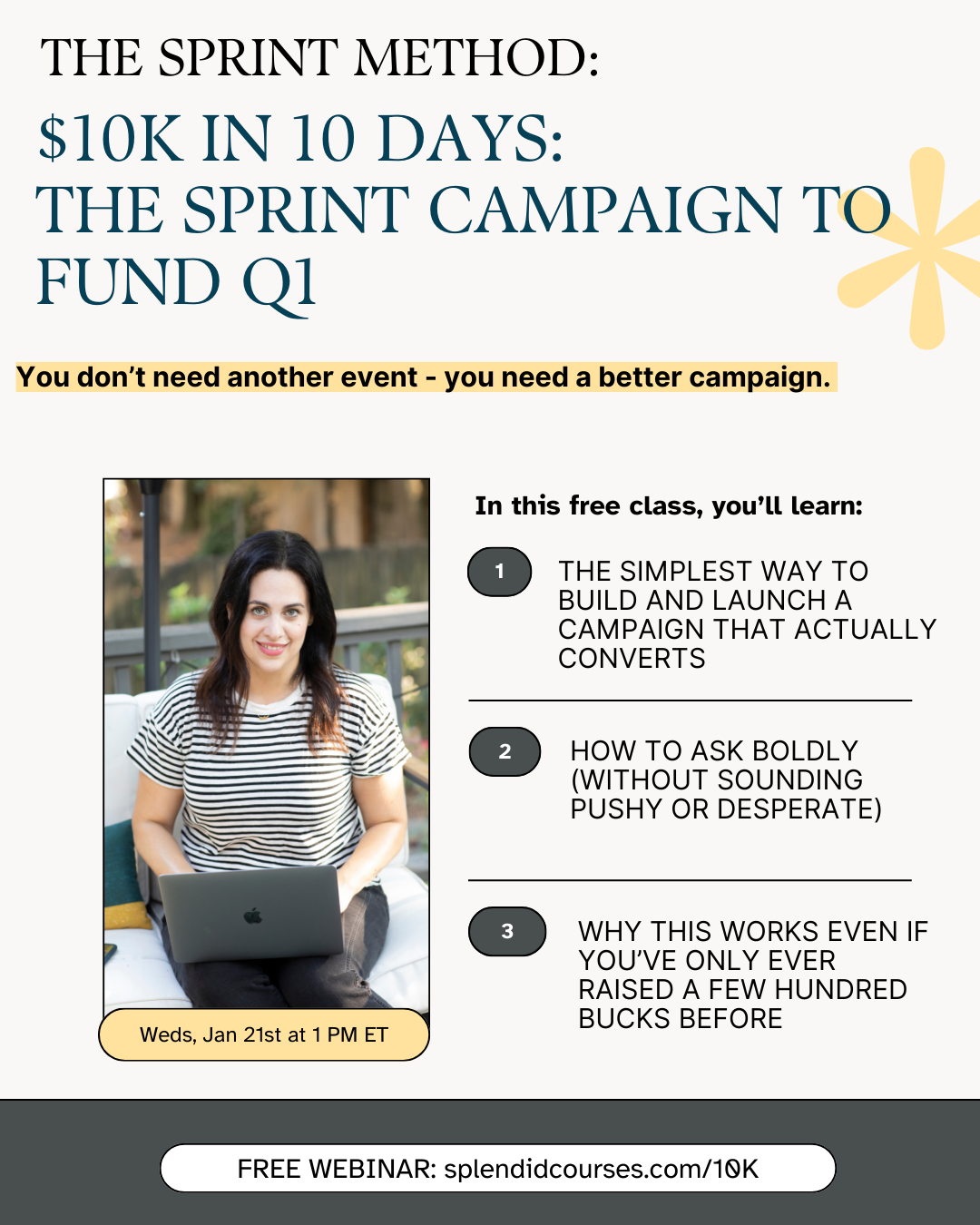
If you don’t know how to run a campaign, The SPRINT Method™ is your foundation
Sprint is for leaders who:
Are raising toward $100K annually
Don’t have a repeatable fundraising system
Feel overwhelmed deciding what goes first
Haven’t been taught donor psychology
Rely on cheerleading instead of strategy
Want $10K+ campaigns without a big staff
Sprint provides structure, templates, messaging support, and a repeatable campaign framework. It teaches you how to drive the car.
If you’re plateauing between $200K and $3M, The Purpose & Profit Club® is the next level
The Club is for leaders who already know how to fundraise but:
Need stronger lead generation
Need consistent, confident asks
Are stuck in relationship-based stagnation
Want to double their next campaign
Need weekly support to prevent drift
This is where strategy deepens, influence expands, and momentum becomes repeatable.
Sprint builds the engine.
The Club pours fuel into it.
The Three-Part Revenue Engine That Changes Everything
When these three elements run together consistently, fundraising stops feeling chaotic.
1. Lead Generation
Most leaders think they have a retention problem.
They actually have a pipeline problem.
Lead generation creates momentum and future opportunity. When it’s missing, everything else feels harder.
What this looks like in practice:
The 15-Minute Lead Builder™
Consistent outreach
Invitations to campaigns or moments
Social Street Team® amplification
Visibility that feels relational, not promotional
2. The Ask Process
Asking is not something you do when you “have time.”
It’s a rhythm.
Strong fundraisers ask early, ask often, and ask decisively. When the rhythm supports you, burnout drops because nothing is bottled up.
This includes:
Short, focused campaign timelines
Direct asks with clear reasons
Digital, major gift, and peer momentum
Shorter cultivation cycles
Clear deadlines
3. Retention
Retention is not thank-you letters.
It’s the experience you create after the gift.
This looks like:
A First 90 Days structure
Personal outreach that matters
High-impact stewardship moments
Follow-up that makes donors feel seen
When lead generation, asking, and retention work together, the year stabilizes.
What This Does Not Mean
This reset does not mean:
Doing all the channels
Overdesigning newsletters
Relying on a PayPal button
Planning gala-scale events with micro teams
Saying yes to every board idea
Creating PDFs no one reads
Prioritizing content over revenue
Spending weeks designing what you could launch in two days
Building programs before building a pipeline
From the small mistake of using a PayPal button
To the big mistake of acting like a $500K organization while spending like a $2M one
Both create overwhelm. Both dilute impact.
What to Sunset Immediately
This is your permission slip.
Sunset:
Legacy events
Volunteer-driven pet projects
Overbuilt communications
Side initiatives that don’t generate revenue
Systems that create friction
Campaigns that take more effort than they return
And sunsetting isn’t just about programs.
It’s about your personal workload.
Just because you can order printer ink doesn’t mean the CEO should.
Just because you can draft the newsletter doesn’t mean the ED should.
Just because you can schedule social posts doesn’t mean it’s a wise use of your time.
Your job is donor conversations, strategy, influence, and pipeline strength.
Not office errands.
The 30-Day Fundraising Reset
Week 1: Simplify the System
Goal: Reduce friction.
Decide on your CRM. (we recommend our partner, Bloomerang).
Decide on a new donation tool (we love Givebutter for organizations that prefer an all-in-one option and Fundraise Up for more established missions).
Choose your top three revenue channels.
Move everything else to a future list.
Create a simple donor segmentation snapshot.
Name what you are sunsetting.
Shorter lists calm the brain.
Week 2: Rebuild the Pipeline
Goal: Restore motion.
Use the 15-Minute Lead Builder™ daily.
Make connections, not content.
Identify your next 20 prospects.
Map your next two asks.
Action breaks overwhelm.
Week 3: Strengthen Retention
Goal: Stabilize revenue.
Clean the list.
Refresh your thank-you process.
Send personal messages to key donors.
Plan two donor moments this quarter.
Retention creates breathing room.
Week 4: Build the 90-Day Plan
Goal: End indecision.
Decide what you’ll ask.
Decide who you’ll ask.
Decide what you’ll stop doing.
Decide what support you need.
Choose Sprint or the Club.
Decisions return energy.
The Close
This reset is not about doing more.
It’s about tightening the system so your effort actually counts.
If you need the foundation, start with Sprint.
If you’re ready to scale, the Club is waiting.
And if you want help mapping your next 90 days, let’s do that.
This is how you rebuild the year before it runs away from you.